October brings us, among other things, la Giornata Internazionale del Caffè (International Coffee Day – Oct 1st). Do we Italians need an excuse to talk about coffee? No, but we’ll take it anyway!
You may already be familiar with how to order coffee in Italy or you’ve probably heard about the eternal shame of ordering cappuccino after 11am, but there are things about our beloved drink that might still surprise you. For instance, did you know that coffee may owe its success in Italy and Europe more broadly to the Pope?
1. From “devil’s drink” to papal blessing
La pianta del caffè (the coffee plant) originally comes from Ethiopia, more precisely from Kaffa, a province in the southwest of the country (hear the similarity in sound? Kaffa… caffè).
By the 15th century, coffee had reached neighbouring Yemen, where Sufi mystics used it for an energy boost during their long prayer sessions. Word spread fast, and so did coffee, which became extremely popular across the Islamic world. Since alcohol was strictly forbidden by religion, many welcomed it as the perfect alternative: all the kick and zero sin. No wonder it earned the nickname “wine of Arabia.”
So how did coffee land in Italy? For that, we need to thank Mr Prospero Alpini, a 16th-century physician and botanist who discovered the coffee plant during his time in Egypt working for the consul of the Venetian Republic. He was the first to bring back news of it to Italy, describing its properties and how the Egyptians were using it. Then the Venetian merchants, always quick to see a good business opportunity, took care of the rest and brought i chicchi di caffè (coffee beans) home through their trading routes.
But not everyone was thrilled: a stimulating drink, and from Muslim countries no less? Mamma mia! The clergy immediately labelled it la bevanda del diavolo (the devil’s drink) and even asked the Pope to ban it officially.
Luckily for us, the Pope at the time, Clement VIII (the one who sent philosopher Giordano Bruno to be burned at the stake for heresy in Rome’s Campo de’ Fiori), decided to judge for himself. The story goes that he asked for una tazza (a cup) of the scandalous drink and after un sorso (a sip), he declared it was so good that banning it was out of the question. Instead, he would trick the Devil by baptizing coffee to make it a good Christian drink. And so, coffee got its holy stamp of approval and began its rise in popularity.
True or not, it’s hard to imagine a better PR story for coffee!
2. A magazine born over coffee
You know those conversations that start with Ci prendiamo un caffè? (How about we grab a coffee?) and somehow turn into deep conversations about all sorts of topics? Well, in 18th-century Milan, a group of intellectuals decided to turn them into a magazine.
It was 1764 when writer Pietro Verri and a group of fellow Milanese thinkers founded Il Caffè (The Coffee), one of the very first Italian periodicals. At the time, coffee houses were the new meeting spot, and the magazine was designed to feel like the lively discussions happening around their tables over a nice cup.
The articles were written in down-to-earth Italian, close to the way people actually spoke, so they could reach as many readers as possible, not just the scholarly circles. And they covered a wide range of topics too, from justice and education to economy and agriculture.
Quite a change from what was happening in the osterie (taverns), where conversations were fuelled by wine rather than coffee and were, well, less enlightened.
Il Caffè didn’t last long though. It closed in 1766, after only two years, but in that short time, it became a key voice of Enlightenment thinking in Italy and echoed for decades. Curious to take a peek? Browse an extract here.
3. We love coffee but we’ve only just started growing it
Every day we make millions of coffees here in Italy, but we only prepare them, we’ve never actually grown it here. The thing is, coffee plants like a tropical climate and Italy has never been able to guarantee those conditions. So, for centuries we’ve been the most passionate coffee lovers without a single homegrown chicco (bean).
Or at least, that was the case until a few years ago, when the Morettinos, a family of torrefattori (coffee roasters) from Palermo, started experimenting with the help of the town’s Botanical Garden and planted some seeds right in the garden of the family roastery. It took a lot of patience but those plants are finally bearing fruits, officially giving life to Italy’s first open-air piantagione di caffè (coffee plantation).
Part of the credit goes to climate change, though: it usually brings a long list of problems, but in this case it’s made Sicily hospitable enough to welcome plants that once only thrived on the other side of the world. Now, no offence to Brazil, Colombia and the other usual suspects, but what a location! Mediterranean sunshine, the sea, rich and fertile soil… cosa volere di più? (What more could you want?).
4. Why we call it “espresso”
Time to dig in the language! The word espresso covers two key aspects of how coffee is made and served.
First of all, espresso is the past participle of the verb esprimere, which means “to express, to state.” But its roots lie in the Latin exprimere, which was far more literal: ex (out of) plus primere (to press, to squeeze). In other words, “to press out.” That’s the meaning we are after, because it describes how coffee is made: hot water is pushed under pressure through a compact layer of ground coffee, extracting all its flavour in a short, intense shot.
But espresso in Italian also carries the idea of something made quickly, right on the spot. Indeed, our coffee is prepared the moment we order it, and it’s made fast. How fast? To give you an idea, a duo of Italian baristas holds the Guinness World Record for making 623 espressos in just one hour! Okay, that’s a bit extreme, but walk into any Italian bar during the morning rush and you’ll be amazed by the speed behind the counter.
Neither the pressure nor the speed would exist without la macchina per caffè espresso (the espresso machine). Back in the 19th century, making coffee took time that the rapidly industrialising society couldn’t really spare. So, in 1884, Turin entrepreneur Angelo Moriondo, who ran a hotel right just across from the city’s train station, invented a machine that used steam pressure to prepare coffee much faster.
However, Mr Moriondo used the technology exclusively in his own establishments – he was quite jealous of his invention, come dargli torto (who can blame him). The concept was later refined by Luigi Bezzera and Desiderio Pavoni in the early 1900s, bringing espresso machines to bars to cafès across the country. And, well, il resto è storia (the rest is history)!
5. And what about the “moka”?
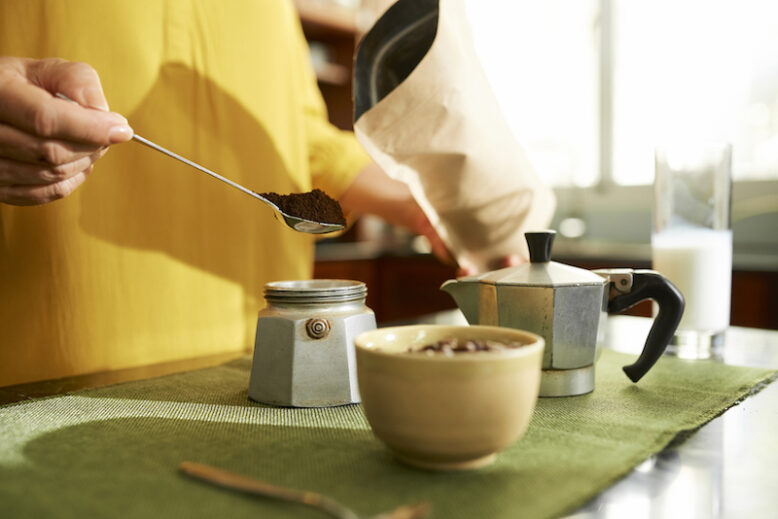
The espresso machine is sorted, now let’s talk about that little strumento (tool) sitting on the stove of every Italian kitchen, and the ultimate souvenir to bring back from Italy: the moka, also called la caffettiera (the coffee maker).
Its inventor was Mr Alfonso Bialetti, a keen observer of even the most unlikely things. In the early 1930s, he ran a small workshop in Piedmont that made aluminium goods, and one day, watching his wife do the laundry, he had a stroke of genius. As customary at the time, she was using a large pot with a central tube that carried boiling soapy water up and poured it back down over the clothes, and he realised he could apply the same system to coffee.
He named his invention moka after Mocha, the port town on Yemen’s Red Sea coast that played a strategic role in the coffee trade between the 15th to 17th centuries.
The moka revolutionised home coffee culture, making it possible to prepare a rich cup in just a few minutes without necessarily going to the local café. And the marketing was just as brilliant, with the first advertising campaign promising In casa un espresso come al bar (An espresso at home, just like at the bar).
Now, between us, a moka doesn’t technically make espresso, just simple coffee, since it works a bit differently from a professional espresso machine, using much lower pressure for example. But we are not into technicalities here.
6. Coffee in Italy comes in more versions than you can count
Choosing your coffee in Italy may be harder than it looks, as this fun movie scene proves.
According to YouGov data from last year, the magic trio in Italy is il caffè espresso (63,5%), il cappuccino(41,5%), and il caffè macchiato (33,4%). However, when you visit an Italian café, you’ll see the menu goes way beyond these classics.
Craving something chocolaty? Try un mocaccino, a delicious mix of espresso, melted chocolate and steamed milk (or, in some versions, whipped cream). Not to be confused with il marocchino (lit. “the Morrocan”), which swaps the melted chocolate for a dusting of cocoa powder.
Or perhaps you’ve eaten a little too much and could use some help with digestion. In that case, un caffè corretto (lit. “corrected coffee”) might come to the rescue: an espresso with a splash of liquor like grappa or anisette.
And if it’s summer and you’re after something cold, ask for un caffè shakerato: espresso, ice and sugar all shaken together like a cocktail.
I honestly couldn’t tell you how many variations there are, but the list could go on and on. And don’t even get me started on local specialties! Depending on where your travels take you, you might come across things like il caffè leccese from Salento in Apulia (espresso poured over ice and almond milk), il caffè padovano from Padua (espresso with mint syrup, whipped cream, and a dusting of cocoa), or il ponce from Livorno (espresso with sugar, lemon zest, and a locally produced rum). And that’s just to name a few!
Oh, and let’s not forget il caffè dello studente, (the student’s coffee), a classic of Italian university life, at least before energy drinks came along. You make coffee in the moka, then prepare another one with that coffee in place of water. If you need a way to stay awake, look no further.
And finally, il caffè sospeso (lit. “the suspended coffee”). Technically, it’s not a type of coffee, but a beautiful tradition born in Naples. It works like this: you order a coffee but pay for two, so someone else can enjoy one for free. A simple way of sharing the pleasure of a cup of coffee.


Valentina Nicastro is a travel writer in love with her home country, Italy. Having travelled widely around the globe, she realised there was more to explore closer to home and decided to put the passport aside for a while. When she is not immersed in documenting Italy, you’ll find her donning her communication consultant hat, weaving words as a content writer and bridging linguistic divides as a translator.