Prendere is a key verb for speaking in Italian. It means “to take, but we use it in many everyday situations, whether we’re catching a train, grabbing a cappuccino, or coming down with a cold!
prendere
to take
How to conjugate prendere in Italian
While prendere is mostly regular, it behaves irregularly in some past tenses. Most of the time, it pairs with the auxiliary verb avere (to have), for example, ho preso (I took). But in reflexive constructions (like prendersi una pausa — “to take a break”), it requires essere (to be) as the auxiliary, and you’ll need to adjust the past participle to match the subject in gender and number, for instance, mi sono presa una pausa (I took a break).
Here’s an overview of prendere in a few common tenses:
Simple present
- Io prendo
- Tu prendi
- Lui/Lei prende
- Noi prendiamo
- Voi prendete
- Loro prendono
Imperfect
- Io prendevo
- Tu prendevi
- Lui/lei prendeva
- Noi prendevamo
- Voi prendevate
- Loro prendevano
Simple Future
- Io prenderò
- Tu prenderai
- Lui/lei prenderà
- Noi prenderemo
- Voi prenderete
- Loro prenderanno
Present Subjunctive
- Io prenda
- Tu prenda
- Lui/lei prenda
- Noi prendiamo
- Voi prendiate
- Loro prendano
Present perfect
- Io ho preso
- Tu hai preso
- Lui/lei ha preso
- Noi abbiamo preso
- Voi avete preso
- Loro hanno preso
Passato remoto
- Io presi
- Tu prendesti
- Lui/lei prese
- Noi prendemmo
- Voi prendeste
- Loro presero
Present Conditional
- Io prenderei
- Tu prenderesti
- Lui/lei prenderebbe
- Noi prenderemmo
- Voi prendereste
- Loro prenderebbero
All the meanings of prendere in Italian
Now let’s see the many contexts in which prendere is used in daily conversation.
1. Prendere – to physically take something
In its most basic and common meaning, prendere is used to describe the act of taking or grabbing something, very similar to the English “to take” or “to pick up.” For example:
Devo andare a prendere la macchina dal meccanico.
I have to go pick up the car from the mechanic.
Possiamo prendere la vecchia macchina da scrivere di papà?
Can we take Dad’s old typewriter?
2. Prendere – for transport
Another very common use of prendere is when talking about travelling from point A to point B using some form of transportation, such as:
Prendo il treno per tornare a casa.
I’m taking the train to go back home.
Domani prendiamo un volo per Shanghai.
Tomorrow we’re flying to Shanghai.
Here are a few other examples:
- Stanno andando a prendere l’autobus. – They’re going to take the bus.
- Potete prendere la metro per arrivare in aeroporto. – You can take the metro to get to the airport.
- Hanno preso la macchina per tornare in Sicilia. – They drove back to Sicily.

3. Prendere – to pick someone up
We generally use prendere when picking someone up. In this context, it is paired with other verbs to express different nuances
– Andare a prendere: to go pick someone up
- Devo andare a prendere Andrea in palestra. – I need to go pick up Andrea at the gym.
– Passare a prendere: to pick someone up
- Passo a prenderti alle 7! – I’ll pick you up at 7!
– Venire a prendere: to come pick someone up
- Puoi venire a prendermi a scuola? – Can you come pick me up from school?
These three combinations are super common in everyday Italian, especially when making plans or coordinating with others.

4. Prendere – to order food and drinks
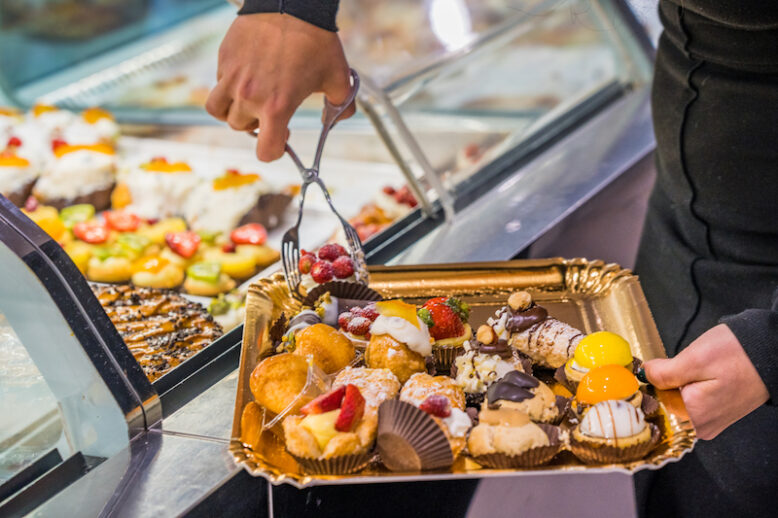
When you’re ordering something to eat or drink in English, you’d typically say “I’ll have…” In Italian, though, the verb to use in these situations is prendere. Here are some examples:
- Prendo una pizza capricciosa. – I’ll have a capricciosa pizza.
- Prendiamo anche delle patatine fritte. – We’ll also have some fries.
- Mia figlia prende la pasta al pomodoro. – My daughter will have pasta with tomato sauce.
You’ll also hear prendere in questions when the waiter or a friend wants to know what you’re having, for instance:
- Tu cosa prendi come antipasto? – What are you having for a starter?
- Cosa prendete da bere? – What are you having to drink?

5. Prendere – to talk about money
While the more formal verb for “to earn” in Italian is guadagnare, we tend to prefer prendere when talking about salaries, fees, or payments. It just sounds more casual and natural, especially in spoken language. In these cases, prendere takes on meanings similar to “to make” (in terms of income) or “to charge” (for services):
Prendo un bello stipendio, non posso lamentarmi.
I make a nice salary, I can’t complain.
- Sai quanto prende il dentista per un’otturazione? – Do you know how much the dentist charges for a filling?
- Quanto ti ha preso l’elettricista per il nuovo impianto? – How much did the electrician charge you for the new system?

6. Prendere – to talk about getting sick and taking medicine
While in English you say “catch a cold” or “come down with the flu,” in Italian, we take an illness. It might sound a bit strange at first, but it’s a perfectly natural and widely used expression in Italian:
Prenderai il raffreddore se non ti copri!
You’ll catch a cold if you don’t bundle up!
Mio marito ha preso un brutto mal di gola.
My husband caught a bad sore throat.
Prendere is also the standard verb when it comes to taking medicine:
- Hai preso l’antibiotico ieri sera? – Did you take the antibiotic last night?
- Non dimenticare di prendere le pillole per la pressione! – Don’t forget to take your blood pressure pills!

7. Prendere – as a synonym for acquistare or comprare
In everyday Italian, prendere is frequently used instead of the more formal acquistare or the standard comprare to mean “to buy” or “to get” when running errands or shopping:
Ho preso una borsa nuova.
I bought a new bag.
Se passi dal fruttivendolo, prendi un po’ di insalata per favore.
If you stop by the greengrocer, grab some lettuce, please.
8. Prendere – for getting something, from licenses to fines
Sometimes, prendere takes on the meaning of “to get” in the sense of receiving, earning, or being given something. This use is very common when talking about achievements, awards, or even fines. For example:
Abbiamo preso un’altra multa.
We got another fine.
- Finalmente mia sorella ha preso la patente! – My sister finally got her driver’s license!
- I miei cugini hanno preso il diploma. – My cousins got their diploma.

9. Prendere – to express liking someone or something
Another interesting use of prendere in Italia is to describe when someone or something pulls us in emotionally or mentally. Here are some natural, everyday examples:
Carlo è molto preso da Stefania.
Carlo is really into Stefania.
- Quella serie che mi hai consigliato mi sta prendendo un sacco. – I’m really getting into that TV series you recommended.
- Mia figlia è molto presa dai nuovi corsi all’università. – My daughter is really caught up in her new university courses.
10. Prendere – to give directions
Whenever we’re giving or understanding how to get somewhere, prendere is the key verb for “taking” the right road, turn, or exit. You’ll hear it a lot in instructions or while following GPS instructions, such as:
Attraversa il ponte e prendi la prima strada sulla sinistra.
Cross the bridge and take the first street on the left.
- Dovete prendere l’autostrada per Bologna e uscire a Modena sud. – You have to take the highway toward Bologna and exit at Modena South.
- Avresti dovuto prendere la seconda uscita alla rotonda! – You should have taken the second exit at the roundabout!

11. Prendere – to talk about how you treat or handle someone/something
You can use prendere when describing how you treat or deal with something or someone. A couple of useful expressions are prendere per il verso giusto (to handle someone the right way) and prendere con le buone (to try to be nice):
Anna è una ragazza molto divertente, basta prenderla per il verso giusto.
Anna is a really fun girl, you just have to approach her the right way.
- Prova a prenderlo con le buone, magari si calma. – Try to be nice to him, he might calm down.
In this context, prendere can also be used in a more physical or figurative sense to describe rough or harsh treatment, like prendere a schiaffi (to slap someone) or prendere a male parole (to speak harshly to someone).
The reflexive form: prendersi
The reflexive form prendersi can mean “to get along”:
Luca e Mario non si prendono proprio.
Luca and Mario don’t get along at all.
More generally, many expressions with prendere can also appear in the reflexive form, which gives extra emphasis to the subject performing the action. In fact, this reflexive form is used much more frequently in everyday speech. Take a look at these two sentences:
- Abbiamo preso un caffè insieme per discutere del progetto. – We had a coffee together to discuss the project.
- Ci siamo presi un caffè insieme per discutere del progetto. – We had a coffee together to discuss the project.
In the second sentence, using the reflexive form (ci siamo presi) emphasises the involvement of the subjects (we) in the action of having the coffee, making it sound more engaged.
The reflexive form is also used in several common expressions, including:
- Prendersi cura – To take care of
- Prendersi la briga – To take it upon yourself
- Prendersi la responsabilità – To take responsibility
- Prendersi una pausa – To take a break
The pronominal form: prendersela
Prendersela is a colloquial way to express “to get angry” or “to take offense” over something. It’s formed by combining prendere with the reflexive pronoun si (which becomes se when paired with another pronoun), followed by the direct object pronoun la.
In compound tenses, prendersela requires the auxiliary verb essere (to be) because it’s reflexive. Additionally, the past participle preso becomes presa because la is feminine (the direct object pronoun la doesn’t change as it’s a fixed part of the construction, so the past participle is always presa).
Here are a couple of examples:
Non devi prendertela ogni volta che qualcuno ti fa un’osservazione.
You shouldn’t get upset every time someone makes a comment.
Non sono andato alla festa e i miei amici se la sono presa.
I didn’t go to the party, and my friends got upset.
Common expressions with prendere in Italian
Finally, let’s explore some of the most common expressions with prendere that are widely used in everyday Italian conversation:
Prendere alla lettera – To take literally
Non prendere tutto alla lettera, stavo solo scherzando! – Don’t take everything literally, I was just joking!
Prendere con filosofia – To take something philosophically
Bisogna prendere la vita con filosofia. – We must take life philosophically.
Prendere con le molle / con le pinze – To take something cautiously
Prendi sempre con le molle quello che dice Beatrice. – Always take what Beatrice says cautiously.
Prendere due piccioni con una fava – To kill two birds with one stone
Andando al mercato, prendo due piccioni con una fava: faccio la spesa e porto il cane a fare una passeggiata! – By going to the market, I’ll kill two birds with one stone: do the shopping and take the dog for a walk!
Prendere esempio (da qualcuno) – To follow someone’s lead
Dovresti prendere esempio da Grazia, che è sempre così organizzata. – You should follow Grazia’s lead, she’s always so organized.
Prendere ferie – To take time off / go on vacation
Prenderò ferie la prossima settimana. – I’m taking time off next week.
Prendere fischi per fiaschi – To misunderstand
Guarda che stai prendendo fischi per fiaschi, io non ho mai detto quelle cose! – Look, you’re completely misunderstanding, I never said those things!
Prendere i voti – To take religious vows
Andrea ha preso i voti l’anno scorso. – Andrea took his religious vows last year.
Prendere il largo – To set off (both physically and metaphorically)
Appena il mare è calmo, prenderemo il largo. – As soon as the sea calms down, we’ll set off.
Prendere il sole – To sunbathe
Oggi andiamo in spiaggia a prendere il sole. – Today we’re going to the beach to sunbathe.
Prendere in affitto – To rent
Abbiamo preso in affitto un appartamento al mare per tutto il mese di agosto. – We rented an apartment by the sea for the whole month of August.
Prendere in considerazione – To take into consideration
Prenderemo in considerazione tutte le proposte prima di decidere il da farsi. – We’ll consider all the proposals before deciding what to do.
Prendere in giro – To tease / make fun of
Smettila di prendermi in giro, adoro queste scarpe a pois! – Stop teasing me, I love these polka-dot shoes!
Prendere in prestito – To borrow
Posso prendere in prestito la tua giacca di pelle stasera? – Can I borrow your leather jacket tonight?
Prendere le distanze – To distance yourself
La squadra ha preso le distanze dalla decisione dell’allenatore. –The team distanced itself from the decision of the coach.
Prendere lucciole per lanterne – To misunderstand
Mi spiace dirlo, ma hanno proprio preso lucciole per lanterne! – I’m sorry to say it, but they really got it wrong!
Prendere nota – To take note
Hai preso nota di tutto durante la riunione? – Did you take note of everything during the meeting?
Prendere sul serio – To take seriously
Prendi sempre tutto troppo sul serio, rilassati! – You always take everything too seriously, relax!
Prendere un abbaglio – To misjudge something
Credo che tu abbia preso un abbaglio con quelle persone persone, non sono affidabili. – I think you misjudged those people, they’re not reliable.
Prendere un appuntamento – To book an appointment
Devo prendere un appuntamento dal dermatologo. – I need to make an appointment with the dermatologist.
Prendere una decisione – To make a decision
Hai preso una decisione riguardo a quella proposta di lavoro? – Have you made a decision regarding the job offer?
Prendere una posizione – To take a stance
Il sindaco ha preso una posizione chiara in merito alla proposta di nuovi autovelox. – The mayor has taken a clear stance on the proposal for new speed cameras.
Per partito preso – Parti pris / out of preconceived prejudice/opinion
Non è una buona idea rifiutare così, lo sta facendo solo per partito preso. – It’s not a good idea to refuse like that, he’s acting out of prejudice / a preconceived stance.

Valentina Nicastro is a travel writer in love with her home country, Italy. Having travelled widely around the globe, she realised there was more to explore closer to home and decided to put the passport aside for a while. When she is not immersed in documenting Italy, you’ll find her donning her communication consultant hat, weaving words as a content writer and bridging linguistic divides as a translator.