I’m sure the word memoria feels instantly familiar, since it closely resembles “memory.” Just like in English, it can refer to remembering something, but in Italian, it carries its own nuances.
memoria
memory
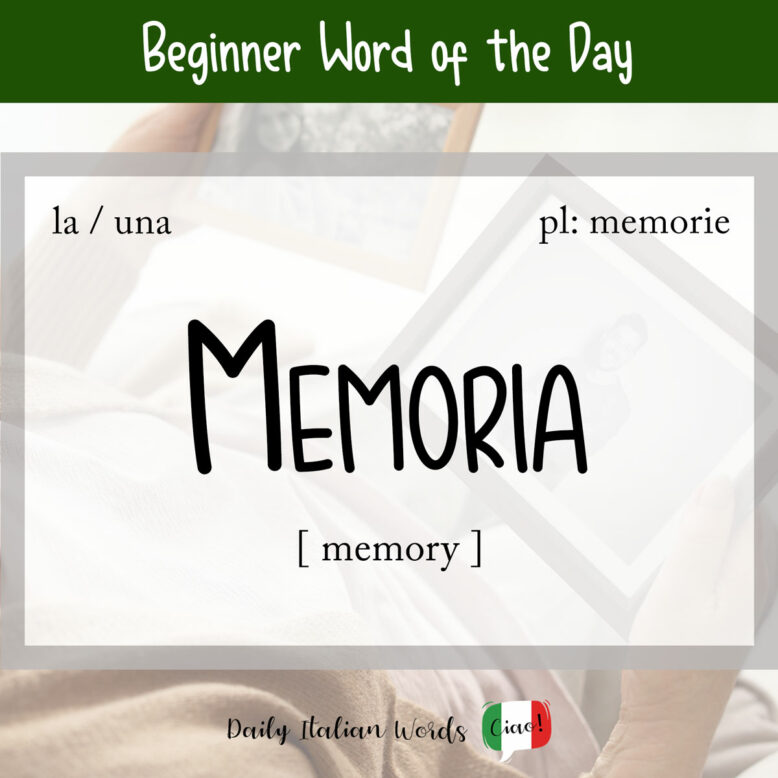
Memoria is a feminine noun, and its plural form is memorie. Here are its definite and indefinite articles:
- la memoria = the memory
- le memorie = the memories
- una memoria = a memory
- delle memorie = some memories
These are the main ways we use this word:
1. MEMORIA = Memory
When we talk about memoria, the first thing it usually means is memory, our brain’s ability to keep track of the things we experience. There are different types of memoria, such as:
- Memoria a breve termine: Short-term memory
- Memoria a lungo termine: Long-term memory
- Memoria fotografica: Photographic memory
- Memoria storica: Historical memory
Greta ha una memoria fotografica incredibile, ricorda ogni dettaglio!
Greta has an incredible photographic memory, she remembers every single detail!
We use memoria in many everyday expressions, such as:
- Avere buona memoria: To have good memory
Anche se studio poco, ho buona memoria e riesco a ricordare le informazioni importanti.
Although I don’t study much, I’ve got a good memory and can remember the important stuff.
- Non avere memoria: To have a bad memory
Possibile che dimentichi sempre dove metti le cose? Non hai proprio memoria!
Do you seriously forget where you put things every single time? You’ve got no memory at all!
- Avere la memoria di un elefante: To have great memory (literally, “to have the memory of an elephant”)
Mia nonna ha la memoria di un elefante; ricorda ancora tutti i dettagli della sua infanzia.
My grandma has got an elephant’s memory; she still remembers every detail from when she was a kid.
- Perdere la memoria: To lose memory (and when you lose memory, you experience amnesia, same word as in English)
Dopo l’incidente, Marco ha perso la memoria per qualche ora.
After the accident, Marco lost his memory for a few hours.
- Riacquistare la memoria: To regain memory
Ho trovato il signor Carlo in piazza: era spaesato, ma lentamente ha riacquistato la memoria.
I found Mr. Carlo in the square: he was disoriented, but slowly regained his memory.
- Rinfrescare la memoria: To refresh somebody’s memory
Sicuro di non sapere che giorno è oggi? Devo rinfrescarti la memoria?
Are you sure you don’t know what day it is today? Do I need to refresh your memory?
- Scolpire nella memoria: To etch into one’s memory
Il ricordo di quel terribile giorno è ancora scolpito nella memoria dell’intera comunità.
The memory of that terrible day is still etched into the memory of the whole community.
- Tornare con la memoria a: To think back to (literally, “to return with the memory to”)
Ogni volta che guardo questa foto, torno con la memoria a quella splendida estate!
Whenever I see this photo, I think back to that wonderful summer!
- Se la memoria non mi inganna: If memory serves (literally, “if memory doesn’t deceive me”)
Se la memoria non mi inganna, la vecchia casa dei nonni dovrebbe essere qui.
If memory serves, my grandparents’ old house should be around here.
- A memoria d’uomo: In living memory (literally, “at man’s memory”)
A memoria d’uomo, non c’è mai stato un inverno così freddo qui.
In living memory, there’s never been a winter this cold here.
- Un vuoto di memoria: A memory lapse
Come cavolo si chiamava quel posto dove andavamo sempre d’estate? Aiutami, ho un vuoto di memoria!
What the heck was the name of that place we always went to in the summer? Help me, I’m having a memory lapse!
- Che memoria!: What a memory!
Ti ricordi ancora tutti i nomi dei tuoi compagni di classe delle elementari? Però, che memoria!
You still remember all the names of your classmates from elementary school? Wow, what a memory!
There’s also the expression a memoria (by heart), which is used in specific expressions like:
- Studiare a memoria: To study by heart
- Imparare a memoria: To learn by heart
- Sapere a memoria: To know by heart
- Ripetere a memoria: To recite by heart (we also say ripetere a pappagallo – literally, “to repeat like a parrot”)
Se ti limiti a studiare a memoria, rischi solo di ripetere a pappagallo senza davvero imparare!
If you just study things by heart, you’ll end up parroting them without learning anything!
2. MEMORIA = Remembrance
In Italian, memoria can also mean the act of remembering or honoring someone or something, often through ceremonies or commemorations.
A common expression in this sense is in memoria di (in memory of), for example:
Questo è l’albero che abbiamo piantato in memoria di nonno Gino.
This is the tree we planted in memory of grandpa Gino.
A related term is memoriale (memorial), which refers to monuments built to commemorate a person or event, such as the Memoriale della Shoah in Milan’s Central Station or the Memoriale Brion near Treviso.
In this context, Memoria is sometimes written with a capital letter, to show it’s about remembering important historical events for a community. Some related expressions include:
- Il Giorno della Memoria / La Giornata della Memoria: Remembrance Day. It’s celebrated every year on January 27th to pay tribute to the victims of the Holocaust.
- Luoghi della Memoria: Places of Remembrance. These are sites dedicated to keeping historical memory alive, such as battlefields, cemeteries, and former concentration camps.
- Turismo della Memoria: Remembrance tourism. A type of travel focused on visiting places and sites linked to important historical events, especially those of the two World Wars.
3. MEMORIA = Memorandum, memo
In legal contexts, una memoria is a document that outlines the key facts of a case during a trial. It can be:
- Una memoria processuale: A pleading
- Una memoria difensiva: A reply brief
- Una memoria integrativa: A supplementary statement
L’avvocato della controparte ha depositato la memoria difensiva.
The other side’s lawyer has filed their reply brief.
4. MEMORIA = Data storage
We also use memoria in the context of technology to refer to the hardware that stores data. For example, we can talk about:
- Memoria del computer: Computer memory
- Memoria del telefono: Phone memory
- Memoria della fotocamera: Camera memory
- Scheda di memoria: Memory card
Ho la memoria del telefono piena, non posso fare altre foto.
There’s no space left on my phone, I can’t take any more pictures.
5. MEMORIE = Memoir
When used in the plural, memorie refers to the literary genre of memoirs, which focus on specific episodes or events from a person’s life. A common expression is scrivere le proprio memorie (to write one’s memoir), which we often use jokingly in everyday conversation, like:
Con tutto quello che ti succede, dovresti scrivere le tue memorie… sarebbero un bestseller!
With everything that happens to you, you should write your memoir… it would be a bestseller!
The word memoriale, which we’ve seen earlier in the sense of a monument, also appears in this context: it means a written account where the author describes events they witnessed or took part in, either for legal purposes or more generally to share information. For example:
Il giornalista ha scritto un memoriale sui fatti di cronaca che hanno scosso la città nell’ultimo anno.
The journalist wrote a memoir of the news stories that shook the city over the past year.

Valentina Nicastro is a travel writer in love with her home country, Italy. Having travelled widely around the globe, she realised there was more to explore closer to home and decided to put the passport aside for a while. When she is not immersed in documenting Italy, you’ll find her donning her communication consultant hat, weaving words as a content writer and bridging linguistic divides as a translator.