Campo sounds a lot like the English word camp, and yes, that’s one of its meanings. But it’s just the beginning! There’s actually quite a lot packed into this Italian word, so get comfy and let’s explore its many uses.
campo
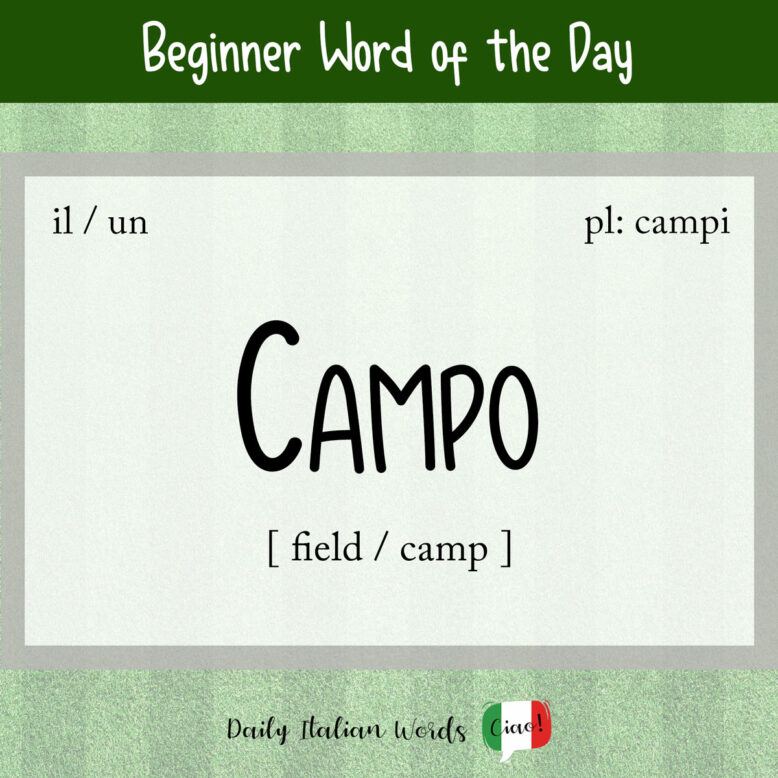
But first, a quick grammar note: campo is a masculine noun, so it’s il campo in the singular, and i campi in the plural.
- il campo
- i campi
- un campo
- dei campi
1. Campo = field (agricultural)
This first meaning of campo in Italian comes straight from its Latin ancestor, campus, which translates as countryside. So, it refers to an agricultural field.
Hanno piantato degli ulivi nel campo dietro casa nostra.
They planted olive trees in the field behind our house.
A campo can take many forms, for example:
- Un campo di grano / mais / patate: a wheat/corn/potato field
- Un campo di girasoli / papaveri: a sunflower / poppy field
- Un campo coltivato: a cultivated field
- Un campo incolto: an uncultivated field
- Un campo arato: a ploughed field
- Un campo recintato: a fenced field
- Un campo a maggese: a field left fallow
If the field happens to be on the smaller side, we sometimes use the diminutive campicello, which can sound either affectionate or gently ironic, depending on the tone.
Ci è rimasto un misero campicello di pomodori, tutto il resto è andato distrutto.
All we have left is a poor little tomato patch, the rest was destroyed.
These are some common actions we can perform with a campo:
- Coltivare un campo: to cultivate a field
- Zappare un campo: to hoe a field
- Arare un campo: to plough a field
- Irrigare un campo: to irrigate a field
- Concimare un campo: to fertilise a field
- Seminare un campo: to sow a field
- Vangare un campo: to dig a field
When talking about products of the countryside, two lovely expressions may pop up in our conversations:
- Fiori di campo: wildflowers
- Erbe di campo: wild herbs
And finally, when campo is in the plural form (campi), it can also be used as a synonym for campagna (countryside) in expressions like:
- Andare per campi: to wander through the countryside (literally, to go through the fields)
Ci piace andare per campi in cerca di erbe selvatiche.
We love wandering through the countryside in search of wild herbs.
- Il lavoro nei campi: rural work (literally, work in the fields)
In paese c’è una bella mostra fotografica dedicata al lavoro nei campi.
In town, there’s a beautiful photo exhibition dedicated to rural work.

2. Campo = Field, sector (work)
Another common meaning of campo refers to someone’s area of expertise or professional field. It’s used much like the English “field of work” or “field of study.”
Lavoro nel campo dell’informatica da oltre 10 anni.
I’ve been working in the IT field for over ten years.
Alessandro è il numero uno nel suo campo!
Alessandro is the best in his field!
Quest’anno sono stati fatti importanti passi avanti in campo medico.
This year, significant progress has been made in the medical field.
In this context, you’ll come across campo in expressions like:
- Campo scientifico: scientific field
- Campo artistico / letterario / musicale: artistic, literary, or musical field
- Campo professionale: professional field
- Campo di studio: field of study
- Campo di azione: scope of activity, range of competence
- Campo di ricerca: field of research
- Campo d’indagine: field of investigation
- Campo di competenza: area of expertise (in legal contexts, this can also refer to the competent jurisdiction)
Speaking of sectors, campo forms terms specific to certain fields. For example, in medicine, there’s il campo visivo (visual field), and in physics, il campo magnetico (magnetic field).

3. Campo = Field (generic)
In a broader sense, campo is simply a space meant for a particular activity, whatever that might be. Here are some common examples:
- Un campo sportivo: a sports field
- Un campo di calcio/pallavolo/golf ecc.: a football / volleyball / golf field
- Un campo di gara: a competition field
- Un campo estivo: a summer camp
- Un campo scout: a scout camp
- Un campo di accoglienza: a refugee camp
- Un campo profughi: a refugee camp
- Un campo nomadi: a nomads camp
- Un campo base: a base camp
- Un campo santo: a cemetery
Beyond these practical uses, campo also appears as a synonym for a square or open space in some of Italy’s most charming places.
In Rome, for example, there’s the famous Campo de’ Fiori, home to one of the city’s most atmospheric markets. The name literally means “field of flowers,” a nod to the fact that the area was once a large meadow with wild blooms.
And if you happen to visit Venice, you’ll notice plenty of campi and campielli on your map. These are open spaces that were originally grassy areas used for farming, around which daily life took place (the difference between a campo and a campiello is mainly size).
4. Campo = Field, camp (military)
Campo is also the word we use for the area where battles are fought and armies train. In this sense, a campo can be:
- Un campo di battaglia: a battlefield. We use it also figuratively to describe a place that is a total mess.
Questa camera è un campo di battaglia, sistemala subito!
This room is a battlefield, clean it up right now!
- Un campo trincerato: an entrenched camp
- Un campo nemico: an enemy camp
- Un campo militare: a military camp
- Un campo minato: a minefield. Used metaphorically, it refers to a sensitive topic.
Evita quell’argomento, è un campo minato: rischi di riaprire vecchie ferite.
Avoid that topic, it’s a minefield: you risk reopening old wounds.
- Un campo di prigionia: a prison camp
- Un comandante in campo: a field commander
From this military meaning come a number of set phrases:
- Morire sul campo: to die in battle
- Abbandonare il campo: to retreat, withdraw
- Scendere in campo: literally “to take the field,” meaning to join the fight. In sports, it describes players entering the game, and more in general, it’s used to mean stepping in, taking action, or getting involved in a situation.
Il sindaco è sceso in campo a fianco dei cittadini per protestare contro i tagli alla sanità.
The mayor joined the citizens in protesting against cuts to healthcare services.
- Tenere il campo: to maintain control of the field, also used figuratively, especially in sports, when a team or player is keeping control or staying ahead in a game.
I giocatori stanno tenendo bene il campo, gli avversari non riescono a far girare la palla.
The players are controlling the field, leaving the opponents struggling to get the ball moving.
- Guadagnare campo: to gain ground. It’s also used in sports to describe a team advancing, or more broadly to talk about something or someone that is gaining momentum.
Il nuovo trend sta guadagnando campo nel settore alberghiero.
The new trend is gaining ground in the hotel industry.
Another handy expression to know is da campo, which means “for use in the field.” We use it to describe those portable things made for military use and, by extension, for outdoor situations, such as in campeggio (camping). For example, you might hear:
- Un ospedale da campo: a field hospital
- Una cucina da campo: a field kitchen
- Un fornello da campo: a camp stove
- Un letto da campo: a camp bed
An interesting historical note: one of Rome’s most elegant neighborhoods, home to Piazza di Spagna, Piazza del Popolo, and Via Margutta, is called Campo Marzio. Today it’s a fashionable spot, but in ancient Roman times this was an area dedicated to military training (Marzio comes from Mars, the god of war).
Finally, a related noun worth remembering is campale. Literally, this adjective describes something taking place on the battlefield, like una battaglia campale (a pitched battle). But beyond the literal meaning, we commonly use it for a situation that is particularly demanding or intense, such as:
Preparati, domani sarà una giornata campale tra trasloco e chiamate di lavoro!
Get ready, tomorrow will be a full-on day with the move and all those work calls!

5. Campo = Signal (mobile reception)
Campo takes on a completely different meaning when talking about phones: it’s the mobile signal or reception. For example, if someone calls and we can barely hear them, we might say:
Mi senti? Aspetta, cerco un punto dove c’è più campo.
Can you hear me? Wait, I’m trying to find a spot with better signal.
Or, if your phone never rang and you later find a voicemail, you could explain:
Scusa il telefono non prendeva, c’era poco campo.
Sorry, my phone wasn’t getting reception, there was little signal.
6. Campo = Field (photography & cinema)
Campo appears in a key concept in photography and cinematography: la profondità di campo (depth of field). This is the distance between the closest and farthest parts of a shot that appear in focus.
Depending on the depth, there are different types of campo:
- Campo lunghissimo: extreme long shot
- Campo lungo: long shot
- Campo medio/ Mezzo campo: medium long shot
- Campo totale: master shot
Two more expressions you’re likely to come across with campo in cinema and photography are:
- Fuori campo: offscreen, describing things that lie outside the camera’s frame. The same expression is used beyond cinema and photography, as in fuori campo IVA meaning something is not subject to VAT.
- Voce fuori campo: voice over, referring to the the voice of someone who’s not visible within the framing.

7. Campo = Background (art)
By contrast, in art and graphic design, campo is the background of a painting or artwork.
L’affresco mostra il santo in piedi su campo dorato.
The fresco depicts the saint standing against a golden background.
Per la nuova campagna, è stato scelto un testo bianco su campo blu.
For the new campaign, a white text on a blue background was chosen.
A related term here is campitura, which describes a uniform layer of colour applied by the artist to a painting.
Other common expressions with CAMPO in Italian
There are some other useful expressions with campo that we use in everyday conversation:
- Lasciare campo libero: literally “to leave the field open,” it means to step aside and give free rein.
L’albero lo scelgo io, ma ti lascio campo libero per le decorazioni!
I’ll pick the tree, but I’ll give you free rein with the decorations!
- Mettere in campo: literally “to put on the field,” it’s used to mean to bring into play or to deploy.
Per risolvere la situazione, l’azienda ha messo in campo tutte le risorse disponibili.
To solve the situation, the company deployed all available resources.
- A tutto campo: literally meaning “covering the whole field,” this expression is very common in sports, especially in football, to describe a player who moves everywhere on the field and can do many roles, similar to the English term “box-to-box.” We also use a tutto campo in everyday life when talking about something that covers all aspects of a situation or is done without limits or restrictions, for example:
La polizia sta conducendo un’indagine a tutto campo sul traffico di droga in città.
The police are carrying out a thorough investigation into drug trafficking in town.
È un sindaco a tutto campo quello che si è raccontato ieri ai microfoni della radio locale.
On the local radio yesterday, the mayor came across as an engaged, all-around leader, covering every topic.
- Sul campo: field based. For instance, you can say una ricerca sul campo (field study), una prova sul campo (a field test), or esperienza sul campo (fieldwork).

Valentina Nicastro is a travel writer in love with her home country, Italy. Having travelled widely around the globe, she realised there was more to explore closer to home and decided to put the passport aside for a while. When she is not immersed in documenting Italy, you’ll find her donning her communication consultant hat, weaving words as a content writer and bridging linguistic divides as a translator.