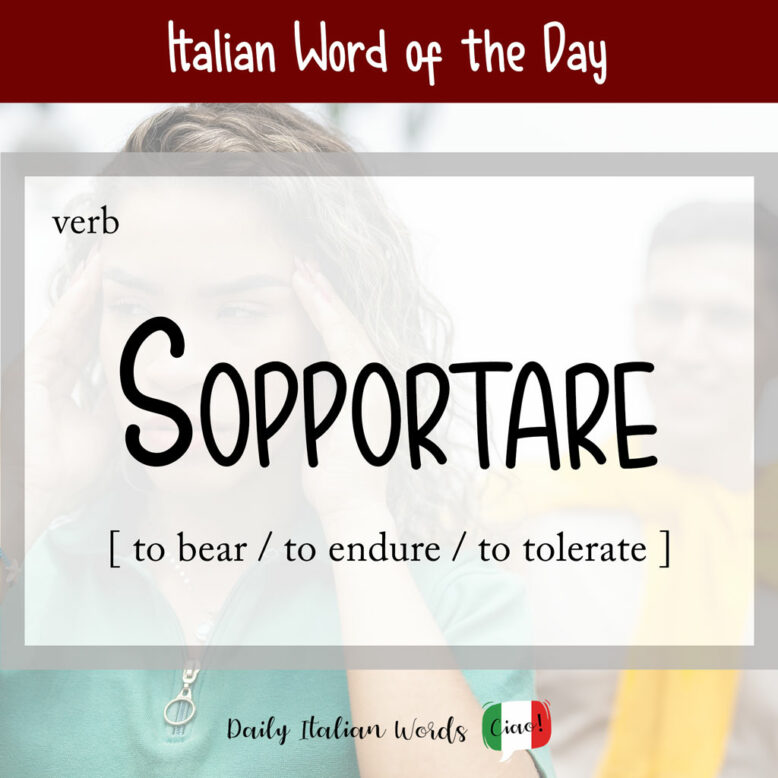
At first glance, sopportare looks like the English word support, so you might assume it means pretty much the same thing. Well, not quite. In Italian, sopportare actually means “to bear,” “to endure,” or “to put up with.” So if you proudly tell your Italian friends Vi sopporto! thinking you’re saying “I support you,” you’ve actually just announced, “I tolerate you.” Not exactly the warm show of friendship you had in mind!
sopportare
So, to avoid any awkward misunderstandings, let’s take a look at the main usages of sopportare in Italian:
1. Sopportare = To hold up, to bear
In its most literal sense, sopportare in Italian means to hold up or to bear a physical weight. For example:
Questa mensola non riesce più a sopportare tutti quei libri.
This shelf can’t hold all those books anymore.
Queste piccole colonne sopportano tutto il peso dell’architrave.
These small columns bear all the weight of the architrave.
However, in everyday Italian, when referring to physically holding or supporting something, it’s more common to use sostenere, while sopportare is more used in a figurative sense, as we’ll see in the next sections.
2. Sopportare = To endure, to bear, to put up with
In a more figurative use, sopportare is what we do when we have to put up with something tough, like un dolore (a pain), una ingiustizia (an injustice), or una spesa imprevista (an unexpected expense).
Simona sopporta questa situazione solo per amore di suo figlio.
Simona is putting up with this situation only because she loves her son.
Non so come Riccardo sia riuscito a sopportare un dolore così grande.
I don’t know how Riccardo managed to endure such great pain for so long.
Here are some typical examples of things a person might sopportare in this sense:
- Sopportareun grande dolore: to endure great pain
- Sopportare una sventura: to bear misfortune
- Sopportare una situazione difficile: to endure a difficult situation
- Sopportare un danno: to bear a damage
- Sopportare perdite ingenti: to endure heavy losses
- Sopportare una rinuncia: to endure a sacrifice
- Sopportare una spesa imprevista: to bear an unexpected expense
- Sopportare una perdita: to bear a loss
- Sopportare un onere fiscale: to endure a tax burden
An expression we often use in everyday conversation combines sopportare with the particle ne, forming phrases like ne sopporta di tutti i colori (he/she puts up with all sorts of things) or quante ne ha sopportate (how much he/she has endured). The particle ne here stands for all the things a person has to endure, and the whole expression conveys a sense of drama or sympathy, and sometimes even admiration, for their patience!
Silvia ne sopporta di tutti i colori, non so come faccia!
Silvia puts up with all sorts of things, I don’t know how she does it!
Tommaso ne ha sopportate troppe, prima o poi doveva esplodere.
Tommaso has endured too much, sooner or later he was bound to explode.
3. Sopportare = To tolerate, to put up with, to stand
Aaah, life is full of situations (and people) we simply have to tolerate!That’s the other sense of sopportare in Italian: to tolerate someone or something that’s fastidioso (annoying).
Matteo è davvero indisponente. Lo sopportiamo solo perché lavora bene.
Matteo is really annoying. We put up with him only because he’s good at his job.
Sopporto i suoi scherzi solo perché so che non è cattivo.
I tolerate his jokes only because I know he means no harm.
In this context, sopportare is frequently used in the negative form to express that we’ve had enough of someone or something, just like saying “I can’t stand” in English.
Non sopporto la sua risata, è davvero fastidiosa!
I can’t stand her laugh, it’s so annoying!
Non sopporto chi si lamenta per ogni cosa.
I can’t stand people who complain about everything.
Bambini, non vi sopporto più, andate a giocare fuori!
Kids, I can’t stand you anymore, go play outside!
Common things people can’t stand include:
- Non sopporto il caldo /il freddo: I can’t stand the heat / the cold
- Non sopporto i maleducati: I can’t stand rude people
- Non sopporto i prepotenti: I can’t stand bullies
- Non sopporto le ingiustizie: I can’t stand injustices
- Non sopporto la falsità: I can’t stand fake people
- Non sopporto la confusione: I can’t stand confusion / chaos
- Non sopporto la maleducazione: I can’t stand bad manners
- Non sopporto chi interrompe: I can’t stand people who interrupt
- Non sopporto la superficialità: I can’t stand superficiality
Fun fact: In Italian, when we really can’t stand someone, we casually say non poter vedere qualcuno, which literally means “not to be able to see someone.” It’s as if our dislike is so intense that even our eyes are like, “Nope, we simply can’t!”
La mia collega è una gran pettegola, non posso proprio vederla!
My coworker is such a gossip, I really can’t stand her!
4. Sopportarsi = To put up with each other
When the feeling of tolerance (or intolerance) is mutual, we use the reflexive form sopportarsi, which perfectly captures that shared eye-roll between two people.
Si sopportano da anni solo per il bene della famiglia.
They’ve been putting up with each other for years only for the sake of the family.
Dopo mesi di convivenza forzata, non si sopportano più.
After months of being stuck together, they can’t stand each other anymore.
The adjectives “sopportabile” and “insopportabile”
The verb sopportare gives us two adjectives that we often use in everyday conversations:
- Sopportabile, used to describe something bearable, perhaps because it’s reasonable or not excessive.
Fortunatamente, il caldo oggi è sopportabile.
Fortunately, the heat today is bearable.
Il lavoro è stressante, ma l’ambiente lo rende sopportabile.
The job is stressful, but the environment makes it manageable.
- Insopportabile, used to describe something that’s intolerable or unbearable.
I maglioni di lana mi provocano sempre un prurito insopportabile.
Wool sweaters always give me an unbearable itch.
È un ragazzo intelligente, ma a volte è proprio insopportabile!
He’s a smart guy, but sometimes he’s just unbearable!

Valentina Nicastro is a travel writer in love with her home country, Italy. Having travelled widely around the globe, she realised there was more to explore closer to home and decided to put the passport aside for a while. When she is not immersed in documenting Italy, you’ll find her donning her communication consultant hat, weaving words as a content writer and bridging linguistic divides as a translator.