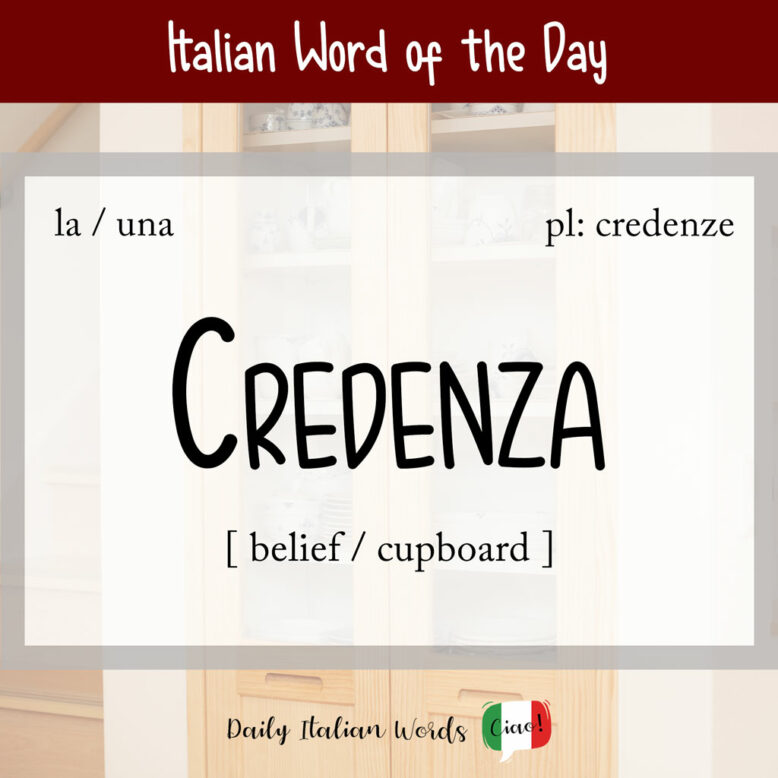
There is a certain charm to the Italian word credenza (pronounced with a nice, rolling R), because it carries two completely different meanings, one abstract and one physical: it refers to the act of believing, yet it is also the word for a cupboard. These definitions might seem totally unrelated, but there is actually a really interesting link between them.
credenza
Before we explore that connection, a quick grammar note: it’s a feminine word, la credenza, becoming le credenze in the plural.
1. Credenza = Belief, conviction
The first meaning takes us back to the word’s roots: credenza comes from the Latin credere, meaning “to trust.” So, in this sense, this word is all about the act of believing something to be true.
We use it to talk about a religious belief (una credenza religiosa), but also to refer to those shared convictions and popular opinions that are deeply rooted in tradition (often with a bit of superstition). For example:
- Una credenza popolare: A folk belief. This is traditional knowledge, the kind of things that are so ingrained, it feels like everyone just knows them.
L’idea che passare sotto una scala porti sfortuna è una vecchia credenza popolare.
The idea that walking under a ladder brings bad luck is an old folk belief.
- Una credenza antica: An ancient belief. This is another common expression you’ll often hear when discussing traditional ideas from the past.
Molte credenze antiche legano la qualità del vino alle fasi della luna.
Many ancient beliefs tie the quality of the wine to the phases of the moon.
- Una falsa credenza: A false belief, a myth. This is used to describe and debunk ideas that a lot of people believe but aren’t actually true.
Ci sono tante false credenze su ciò che fa bene o male alla salute.
There are a lot of myths about what’s good or bad for our health.
The following fixed expressions are commonly used to bring up common beliefs:
- Secondo una credenza diffusa…: According to a widespread belief…
Secondo una credenza diffusa, mangiare carboidrati a cena fa ingrassare.
According to a widespread belief, eating carbs at dinner makes you gain weight.
- È credenza generale che…: It is a common belief that…
Tra gli studenti napoletani è credenza generale che il Cristo Velato si possa ammirare solo dopo la laurea.
Among Neapolitan students, it is a common belief that the Veiled Christ statue should only be admired after graduation.**
**Superstition has it that visiting Giuseppe Sanmartino’s masterpiece in the Sansevero Chapel while you are still a student means you’ll never get your degree!
2. Credenza = Cupboard
The second meaning of credenza in Italian is much more practical: it’s a cupboard, a piece of furniture.
While these pieces come in countless styles, when I hear this word, I always picture those charming, heavy wooden cupboards in a nonna’s home, with bottom cabinets to stash food and everyday stoviglie(dishware), and glass doors above to proudly showcase the servizio buono (the “good china” generally received as a wedding gift).
Abbiamo restaurato la vecchia credenza della zia Maria, ora sembra nuova.
We restored Aunt Maria’s old cupboard, now it looks new.
So, how did this word come to mean such different things as a “belief” and a “cupboard”? The story goes like that: back in the 16th century, poisoning food at banquets was a common strategy to eliminate political rivals. To protect themselves, nobles started to employ a trusted servant known as the Mastro Credenziere, whose job was to taste all the food before it was served.
This safety check was known as the servizio di credenza(literally, the “service of belief”) because it gave everyone the “belief” that the food was safe to eat. And since the ritual was always performed on a cupboard, the furniture itself eventually inherited the name: credenza. In other words, the cupboard became the place where trust was proven, linking the practical piece of furniture to the original concept of belief.
Valentina Nicastro is a travel writer in love with her home country, Italy. Having travelled widely around the globe, she realised there was more to explore closer to home and decided to put the passport aside for a while. When she is not immersed in documenting Italy, you’ll find her donning her communication consultant hat, weaving words as a content writer and bridging linguistic divides as a translator.