Punto in Italian is a super common word you’ll come across often, not just because it has many meanings, but because it appears in lots of idioms and everyday phrases.
punto
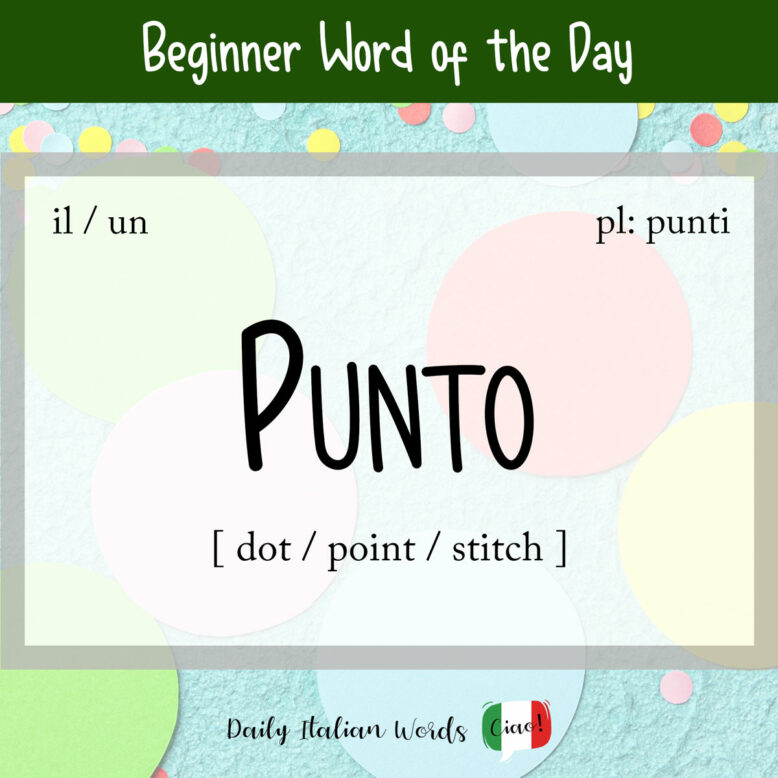
Grammatically speaking, it’s a masculine noun:
- il / un punto (singular)
- i / dei punti (plural)
In this article, I’ll show you the main ways to use this versatile word, from geometry to sports and games. I’ve organized them into categories to make them easier to remember.
So, andiamo dritti al punto (let’s get straight to the point) and look at all the different meanings!
Concrete meanings of PUNTO in Italian
Let’s start with the most visual uses of punto, the ones you can picture.
1. Punto = Dot (graphics & writing)
Il punto is the most basic graphic sign. Just press your pen to the paper and voilà, you’ve made a tiny mark… un punto! You can use it to punctuate sentences, organize information, and even guide someone’s eye.
Ricordati di mettere un punto alla fine della frase.
Remember to put a full stop at the end of the sentence.
Il grafico ha scelto di usare il libro come punto focale della locandina.
The graphic designer chose to use the book as the focal point of the poster.
These are some common punctuation marks with punto:
- Punto: full stop / period
- Punto e a capo: new paragraph
- Punto e virgola: semi colon
- Punto interrogativo: question mark
- Punto esclamativo: exclamation mark
- Punto elenco: bullet points
- I puntini di sospensione: ellipsis
But il punto doesn’t only sit on the page; it’s also used in these figurative expressions:
- Punto: end of the story. It’s a casual way to firmly close a conversation firmly, leaving no room for further discussion.
Ho detto che non si può fare, punto!
I said it can’t be done, end of story!
- Punto e basta: that’s it. This is another casual exclamation to end a discussion, emphasizing there is nothing more to discuss.
Ti ho detto che non puoi tornare così tardi, punto e basta!
I told you that you can’t come back so late. That’s it!
- Essere punto e a capo: literally “to be dot and back to head,” it means being back to square one.
Ne abbiamo parlato tanto, ma alla fine siamo punto e a capo.
We talked a lot about it, but in the end, we’re back to square one.
- Mettere un punto: literally “to put a point,” and we use it figuratively to express the idea of putting an end to something.
Dopo l’ennesima discussione, Silvia ha messo un punto alla sua storia con Diego.
After yet another argument, Silvia put an end to her relationship with Diego.
- Mettere i puntini sulle i: literally “to put the little dots on the i.” This means being super meticulous or wanting to clarify every detail. Historically, the letter i didn’t have a dot, which caused confusion with other letters. Adding the dot helped avoid mistakes, but not everyone did it at first. Those who insisted on dotting their i’ s were seen as a bit too precise, and that’s where the expression comes from!
Non sopporto più la mia collega, vuole sempre mettere i puntini sulle i!
I can’t stand my colleague anymore, she’s so pedantic!
2. Punto = Stitch (sewing)
In sewing and embroidery, un punto is one single stitch made with a needle and thread that builds up into seams, patterns, or beautiful embroidery.
Ho fatto l’orlo con dei punti provvisori, prima di passare alla cucitura definitiva.
I hemmed the fabric using temporary stitches before making the final seam.
Common types of punto in embroidery are:
- Punto croce: cross stitch
- Punto catenella: chain stitch
- Punto raso: satin stitch
- Puntoerba: stem stitch
- Puntomosca: fly stitch
Mia nonna è una maga del punto croce, fa dei ricami bellissimi!
My grandma is a wizard at cross stitch, she makes the most beautiful embroidery!
3. Punto = Stitch (surgery)
Then there’s the less fancy punto, the kind doctors use to close a cut or wound. The technical term is punto di sutura (suture), but in everyday Italian, we just say punto.
Il medico ha detto che ci vorranno almeno 10 punti per chiudere la ferita alla testa.
The doctor said it will take at least 10 stitches to close the wound on the head.
The key verbs to use with punto in this context are:
- Mettere i punti: to put in stitches / to stitch up
- Togliere i punti: to remove stitches
4. Punto = Point (position, space)
Moving to a totally different meaning, punto can also mean a precise spot in space. It could be the place where you meet someone, a scenic viewpoint, or a point on a map. Think of it as a spot that’s exactly there and nowhere else.
C’è un bellissimo punto panoramico qui vicino, andiamo a vederlo?
There’s a beautiful viewpoint nearby, shall we go see it?
La Transiberiana d’Italia raggiunge il punto più alto alla stazione di Rivisondoli-Pescocostanzo (1268 m).
The Italian Trans-Siberian Railway reaches its highest point at Rivisondoli-Pescocostanzo station (1268 m).
Arrivati a questo punto della strada, dobbiamo lasciare la macchina e proseguire a piedi.
Arriving at this point of the road, we need to leave the car and continue on foot.
These are some handy expressions to remember:
- Un punto di ritrovo: a meeting point
- Un punto vendita: a shop (literally, a sales point)
- Un punto panoramico: a scenic spot or viewpoint
- Un punto di partenza / arrivo: a starting / finishing point
- Un punto di passaggio: a stopover or passing point
- Un punto cardinale: a cardinal point
- Un punto sulla mappa: a point on the map
5. Punto = Dot, spot, small mark (generic)
More generally, un punto can be any small mark or thing that catches your eye. It could be a mark on paper, a dot in the distance, a splash of colour, or even those tiny black spots that sometimes show up on our skin!
Da quassù, la nostra barca sembra un punto rosso in mezzo al mare.
From up here, our boat looks like a red dot in the middle of the sea.
Some fixed expressions:
- Un punto luce: a lighting spot
- Un punto di colore: a pop of colour
- Un punto nero: a blackhead
6. Punto = Point (geometry & maths)
And now, back to school for a moment: il punto is the most basic geometric element. It’s simply a location in space, with no length, width, shape, or size.
Le rette incidenti sono due o più linee che si incontrano in un punto.
Intersecting lines are two or more lines that meet at a point.
Prova a tracciare una linea dal punto A al punto B.
Try drawing a line from point A to point B.
In Italian, il punto is also used in numbers to mark the thousands (5.000), while English uses a comma (5,000).
And if you venture into finance, il punto appears in expressions like il punto percentuale (percentage point) and il punto base (basis point). For example:
La Commissione ha tagliato i tassi di interesse di 25 punti base.
The Commission cut interest rates by 25 basis points.
Abstract meanings of PUNTO in Italian
Now let’s look at situations where punto doesn’t mean something physical.
7. Punto = Topic, aspect, issue
In this sense, punto is like a mental dot: the exact topic or issue we’re focusing on in a conversation or in writing. It’s very common in both formal and everyday Italian.
Su questo punto non riusciamo a trovare un accordo con il cliente.
On this point, we can’t reach an agreement with the client.
Il primo punto all’ordine del giorno è l’installazione dei nuovi citofoni.
The first item on the agenda is the installation of the new intercoms.
Secondo me, questo punto della presentazione è poco chiaro.
In my opinion, this part of the presentation is a bit unclear.
These are some useful phrases for everyday conversation:
- Il punto della questione: the main point, the heart of the matter. We also say il nocciolo della questione (literally, “the kernel of the matter”)
- Un punto cruciale: a crucial point, a key issue
- Un punto di accordo: a point of agreement
- Un punto fermo: a fixed point, something stable or certain
- I punti di un programma elettorale: the points/items of a political agenda
- Chiarire un punto: to clarify a point
- Cogliere il punto: to get the point
- Non capire il punto: to miss the point
- Andare dritti al punto: to go straight to the point
- Qui sta il punto: that’s the point, this is the crux of the matter
8. Punto = Moment, stage, point in time
Punto can also mean a moment in time or a stage in a process, like a little dot marking where we are in a situation.
A questo punto, non possiamo tornare indietro.
At this point, we can’t go back.
Siamo arrivati al punto in cui dobbiamo decidere.
We’ve reached the point where we have to decide.
Fino a questo punto tutto è andato bene.
Up to this point, everything has gone well.
Some expressions you’ll hear include:
- Ad un certo punto: at a certain point
- A questo punto: at this point
- Fino a questo punto: up to this point
- Arrivare al punto di: to reach the stage of
- Punto di svolta: turning point
- Punto di non ritorno: point of no return
- In punto di morte: on one’s deathbed
9. Punto = Point (sports & games)
In sports, games, and competitions, un punto is a point you earn in the score.
Abbiamo perso per due punti!
We lost by two points!
La prossima risposta vale ben tre punti!
The next answer is worth a whole three points!
Some handy expressions in these contexts include:
- Fare / segnare un punto: to score a point
- Vincere ai punti: to win on points
- Essere in vantaggio di x punti: to be ahead by x point
- Perdere per x punti: to lose by x points
- Dare dei punti: literally “to give points.” We use this expression mainly figuratively to say someone is far superior in a skill or area. It originates from card games, where seasoned players would give weaker ones a few points of advantage.
Marta darebbe dei punti anche a uno chef stellato: i suoi piatti sono perfetti!
Marta could give points even to a Michelin-star chef: her dishes are perfect!
10. Punto = Bit, stung
Punto can also be the past participle of the verb pungere, meaning “to bite,” “to sting,” or “to prick,” both literally and figuratively.
Sono stato punto da un’ape.
I got stung by a bee.
Quelle critiche lo hanno punto nell’orgoglio.
Those criticisms pricked his pride.
Other idioms and expressions with PUNTO in Italian
Feeling overwhelmed? Well, we’re not done yet! Italian has even more expressions with punto, and there are still a few more to discover.
- A puntino: Perfectly
Che buona questa bistecca, è cotta a puntino!
This steak is so good, it’s perfectly cooked!
- A che punto è/sei/siete?: Where is it at? Where are you/they at?
A che punto sei con il libro che ti ho prestato?
Where are you at with the book I lent you?
- Al punto di / Al punto che: To the point that
Ieri ero stanchissimo, al punto che non riuscivo a tenere gli occhi aperti a cena!
Yesterday I was exhausted to the point that I could barely keep my eyes open at dinner.
- Di punto in bianco: Out of the blue, all of a sudden
Hai saputo di Matteo? Ha lasciato Sara di punto in bianco, senza darle nessuna spiegazione.
Have you heard about Matteo? He left Sara out of the blue, without giving her any explanation.
- Di tutto punto: Perfectly, meticulously
Ci siamo vestiti di tutto punto per l’evento e poi è stato cancellato all’ultimo minuto!
We got all dressed up for the event, and then it got canceled at the last minute!
- Essere a buon punto: Making good progress, being well on track
Sono a buon punto con la traduzione del libro, mi mancano solo due capitoli.
I’m making good progress with the book translation, I only have two chapters left.
- Essere a un punto morto: To be at a dead end, at a standstill, stuck
La trattativa tra le due aziende è a un punto morto.
The negotiations between the two companies are at a standstill.
- Essere sul punto di: To be about to, to be on the verge of
La catena di negozi in cui lavorano è sul punto di fallire.
The chain of stores they work at is about to go bankrupt.
- Fare il punto della situazione:To take stock, to assess the situation
Prima di prendere qualsiasi decisione, dobbiamo fare il punto della situazione con gli altri.
Before deciding anything, we need to assess the situation with everyone else.
- Fino a un certo punto: To a certain point
La capisco fino a un certo punto, credo che ci siano altri fattori da considerare.
I can understand her to a certain point, but I think there are other factors to consider.
- In punto: Sharp, on the dot
Ci vediamo domani alle dieci in punto!
See you tomorrow at ten sharp!
- Mettere a punto: To develop, to fine tune
La casa farmaceutica ha messo a punto un nuovo farmaco contro il diabete.
The pharmaceutical company has developed a new drug for diabetes.
- Punto debole: Weak point, weakness
Il punto debole di questa strategia è la scarsa flessibilità.
The weak point of this strategy is its poor flexibility.
- Punto di forza: Strong point, strength
La rapidità di esecuzione è sempre stata uno dei loro punti di forza.
Speed of execution has always been one of their strengths.
- Punto di vista: Point of view
Dal mio punto di vista, sarebbe meglio rimandare il viaggio.
From my point of view, it would be better to postpone the trip.
- Punto di incontro: Literally, it means meeting point, but it’s more commonly used to refer to a point of agreement or common ground
Quei due discutono sempre, non riescono a trovare un punto di incontro.
Those two are always arguing, they can’t seem to find common ground.
- Punto dolente: Literally, it refers to a painful spot on the body, but it’s more commonly used figuratively to mean a sore point.
La gestione dei rifiuti è il punto dolente di questa amministrazione.
Waste management is the sore point of this administration.
- Punto per punto: Point by point
Hanno smontato la tesi dell’accusa punto per punto.
They took apart the prosecution’s argument point by point.
- Tenere il punto: To hold one’s ground
Durante l’incontro con il cliente, il capo ha saputo tenere il punto nonostante le critiche.
During the meeting with the client, the boss managed to hold his ground despite the criticism.
Valentina Nicastro is a travel writer in love with her home country, Italy. Having travelled widely around the globe, she realised there was more to explore closer to home and decided to put the passport aside for a while. When she is not immersed in documenting Italy, you’ll find her donning her communication consultant hat, weaving words as a content writer and bridging linguistic divides as a translator.