You might know “coda” as a term for the final section of a musical piece, but in Italy, this word takes on much more practical (and sometimes frustrating) meanings.
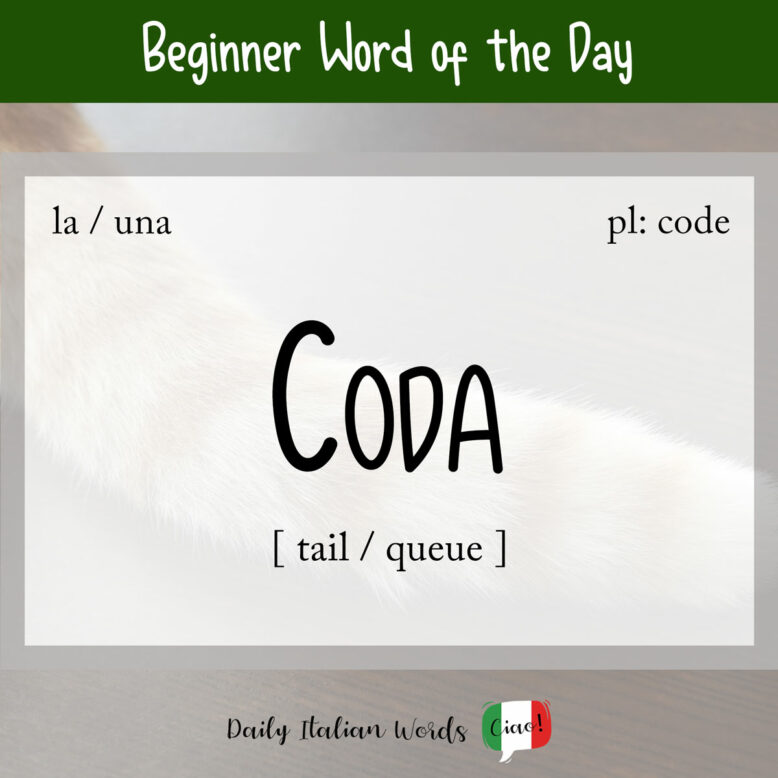
So let’s explore all the main uses of this word, which is a feminine noun (la coda) that becomes le code in the plural.
coda
1. Coda = An animal’s tail
The most literal definition of una coda is an animal’s tail. Whether it’s a cane (dog), a gatto (cat), or even a tiny lucertola (lizard) sprinting up a wall, that elongated part extending beyond the body is always la coda.
Here are some common adjectives you’ll hear us use to describe what an animal’s tail looks like:
- Lunga: Long
- Corta: Short
- Folta: Bushy
- Sottile:Thin
- Pelosa: Hairy, furry
- Mozzata: Cut
- Ispida: Bristly
- Appuntita: Pointed
- Arricciata: Curled
And since a coda is rarely quiet, these are some verbs we use to describe its movement:
- Muovere la coda: To move the tail
- Agitare la coda:To shake the tail
- Abbassare la coda: To lower the tail
- Drizzare / Alzare la coda: To raise the tail
- Scodinzolare: To wag the tail—this is a special verb we use just for joyful dogs
I cani hanno iniziato a scodinzolare non appena lo hanno visto.
The dogs started wagging their tails as soon as they saw him.
You’ll also spot coda on some menus! Here’s what it might mean:
- Coda alla vaccinara: The classic Roman stew made with oxtail.
- Coda di rospo: Literally “toad’s tail,” which sounds unappetizing but it’s actually monkfish.
- Coda d’aragosta: Literally “lobster tail.” Beyond the seafood dish itself, in bakeries around Naples, a coda d’aragosta is a crunchy pastry shaped like a lobster tail and stuffed with sweet cream. Yum!
Lastly, we also use coda for objects that have a “tail-like” extension, for example:
- Un pettine a coda: A rat-tail comb, the kind with that long, pointy handle used by hairdressers to section hair.
- Un pianoforte a coda: A grand piano, the kind that extends horizontally, creating that iconic tail shape.
2. Coda = Ponytail
If you have capelli lunghi (long hair), then you probably often tie it back. In Italian, this hairstyle is called una coda—literally, a “tail.”
Sometimes, you’ll also hear una coda di cavallo (lit, “a horse’s tail”). This is especially common when the hair is long and flowing, because once it’s tied back, you’re basically rocking the same “tail” as a beautiful stallion straight from the Palio di Siena!
Depending on where you tie it, you can use a specific adjective:
- Una coda alta: A high ponytail
- Una coda bassa: A low ponytail
- Una coda laterale: A side ponytail
The “tiny tail:” il codino
When the hair isn’t long enough for a full coda, we switch to the diminutive form un codino (a little tail). Notice the gender change: coda is feminine, but codino is masculine. This is likely because the word originally referred to a traditional men’s hairstyle. Today, it can generally refer to a short, thin ponytail.
And I can’t talk about il codino without mentioning one of Italy’s most famous footballers, Roberto Baggio, famously known as il divin codino (lit, “the divine little ponytail”) because of his iconic hairstyle in the ‘90s.
Finally, with codino, singular and plural make a big difference:
- Un codino (singular) is for when the hair is short and the “tail” is tiny.
- I codini(plural), instead, are two small ponytails, one on each side of the head (what you’d call pigtails in English).
3. Coda = The final part of something
Coda in Italian can also refer more in general to the final or rear part of something.
This could be for example:
- La coda di un abito: A dress train, like on a bridal gown (we also call it strascico).
- La coda del treno: The last carriage of a train.
- La coda del corteo: The very back of a procession or parade.
When you watch a movie, you’ll also see i titoli di coda (literally, “the titles of the tail”). These are the closing credits that come up at the end.
And if you read Italian newspapers, you’ll often come across the expression essere il fanalino di coda. It literally means “to be the little tail light,” and it’s used figuratively to describe being at the bottom of a ranking.
Per molto tempo la città è stata il fanalino di coda in Italia per qualità della vita.
For a long time, the city was at the bottom of the rankings for quality of life in Italy.
4. Coda = Line, queue
This is the meaning of coda you’ll hear the most in Italy… and the one you’ll probably enjoy the least! In everyday Italian, la coda is the line of people waiting their turn, whether it’s alle poste (at the post office), alla cassa (at the checkout), or alla fermata dell’autobus (at the bus stop).
Stiamo aspettando in fila al bar, ci vuole un’eternità per ordinare.
We’re waiting in line at the bar, it’s taking forever to order.
If you’re driving on the autostrada (motorway), you may spot digital signs with the word code (plural). This usually means there’s been an accident, or it’s summer and the entire country has decided to go on vacation at the exact same time. Common phrases include:
- code a tratti: intermittent queues
- code in direzione…: queues in the direction of…
- code fino a…: queues up to… (followed by the name of the place or exit)
Oggi sono previste code a tratti sulla A14 a causa di lavori.
Today, there are expected to be intermittent queues on the A14 motorway because of roadworks.
Key verbs that pair well with coda in this sense include:
- Fare la coda: To queue, to wait in line (lit, “to do the tail”)
- Mettersi in coda: To join the line (lit, “to put yourself in the tail”)
- Essere in coda: To be currently waiting in line (lit, “to be in the tail”)
- Rispettare la coda: To respect the line (a noble concept, not always applied in Italy)
You’ll often hear us use the words fila and coda, to mean “line” or “queue,” such as:
C’è un sacco di coda / fila!
There is a huge line!
Is there a difference? Not really. Technically, fila suggests a “row,” while a coda often looks less like an orderly line and more like a confused cluster of people. But in daily conversation, both words are used pretty much interchangeably.
And here’s a tip: in many Italian shops (like in a bakery or at the pharmacy), there isn’t always a clear physical line, just people standing. So, when you walk in, it’s customary to ask Chi è l’ultimo? (Who’s the last one?).
Expressions with CODA in Italian
Finally, the word coda appears in several idioms we commonly use in everyday conversation:
Avere la coda di paglia
Literally: To have the tail of straw
Meaning: To have a guilty conscience. We use this expression when someone is overly defensive for no reason or reacts as if they’ve been caught (even though nobody said anything). It’s similar to saying “to have something to hide” in English.
Se Elena reagisce così male a una semplice domanda, evidentemente ha la coda di paglia!
If Elena reacts so badly to a simple question, clearly she has a guilty conscience!
This expression comes from a medieval practice used to humiliate defeated or condemned people: they were given a tail made of straw and forced to parade through town for everyone to see. Since straw burns very easily, the poor victims walked around in constant fear that someone might set their “tail” on fire, which made them extremely jumpy and nervous. And that’s exactly the image behind today’s expression: someone who has acoda di paglia is metaphorically just as tense and on edge!
Con la coda tra le gambe
Literally: With the tail between the legs
Meaning: To be humiliated, defeated, or forced to admit failure. Just like in English, this expression evokes the image of a poor dog tucking its tail between its legs. We use it when someone has to walk away after a clear loss, a public failure, or an argument they were cerrtain they would win.
Gli atleti sono tornati a casa con la coda tra le gambe dopo la sonora sconfitta.
The athletes went home humiliated after the crushing defeat.
Un cane che si morde la coda
Literally: A dog biting its own tail
Meaning: A dog chasing its own tail, a vicious cycle. We use this expression in those circumstances when a problem creates another problem, which in turn leads us back to the original problem, just like a dog chasing its own tail and never quite getting hold of it.
C’è traffico perché la gente usa l’auto, ma la gente usa l’auto perché ci sono pochi autobus: il classico cane che si morde la coda.
There is traffic because people use cars, and people use cars because there are few buses: it’s the classic dog chasing its own tail.
Senza capo né coda
Literally: Without head nor tail
Meaning: To be senseless, illogical, or just completely confusing. Since capo implies the beginning and coda implies the end, something lacking both has no structure at all.
Il responsabile del personale ha fatto un discorso senza capo né coda, saltando da un argomento all’altro e senza spiegazioni.
The HR manager gave a speech that made no sense; he kept jumping from topic to topic and without explaining anything.
Fare un testacoda
Literally: To do a head-tail
Meaning: To spin out in a car. Hopefully, this is one expression you’ll never need in real life. Basically, a testacoda happens when a car spins out of control, so the “head” (front) of the car ends up where the “tail” (rear) should be.
Il pilota ha perso il controllo dell’auto e ha fatto un brutto testacoda.
The driver lost control of the car and went into a bad spin.
Un colpo di coda
Literally: A flick of the tail
Meaning: A last-ditch attempt, a final blast. Figuratively, we use this expression to describe a surprise comeback when someone already seemed defeated, or the final manifestation of something that appeared to be over (like a late snowstorm deciding winter isn’t done yet).
Nonostante il bel sole degli ultimi giorni, il colpo di coda dell’inverno ha riportato la neve anche in pianura.
Despite the beautiful sun of the last few days, a final blast of winter brought snow back even to the plains.
Con la coda dell’occhio
Literally: With the tail of the eye
Meaning: Out of the corner of your eye. Basically, it means to glance at someone or something furtively, without turning our head. We use it when talking about subtle spying or moments when we’re trying not to be noticed.
Mentre parlavo con Cristina, tenevo d’occhio Michele con la coda dell’occhio.
While I was talking to Cristina, I was keeping an eye on Michele out of the corner of my eye.

Valentina Nicastro is a travel writer in love with her home country, Italy. Having travelled widely around the globe, she realised there was more to explore closer to home and decided to put the passport aside for a while. When she is not immersed in documenting Italy, you’ll find her donning her communication consultant hat, weaving words as a content writer and bridging linguistic divides as a translator.