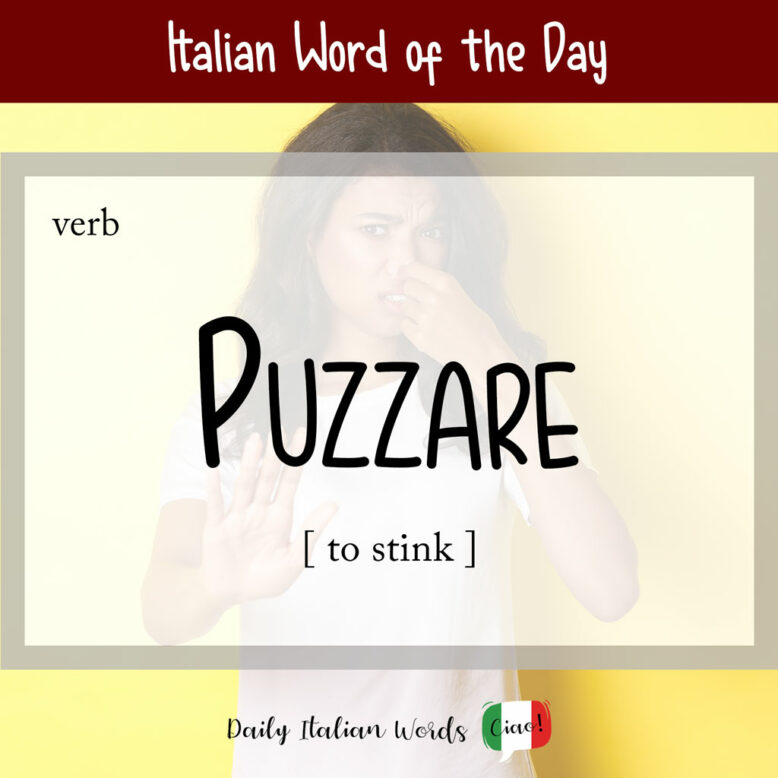
Have you ever walked past an overflowing dumpster in the heat of a summer afternoon? Or perhaps you’ve met someone whose intentions seemed just a little bit… off? If so, you’ve already experienced the essence of today’s word: Puzzare!
Pronounced with a distinctive double “zz” (poot-tsah-reh), this is a great Italian word for describing anything that “stinks:” if we use this verb, you can bet there’s something unpleasant in the air, whether it’s a literal foul scent or a metaphorical “fishy” situation.
puzzare
So, let’s dive into the world of bad smells (literally and figuratively!) and see how you can use the verb puzzare in Italian conversation.
1. Puzzare = To stink, to smell bad
At its most literal, puzzare is what we use when something (or someone!) is giving off a “questionable” aroma. The word comes from the Latin putrere, meaning “to rot,” so, yes, this verb was doomed to be unpleasant from day one!
Questa carne puzza, non è fresca.
This meat smells bad, it’s not fresh.
We often pair puzzare with other words to emphasize exactly how offended our noses are, for example:
- Puzzare da morire: To stink “to death” (perfect when the smell isn’t just bad… it’s a biological weapon!).
- Puzzare da far schifo: To stink so much it’s disgusting (this is the no-filter, very informal option for something that’s truly gross).
- Puzzare tremendamente: To stink terribly (a more “elegant” way to say something is an absolute olfactory disaster).
- Puzzare come un caprone: To stink “like a male goat” (the poor caprone is the undisputed mascot of the “musky and unwashed” world! Not exactly polite, and definitely a hint that a long shower is overdue.).
We can also specify what the smell is by adding the preposition di(of), such as:
- Puzzare di fumo: To smell of smoke
- Puzzare di bruciato: To smell of something burnt
- Puzzare di sudore: To smell of sweat
- Puzzare di chiuso: To smell of “closed-ness”
Finally, from the verb puzzare in this sense, we get two very useful related words:
- The noun puzza (a stink, a bad smell)
Mamma mia, che puzza in questa stanza! Apri la finestra!
My goodness, what a stink in this room! Open the window!
- The adjective puzzolente (stinky, smelly)
Metti fuori quelle scarpe puzzolenti, non le voglio in casa!
Put those stinky shoes outside, I don’t want them in the house!
2. Puzzare = To stink (figuratively)
Just like in English you say something “smells fishy,” in Italian we use puzzare to describe a situation that makes you raise an eyebrow and question what’s really going on. So, when you have the feeling something isn’t right, you can say it puzza – even if the air is filled with the scent of fresh lemons!
Tutta questa fretta puzza, secondo me c’è qualcosa sotto!
All this hurry stinks; in my opinion, there’s something going on!
Sometimes, we like to be specific about the “flavor” of our suspicion, and use puzzare followed by the preposition di (of) and a noun. For example:
- Puzzare di truffa: To smell like a scam
Questa storia puzza di truffa. Mi raccomando, non dargli i tuoi dati!
This story smells like a scam. Make sure you don’t give him your data!
- Puzzare di marcio: To smell like something rotten
C’è qualcosa che puzza di marcio in quell’azienda.
There’s something that stinks of “rottenness” in that company.
- Puzzare di bugia: To smell like a lie
Le sue scuse puzzano di bugia lontano un miglio!
His excuses smell fishy from a mile away.
- Puzzare di intrallazzo: To smell like “shady dealings”
Quei due parlano sempre sottovoce… puzza di intrallazzo!
Those two are always whispering… something shady is going on!
Other times, we don’t even need to say what it smells of. For example, if we’ve just heard a friend’s bizarre excuse, we just shake our head and say:
Mmm… qui la cosa puzza!
Hmm… this doesn’t feel right!
Another common way to use this verb is the expression mi puzza. Literally, it means “it stinks to me,” and we use it when we have a gut feeling that someone is lying or a situation is suspicious. It’s similar to saying “I smell a rat” or “it smells fishy to me” in English.
Ti prestano dei soldi senza interessi? Mi puzza!
They’re lending you money with zero interests? I smell a rat!
A little grammar note: Notice that we use the indirect object pronoun mi (to me), so it’s like the “stink” of the situation is reaching us specifically. Similarly, we can say: ci puzza (it smells fishy to us), gli/le puzza (it smells fishy to him/her), etc.
Common expressions with puzzare in Italian
Finally, here are some classic Italian idiomatic expressions with puzzare that will make you sound like a local in daily conversation:
L’ospite è come il pesce, dopo tre giorni puzza
Literally: A guest is like fish, after three days, it stinks.
This is a golden rule: even if your host welcomes you with open arms and enough pasta to feed a small army, do not overstay. Just like a prized swordfish left out too long, a guest is delightful on day one, but by day three… well, let’s just say the “aroma” of your presence starts to get a bit pungent!
Puzzare ancora di latte
Literally: To still smell of milk
We use this expression when a younger person is being a total “so tutto io” (a know-it-all), acting like a seasoned adult when it’s obvious they don’t have a clue yet. By telling them they still smell of milk, we’re reminding them that they aren’t as “grown-up” as they think they are. Depending on the tone, it can be a light-hearted tease or a verbal slap, so use it carefully.
Avere la puzza sotto il naso
Literally: To have a stink beneath the nose.
This is our way to describe a snob. You know that specific face people make when they walk past something really stinky? The wrinkled nose, the curled lip, the head tilted back in disgust? Precisely the image of a snobbish person walking around like that all the time, as if they think the rest of the world is just one big, permanent bad smell right under their nostrils!

Valentina Nicastro is a travel writer in love with her home country, Italy. Having travelled widely around the globe, she realised there was more to explore closer to home and decided to put the passport aside for a while. When she is not immersed in documenting Italy, you’ll find her donning her communication consultant hat, weaving words as a content writer and bridging linguistic divides as a translator.