
Mossa in Italian can play three different roles: it can be a noun, an adjective, or even the past participle of a verb. What links them all is one central theme: movement, whether literal or figurative.
As a noun, it’s feminine: la / una mossa (singular) and le / delle mosse (plural).
mossa / mosse
Now, let’s explore the main ways it’s used.
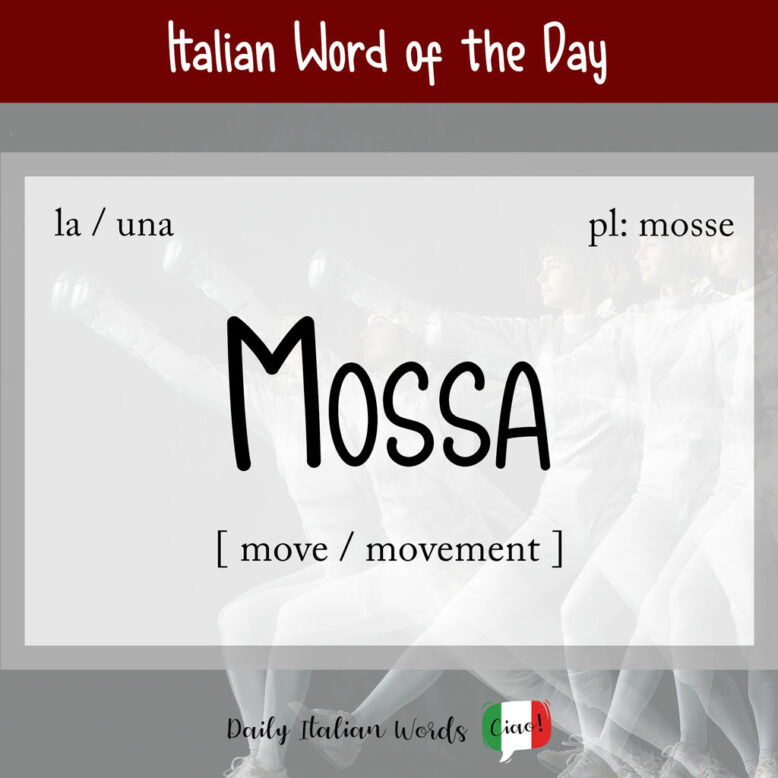
1. Mossa = Movement, move (noun)
The most basic meaning of mossa is simply a movement of the body. We usually say it with the verb fare (to do, to make), as in fare una mossa (to make a movement).
Stavamo passeggiando tranquillamente, ma poi Sergio ha fatto una mossa brusca e il cane è scappato spaventato.
We were strolling peacefully, but then Sergio made a sudden move and the dog ran off scared.
Una mossa as a body movement can be:
- Una mossa involontaria: an involuntary movement
- Una mossa brusca: an abrupt movement
- Una mossa rapida: a quick movement
- Una mossa goffa: a clumsy movement
- Una mossa improvvisa: a sudden movement
- Una mossadel capo, del braccio, ecc.: a movement of the head, the arm, etc. (the focus is on the body part that moves)
- Una mossacon la mano, con la gamba, ecc.: a movement with the hand, the leg, etc. (the focus is on the body part you use to make the movement)
Con una rapida mossa, i ladri le hanno portato via la borsa.
With a quick move, the thieves snatched her bag.
Il Signor Mario ha risposto con una mossa del capo, senza dire una parola.
Mr. Mario responded with a movement of the head, without saying a word.
Mossa can be also a movement in a more embarrassing context: una mossa di corpo is literally “a movement of the body,” but it’s slang for a sudden, uncomfortable trip to the bathroom (a diarrhea emergency!).
And now a cultural fun fact: la mossa also refers to a playful, provocative hip-shaking move! It all started with Maria Campi in the late 1800s, who performed it on variety show stages. Her story inspired the 1970 movie Ninì Tirabusciò, la donna che inventò la mossa (Ninì Tirabusciò, the woman who invented the move). To see the mossa in action, check out around minute 4:25.
2. Mossa = Move (noun)
Beyond physical movement, we use mossa in a figurative sense to mean an action or initiative we take to achieve a goal.
Cambiare strategia all’ultimo minuto è stata una mossa rischiosa, ma fortunatamente è andato tutto bene.
Changing strategy at the last minute was a risky move, but luckily everything worked out.
In this sense, una mossa can be positive, risky, or even a mistake, depending on the context. Some common combinations are:
- Una mossa intelligente: a smart move
- Una mossa vincente: a winning move
- Una mossa decisiva: a decisive move
- Una mossa audace: a bold move
- Una mossa abile: a skillful move
- Una mozza azzardata: a risky move
- Una mozza rischiosa: a risky move
- Una mossa sbagliata: a wrong move
- Una mossa politica: a political move
- Una bella mossa: a clever move, nice one
- Una mossa da maestro: a brilliant move (literally, “a move worthy of a master”)
Investire in quella startup è stata davvero una mossa vincente!
Investing in that startup was really a winning move!
Piero è un grande! Ha concluso la trattativa con una mossa da maestro, ottenendo esattamente quello che voleva.
Piero is awesome! He closed the deal with a brilliant move, getting exactly what he wanted.
A great expression to know is fare la prima mossa, which means “to make the first move.”
We use it whenever someone is the first to act in a situation, whether in business, in a game, or even in romance!
Sono stato io a fare la prima mossa e chiederle di uscire: oggi sono tre anni che stiamo insieme!
I was the one who made the first move and asked her out: today we’ve been together for three years!
In this figurative sense, mossa works in board games too, like scacchi(chess) or dama (checkers), to mean the move or action you choose to make.
Luca è un abile giocatore di scacchi; ha vinto la partita in sole quattro mosse!
Luca is a skilled chess player; he won the game in just four moves!
Similarly, in sports mossa can refer to a clever tactic or maneuver, such as:
La mossa del portiere ha salvato la partita.
The goalkeeper’s move saved the game.
3. Mossa = Blurred, rough, wavy (adjective)
Another way to use mossa is as the feminine form of the adjective mosso. Depending on the context, it can describe different kinds of “movement” that affect how something looks or feels. Here are the three main meanings:
- “Blurred,” when a photo isn’t sharp because of movement.
Questa foto è mossa, rifacciamola!
This photo is blurry, let’s take it again!
- “Rough,” when the sea or water isn’t calm.
Sto facendo un corso di canoa, questa settimana ci alleneremo in acqua mossa.
I’m taking a canoeing course, and this week we’ll be training in rough water.
- “Wavy,” when referring to hair with waves.
Il parrucchiere mi ha consigliato una piega mossa per un look più fresco.
The hairdresser suggested a wavy blow-dry for a fresher look.
Note: The adjective mosso can also mean “sparkling” when describing wine. In this case, it’s always used in the masculine form because vino (wine) is a masculine noun in Italian: il vino mosso (sparkling wine).
4. Mossa = Moved (past participle)
Mossa can also be the feminine form of the past participle of the following verbs:
- muovere: to move, both in the literal sense of physically moving something, or in a figurative sense meaning to motivate or drive.
La macchina non è stata mossa dal parcheggio per giorni.
The car hasn’t been moved from the parking spot for days.
La protagonista del libro è mossa dall’ambizione e dalla sete di potere.
The protagonist of the book is driven by ambition and a thirst for power.
- muoversi: to move oneself, describing both physical movement (changing position) or figurative movement (taking action).
La gatta si è mossa all’improvviso e ha fatto cadere il vaso.
The cat suddenly moved and knocked over the vase.
Dopo aver saputo dell’incidente, Laura si è mossa subito per dare una mano.
After hearing about the accident, Laura immediately sprang into action to help.
Idioms with “mossa” in Italian
Finally, let’s look at a couple of very common expressions with mossa that you’ll hear a lot in casual Italian
- Darsi una mossa: to hurry up, to get moving. This is what we say when we want someone to speed up or stop wasting time.
Lucia, datti una mossa con quella valigia altrimenti perdiamo il treno!
Lucia, hurry up with that suitcase or we’ll miss the train!
This expression is very informal and is mostly used with friends and family. If you use the “formal” version, si dia una mossa, in a serious or polite situation, it would sound quite bossy.
- Fare la mossa: to show that you intend to do something. It’s a colloquial expression used when someone gestures or hints that they will do something, but doesn’t actually do it.
Siamo usciti a pranzo e al momento del conto non ha nemmeno fatto la mossa di pagare.
We went out to lunch, and when it came time to pay, he didn’t even make a move to pay.
It’s more common to hear fare il gesto (literally “to make the gesture “), but you might still hear fare la mossa, so it’s good to know.
Siamo usciti a pranzo e al momento del conto non ha nemmeno fatto il gesto di pagare.
We went out to lunch, and when it came time to pay, he didn’t even make a move to pay.

Valentina Nicastro is a travel writer in love with her home country, Italy. Having travelled widely around the globe, she realised there was more to explore closer to home and decided to put the passport aside for a while. When she is not immersed in documenting Italy, you’ll find her donning her communication consultant hat, weaving words as a content writer and bridging linguistic divides as a translator.