Imagine you’re sitting around a table with Italian friends. Dessert arrives — a gorgeous homemade torta (cake) — and someone says:
Mica male questa torta! Non avevo mica capito che l’avessi fatta tu.
This cake is really good! I had no idea you made it.
Mica la rifaresti per il mio compleanno?
Any chance you’d make it again for my birthday?
See that word, mica? It appears three times in such a short space. That might seem a bit too much, but it’s actually something you’ll often hear in everyday conversations. One of those words that make the language sound so natural.
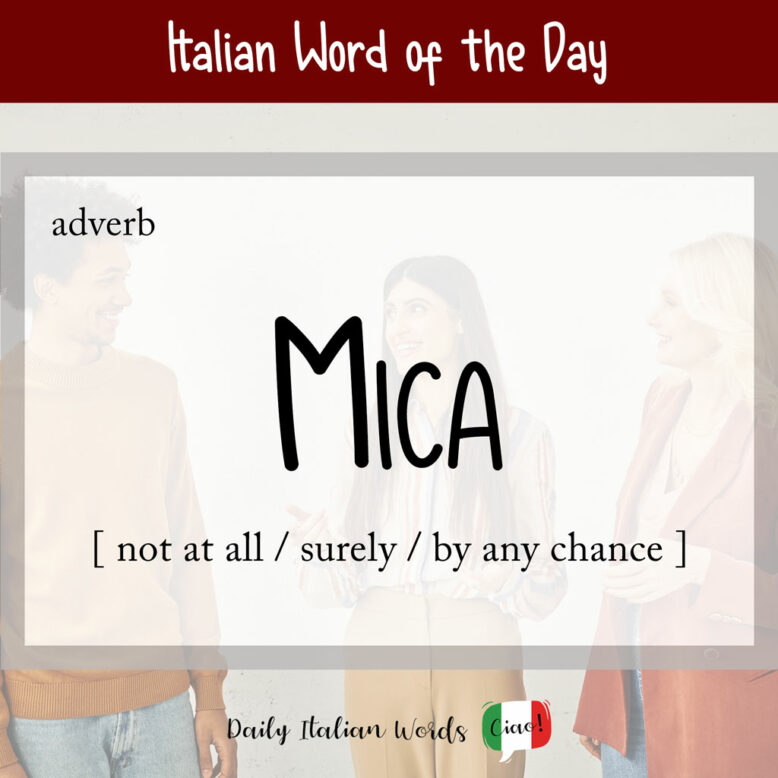
The tricky part is that, depending on the context, mica carries different shades of meaning and there’s no single English equivalent. Below, I break down the main uses with some real-life examples that will help you understand how this word works.
1. MICA = Bread roll
mica
Before we get into the everyday uses of mica in Italian, let’s explore the etymology of this curious word.
Mica comes from the Latin mīca, meaning “crumb.” In the Milanese dialect, the word evolved into micca, a rustic loaf that would crumble into tiny crumbs with every slice. Then during the 1700s, the Austrians, who were occupying Milan at the time, brought with them their Kaisersemmel (the so-called “Emperor’s bread”), a roll shaped like a small rose. Milanese bakers started making their own version: they kept the shape but cleverly removed much of the soft interior, making it better suited to Milan’s humid climate (no one wanted a chewy roll). The result was a lighter roll they named michetta, a playful, diminutive nod to the old micca.
Today, the michetta remains a staple of Milanese food culture (split it open, fill it with mortadella or salame, and you’ve got something super yummy!). And if you travel to other parts of Italy, you’ll find a very similar bread called rosetta — literally, “the little rose.”
2. MICA = Not at all, it’s not like…
Though mica began as a noun, it’s most commonly used as an adverb to reinforce a negation. Think of it this way: dropping mica into a negative sentence is a bit like saying not even a “crumb” of what’s being said is true.
In practice, we use it as a way of pointing out that what someone else thinks or assumes isn’t the case, for instance:
Oggi non fa mica freddo!
It’s not cold at all today!
In this example, we’re not simply saying it’s not cold; we’re reacting to someone who probably suggested it is cold, or maybe grabbed a coat when there’s clearly no need for one. Without mica, the sentence would be a simple, neutral statement. But by adding it, we’re emphasizing that the opposite of what the other person thinks is true.
You’ll hear mica used this way all the time in spoken Italian. This adverb can sit in two different positions within a sentence, and each position follows its own rule.
When mica comes after the verb, the verb needs to be in its negative form (with non).
Non è mica blu questa giacca, è nera.
This jacket isn’t blue at all, it’s black.
Stefano non mi ha mica chiamato.
Stefano didn’t call me at all.
Non lo sapevo mica.
I didn’t know that at all.
When mica comes before the verb, it replaces non entirely, so the verb stays positive.
Mica piove, dai usciamo!
It’s not like it’s raining, come on let’s go out!
Mica posso fare tutto io!
It’s not like I can do everything myself!
Mica ti possono trattare così!
They can’t just treat you like that!
As I mentioned, this use of mica to strengthen a negation is extremely common in casual chats, and it can take on many different nuances. Here are a few you’ll hear a lot:
Non mordo mica! / Mica mordo!
It’s not like I bite!
In this example, mica adds a playful, reassuring tone, the kind of thing we’d say with a smile to put someone at ease when they’re being a little too cautious.
Dai, non è mica lontano! / Dai, mica è lontano!
Come on, It’s not far at all!
Here, mica helps dismiss an exaggeration, like someone complaining about a ten-minute walk as if we’ve just asked them to hike the entire Via Francigena.
Non eri mica stanco? / Mica eri stanco?
Didn’t you say you were tired?
And here, mica adds a cheeky, teasing tone. It’s the type of phrase we’d say with a smirk when something doesn’t quite match what someone said earlier — like when your friend who “couldn’t stay out late” is ordering the third round of Spritz!
3. MICA = Surely… / You’re not seriously…
We also use mica when we’re looking for confirmation (or more often, hoping for a denial) of something. Like when we already suspect the answer but we still ask the question with a tone that says: “please tell me you didn’t…” or “you’re not seriously…”
Non avrai mica invitato anche tua madre?
You didn’t invite your mother too, did you?
In this example, we’re not really asking a neutral question; we’re already hoping the answer is “no, of course not!” Notice how mica in this sense perfectly captures that “Oooh, I have a bad feeling about this” vibe?
Mica penserai di venire vestito così?
You’re not seriously planning to show up dressed like that, are you?
Like when your partner pulls out the Hawaiian shirt for a fancy dinner and you just have to say something. That’s when mica helps you get the message across.
Mica crederete che il Molise esista davvero?
You don’t actually believe Molise seriously exists, do you?
This last one is a classic Italian inside joke: many like to pretend that Molise, a small southern region, doesn’t exist. If you ever want to make an Italian laugh, just casually drop “Ma il Molise esiste davvero?” into a conversation. By the way, it does exist and it’s beautiful!
4. MICA = By any chance
In questions, mica makes requests sound more casual and tentative, similar to saying “you wouldn’t happen to…?” or “by any chance, do you…?” in English.
Scusa, hai mica una penna?
Excuse me, you wouldn’t happen to have a pen, would you?
Conosci mica un buon dentista?
Do you by any chance know a good dentist?
Sapete mica dove si trova la fermata dell’autobus?
Would you happen to know where the bus stop is?
Without mica, these would be regular, direct questions; with it, they soften into something more like a casual, “just thought I’d ask.”
Some common expressions with MICA in Italian
And now, let’s look at a few everyday expressions with mica in Italian that are worth knowing because they’re incredibly common.
Mica tanto = Not really
Remember the first use of mica as a way to strengthen a negation? That’s what’s happening here: mica tanto is essentially a shortcut for non è mica tanto (not really, not that much). It’s a short and sweet response for when things are not quite what we’d hoped for, like:
Ti sei divertito ieri sera? – Mica tanto…
Did you have fun last night? – Not really.
Mica male = not bad
It’s short for non è mica male, once again strengthening the negation. We use it to express a positive opinion, often with a hint of pleasant surprise or admiration, like when something is way better than expected.
Mica male questo vino della casa!
This house wine isn’t bad at all!
And if you remember the very beginning of this article (mica male questa torta! ), now you know exactly what that meant.
Mica vero = That’s not true at all
You guessed it—mica vero is short for non è mica vero. We use this when someone says something we don’t agree with and we want to correct them.
Dicono che vuoi licenziarti. – Mica vero! Chi lo dice?
They say you want to quit your job. – That’s not true at all! Who’s saying that?
Mica scemo/a or Mica fesso/a = Not stupid at all
These expressions stand for non è mica scemo/a and non è mica fesso/a. We use them casually to recognize someone’s furbizia (cleverness).
Si è fatta amica la figlia del capo. Mica scema la ragazza!
She became friends with the boss’s daughter. That girl’s no fool!
And if we want to say that something sounds like a smart move, we could say mica stupido/a:
Restare un giorno in più? Mica stupida come idea, così facciamo le cose con calma.
Stay one more day? That’s actually a pretty smart idea, that way we can take our time and not rush.
Mica per altro
It literally translates to “not for any other reason,” and means things like “Just saying,” or “No particular reason, but…” in English. We generally use it to soften what we’re saying, whether it’s a suggestion we want to frame as a helpful observation, or a question we don’t want to sound too nosy about.
Ti conviene prenotare subito. Mica per altro, ma di sabato è sempre tutto pieno.
You should book right away. Just saying, because Saturdays are always packed.
Mica pizza e fichi = literally, ”not just pizza and figs”
This expression comes from a time when pizza with figs was considered nothing fancy or special, just humble food. So when we say something is mica pizza e fichi, we mean it’s impressive, not to be underestimated. A bit like saying “this is no small thing” in English. We say this in different contexts, from admiring something high-quality to acknowledging a difficult achievement.
Per il matrimonio hanno affittato un castello, mica pizza e fichi!
They rented a castle for the wedding, that’s no small thing!
Essere ammessi a quella università è un grande traguardo, mica pizza e fichi!
Getting into that university is a big deal; it’s no small thing!

Valentina Nicastro is a travel writer in love with her home country, Italy. Having travelled widely around the globe, she realised there was more to explore closer to home and decided to put the passport aside for a while. When she is not immersed in documenting Italy, you’ll find her donning her communication consultant hat, weaving words as a content writer and bridging linguistic divides as a translator.