I’m working out at the gym (well, let’s pretend), when the person next to me starts talking. Just a little comment about how crowded it is, nothing wrong with that. But then come the details about their workout routine, their protein intake, their super-balanced diet. Oh, and a very thorough retelling of the time they ran a marathon. I try the classic exit line Dai, adesso devo andare (Alright, I’ve got to go now) but they just keep talking.
Do you know what we call this kind of person in Italian? Attaccabottoni. Literally, an attacher of buttons. Yep, buttons!
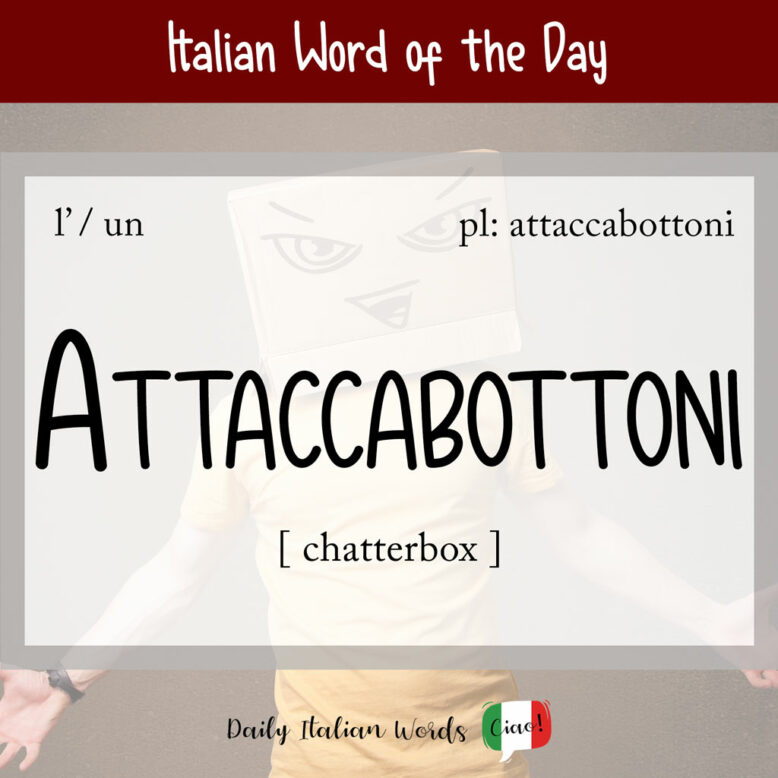
attaccabottoni
What exactly is an attaccabottoni in Italian?
An attaccabottoni is that person who approaches anyone and traps them in long, tedious conversations that simply won’t end. With an attaccabottoni it’s hardly ever a pleasant chiacchierata (chat), but more an endurance test.
They launch into long monologues regardless of whether the other person is genuinely interested or desperately trying to escape. You could say Beh, io vado (Well, I’m going) and start physically moving away, and they will follow you. They’re not necessarily rude, just relentlessly talkative and, well, exhausting.
Quella attaccabottoni del quinto piano mi ferma sempre sulle scale.
That chatterbox from the fifth floor always stops me on the stairs.
Why buttons?
There are a few scuole di pensiero (schools of thought) on why, of all things, we use buttons to describe someone who talks too much.
Theory #1: Trapped at the tailor’s shop
This is the most intuitive explanation. Back in the day, when people used to go to tailor’s shops for their fitted clothes, they had no choice but to stand perfectly still while the sarta/sarto (tailor) took measurements and sewed on the buttons. No phone to pretend to check, just them, the tailor, and nowhere to go. And by the time that last button was sewn on, they had a new shirt… and every detail of the tailor’s life story!
Theory #2: The ancient medical tool
This one is a bit more intense. Centuries ago, doctors used a tool with a rounded tip that resembled a button, which they heated over fire and pressed onto the wounds to stop the bleeding. Not exactly a pleasant experience, as you can guess. So, the idea is that being stuck listening to an attaccabottoni is a bit like having a hot iron pressed against our skin. A bit extreme, sure, but if you’ve ever been trapped hearing about someone’s digestive issues, the metaphor starts making sense!
Theory #3: Big talkers in the trenches
Then, there are those who believe the word was born in the trenches of World War I. Soldiers had to find ways to fill the time while waiting for the next order, and one common task was mending their uniforms, sewing buttons back onto jackets and shirts. And while they sewed, they talked about anything to keep their minds busy. Over time, the two images – sewing buttons and talking nonstop – blended together so much that they became impossible to separate.
Which theory is the right one, nobody knows for sure.
How to use attaccabottoni in a sentence
From a grammar point of view, attaccabottoni is a compound noun, formed by combining the verb attaccare (to attach) and i bottoni (the buttons). There couldn’t be a better image: this person “attaches” themselves to us like a button sewn onto a shirt, and if you’ve ever tried to rip a button off without scissors, you know exactly how that conversation feels!
It’s also an invariable word, meaning the form stays the same whether it’s feminine or masculine, singular or plural:
- Un attaccabottoni — a chatterbox (masculine singular)
- Una attaccabottoni — a chatterbox (feminine singular)
- Degli attaccabottoni — some chatterboxes (masculine plural)
- Delle attaccabottoni — some chatterboxes (feminine plural)
Non sopporto gli attaccabottoni che vogliono raccontarti tutta la loro vita.
I can’t stand people who won’t stop talking and insist on telling you their whole life story.
Ho incontrato quell’attaccabottoni della signora Rossi al supermercato, non la smetteva di parlare.
I ran into that chatterbox Mrs. Rossi at the supermarket, she wouldn’t stop talking.
Le nostre vicine di ombrellone sono delle attaccabottoni incredibili. Una volta ci hanno raccontato l’intero albero genealogico della loro famiglia!
Our beach umbrella neighbours are unbelievable chatterboxes. One time they even talked us through their entire family tree!
Some synonyms for attaccabottoni
Attaccabottoni is a great word, but in Italian we have a few interesting synonyms worth knowing:
Logorroico/a (over-talker): This word comes from logorrhea, which is a medical term for an excessive, uncontrollable flow of word or, as you’d say in English, verbal diarrhea. A logorroico is precisely someone who talks, and talks, with barely a pause to breathe. It can be used as both a noun and an adjective.
La nuova collega è veramente logorroica! (Adjective)
The new colleague is such an over-talker!
Samuele è un logorroico di prima categoria! (Noun)
Samuele is a world-class over-talker!
Lo scocciatore / Il seccatore (nuisance): These are nouns for someone who is a true pain in the neck. The subtle difference between these and attaccabottoni is that an attaccabottoni specifically holds us hostage with conversation, while a scocciatore or seccatore can drain our energy in all sorts of ways, not just by talking. The feminine forms are la scocciatrice and la seccatrice.
Oggi in aereo si è seduto di fianco a me uno scocciatore che non finiva più di parlare.
Today on the plane, a total nuisance sat next to me and wouldn’t stop talking.
Il chiacchierone / La chiacchierona (big talker, chatty): A chiacchierone is simply someone who loves to chat, a big talker. It can be used as both a noun and an adjective, and it’s not necessarily negative. Depending on context, it can be slightly annoying (like that uncle who won’t leave you alone at family dinners until he has explained how the economy works), or mostly playful and affectionate (like an adorable kid who always has a million things to say).
Simone è un bravissimo ragazzo, ma è un po’ troppo chiacchierone.
Simone is a really good guy, but he’s a bit too much of a talker.
The expression attaccare bottone
Besides the noun attaccabottoni, we also have the verbal expression attaccare bottone (literally, to attach a button), which means to strike up a conversation with someone, usually a stranger.
The vibe of attaccare bottone changes depending on the context (and the facial expression of the person telling the story usually gives it away!). With a little wink, attaccare bottone takes on a flirty edge, like “chatting someone up” in English:
Ieri sera al bar c’era un ragazzo carino e ho trovato il coraggio di attaccare bottone.
Last night at the bar there was a cute guy and I found the courage to chat him up.
But when it’s said with an eye roll, it means someone has cornered us in a conversation we never asked for:
Quel signore attacca bottone con chiunque, non riesce a stare zitto neanche in ascensore!
That man strikes up a conversation with anyone, he can’t keep quiet even in an elevator!
Besides attaccare bottone, we have a few more fun, slangy expressions for when someone corners us in painfully boring conversations:
- Attaccare un pippone: pippone is a very colloquial term we use to describe a massive flow of words, generally boring and often with a bit of a lecturing tone.
Ogni volta che usciamo, Stefano ci attacca un pippone sulla politica che non finisce più!
Every time we go out, Stefano launches into an endless rant about politics!
- Attaccare una pezza (literally, to attach a patch), meaning the person sticks to us with their endless talking like a patch ironed onto a pair of jeans… once it’s on, it’s not that easy to get it off!
Ieri al bar Elena mi ha attaccato una pezza sul nuovo ragazzo con cui sta uscendo.
Yesterday at the bar, Elena talked my ear off about the new guy she’s dating.
- Asciugare (literally, to dry), as in, the person is so relentlessly talkative that by the end of the conversation, they’ve totally dried us out with their words!
Ti prego, non mi asciugare anche tu con i tuoi problemi di lavoro oggi!
Please, don’t you drain me too with your work problems today!

Valentina Nicastro is a travel writer in love with her home country, Italy. Having travelled widely around the globe, she realised there was more to explore closer to home and decided to put the passport aside for a while. When she is not immersed in documenting Italy, you’ll find her donning her communication consultant hat, weaving words as a content writer and bridging linguistic divides as a translator.