
If an Italian tells you they have influenza, don’t immediately reach for the hand sanitiser. Yes, we might be home in bed, surviving on broth and re-rurns, but we could just as easily be casually letting you know we have certain power and connections. Because the word influenza in Italian wears two hats: it means both the flu and influence.
influenza
flu / influence
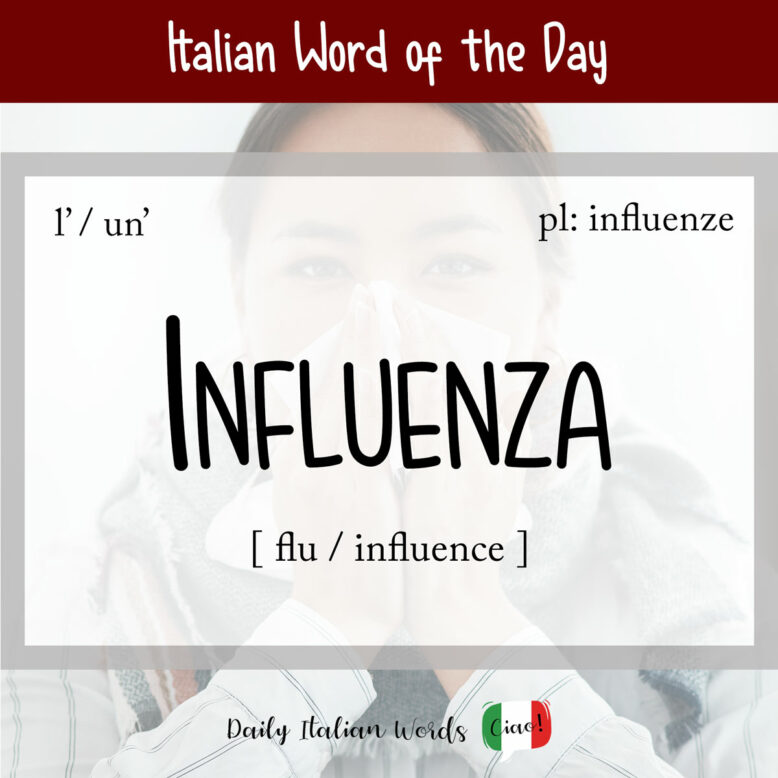
Before diving deeper into this word, first the grammar basics. Influenza is a feminine noun and here’s how it behaves:
- L’influenza (singular) — it’s la influenza, but because the word starts with a vowel, the definite article la drops the “a” and becomes l’.
- Le influenze (plural)
1. INFLUENZA = Flu
Let’s start with the medical meaning. Influenza is the Italian word for the flu, and yes, English has the same word too. In fact, English borrowed it straight from Italian back in the 1700s, after a nasty flu epidemic broke out in the country and eventually swept across Europe, vocabulary included!
The word comes from the Latin influere, meaning to flow in. Flow in from where? The stars. Medieval people didn’t really know what viruses and bacteria were, so they blamed the stars instead; they believed a mysterious force flowed down from the sky and caused illness. Wrong alignment of stars and planets, and boom – coughs, fevers, colds, all “flowing in” from the cosmos.
Even literature took this theory seriously. In Alessandro Manzoni’s classic novel I Promessi Sposi (The Betrothed), a “fatal conjunction of Saturn and Jupiter” gets blamed for the terrible plague of 1630.
Here are some types of influenza you might hear about:
- influenza stagionale = seasonal flu
- influenza intestinale = stomach flu
- influenza aviaria = bird flu
And here are some verbs and expressions we commonly use to talk about the flu:
- avere l’influenza = to have the flu
Ho l’influenza, non posso partire.
I have the flu, I can’t leave.
- prendere l’influenza = to catch the flu
Roberta non si sente bene, mi sa che ha preso l’influenza.
Roberta is not feeling well, I think she’s caught the flu.
- trasmettere l’influenza = to spread the flu
È consigliabile indossare una mascherina per ridurre il rischio di trasmettere l’influenza.
It’s recommended to wear a mask to reduce the risk of spreading the flu.
- essere a letto con l’influenza = to be in bed with the flu
Abbiamo mezzo ufficio a letto con l’influenza questa settimana.
Half the office is out sick with the flu this week.
- avere i postumi dell’influenza = to still be getting over the flu
Stasera non esco, ho ancora i postumi dell’influenza e zero energie.
I’m not going out tonight, I’m still getting over the flu and have no energy.
- C’è in giro un’influenza terribile quest’anno: There’s a nasty flu going around this year (announced every year like breaking news, even though it never is).

2. INFLUENZA = Influence, effect
Over time, we took that same idea of invisible power flowing in and applied it to something a lot less feverish: influence. This is the figurative meaning of influenza — having an impact or effect on someone or something.
I loro piatti hanno una chiara influenza francese.
Their dishes are clearly influenced by French cuisine.
Here are some of the most common expressions you’ll hear:
- avere influenza su qualcuno/qualcosa = to have an influence on someone/something
Quel tipo ha una pessima influenza su di lei.
That guy is a really bad influence on her.
- esercitare influenza su qualcuno/qualcosa = to have an influence on someone/something. It means the same as the expression above, just a bit more formal
Le sue teorie hanno esercitato una profonda influenza sul pensiero politico dell’epoca.
His theories had a profound influence on the political thought of the time.
- essere sotto l’influenza di qualcuno/qualcosa: to be under the influence of someone/something. This phrase can be used in two ways: figuratively, as in being shaped by something (sometimes even too shaped, in a way that feels like losing your own voice); or literally, as in being under the influence of some kind of substance.
Il ragazzo non sembrava lucido, probabilmente era sotto l’influenza di droghe.
The guy didn’t seem clear-headed, he was probably under the influence of drugs.
- subire l’influenza di qualcuno/qualcosa = to be influenced by someone or something.
Gli adolescenti subiscono molto l’influenza degli amici.
Teenagers are heavily influenced by their friends.
- la sfera di influenza = the sphere of influence. We generally use this expression to describe how far someone’s (or something’s) power or impact reaches.
Con l’acquisizione della nuova startup, l’azienda ha allargato la sua sfera di influenza sul mercato tecnologico.
With the acquisition of the new startup, the company expanded its sphere of influence in the tech market.
Finally, just like in English, we often pair influenza with specific adjectives to describe the nature of that impact:
- influenza negativa / cattiva influenza = bad / negative influence
Siete proprio una cattiva influenza! Mi fate sempre spendere troppi soldi.
You are such a bad influence! You always make me spend too much money.
- influenza positiva = positive influence
Viaggiare da solo in giro per il mondo ha avuto un’influenza positiva sulla sua capacità di adattamento.
Traveling alone around the world has had a positive impact on his ability to adapt.
- influenza crescente = growing / increasing influence
Non possiamo ignorare l’influenza crescente dei social durante le campagne elettorali.
We can’t ignore the growing influence of social media during election campaigns.
- influenza diretta / indiretta = direct / indirect influence
Il clima ha un’influenza diretta sull’agricoltura.
The climate has a direct influence on agriculture.
- influenza reciproca = mutual influence
Il rapporto tra i due artisti è sempre stato caratterizzato da un’influenza reciproca.
The relationship between the two artists has always been characterised by a mutual influence.


Valentina Nicastro is a travel writer in love with her home country, Italy. Having travelled widely around the globe, she realised there was more to explore closer to home and decided to put the passport aside for a while. When she is not immersed in documenting Italy, you’ll find her donning her communication consultant hat, weaving words as a content writer and bridging linguistic divides as a translator.