Italian Idiom: Avere le braccine corte (to be stingy)

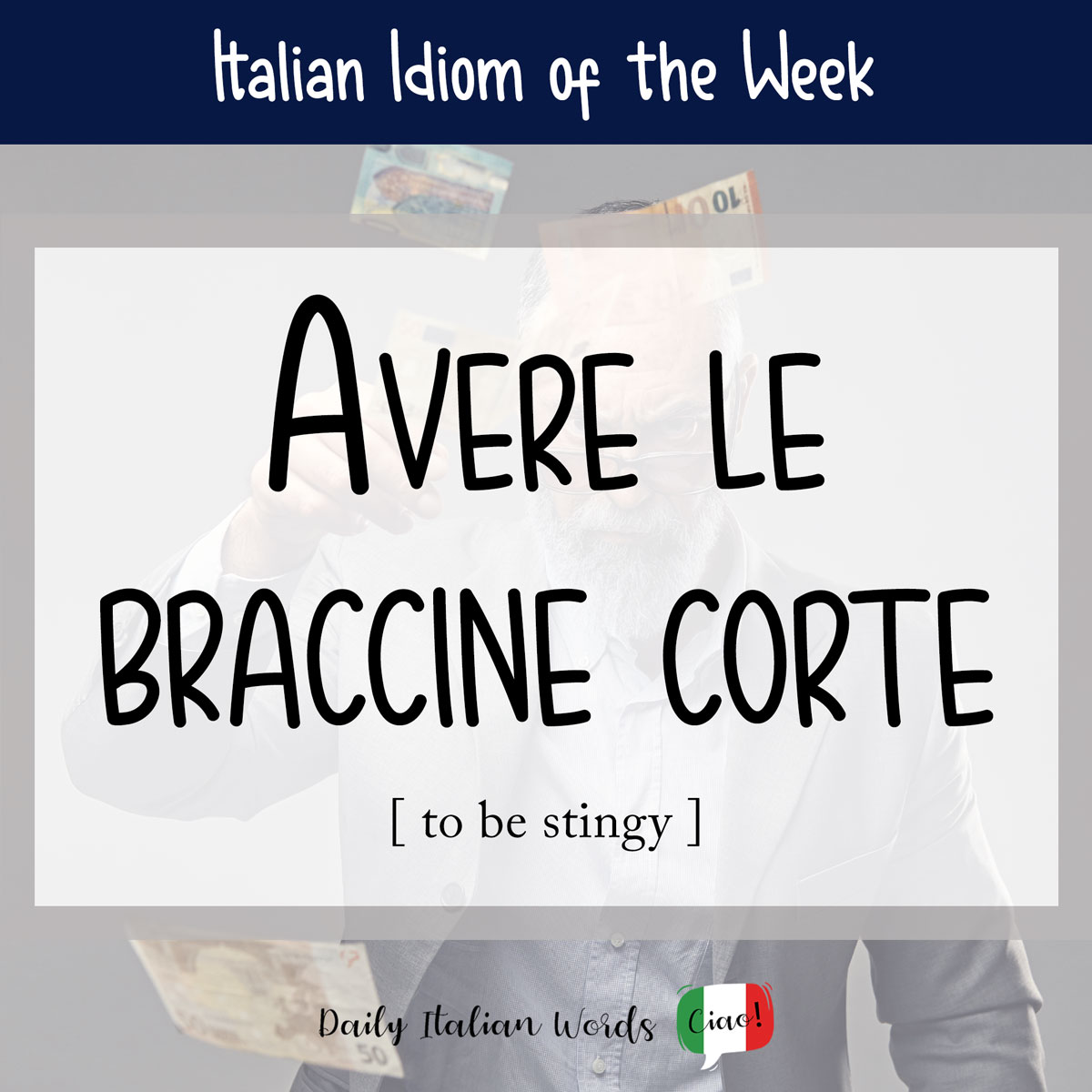
Italians have many ways to refer to someone who doesn’t like to spend money. You might be called spilorcio, taccagno, tirato, or tirchio. But if they want to sound more poetic, they’ll use the idiomatic expression avere le braccine corte. avere le braccine corte to have short arms Avere le braccine corte literally translates to …

Read more

Italian Word of the Day: Benessere (well-being)

Along with health, happiness, and other essentials, we seek physical and mental well-being to feel fulfilled in our lives. benessere well-being The Italian word for well-being is benessere, which is the mirror image of the English term – bene means well, and essere means being (as a noun) or to be (as a verb). Another …

Read more

Italian Word of the Day: Sonno (sleep / sleepiness)

If there’s one thing most of us likely don’t get enough of, especially those with young children, it’s sleep. The noun translates as sonno in Italian. sonno sleep / sleepiness The word comes from Latin somnus, which derives from Proto-Italic *swepnos and Proto-Indo-European *swépnos, rooted in *swep- meaning “to sleep.” It is a masculine noun …

Read more

Italian Idiom: Prenderci gusto (to develop a taste / take a liking)

If you try something new and find yourself enjoying it more and more despite initially thinking you wouldn’t, you might say that you’ve “developed a taste” or “taken a liking” to it in English. In Italian, there’s a similar expression: prenderci gusto. prenderci gusto to develop a taste / take a liking Prendere is an …

Read more

Italian Word of the Day: Bizza (tantrum / scene)

You might already know the very common word capriccio, but did you know there’s another Italian word for a tantrum or scene? That word is bizza! bizza tantrum / scene Bizza is a feminine noun that takes the following definite and indefinite articles: While capriccio is more generic, bizza tends to indicate a brief and …

Read more

Italian Word of the Day: Magro (thin / slim / light / scarce)

Some adjectives in Italian have only one straightforward meaning, while others encompass a range broader than you might anticipate. Magro is one such adjective! magro thin / light / scarce Since magro is an adjective, its ending changes based on the gender and number of the subject – magro (masculine, singular), magra (feminine, singular), magri …

Read more