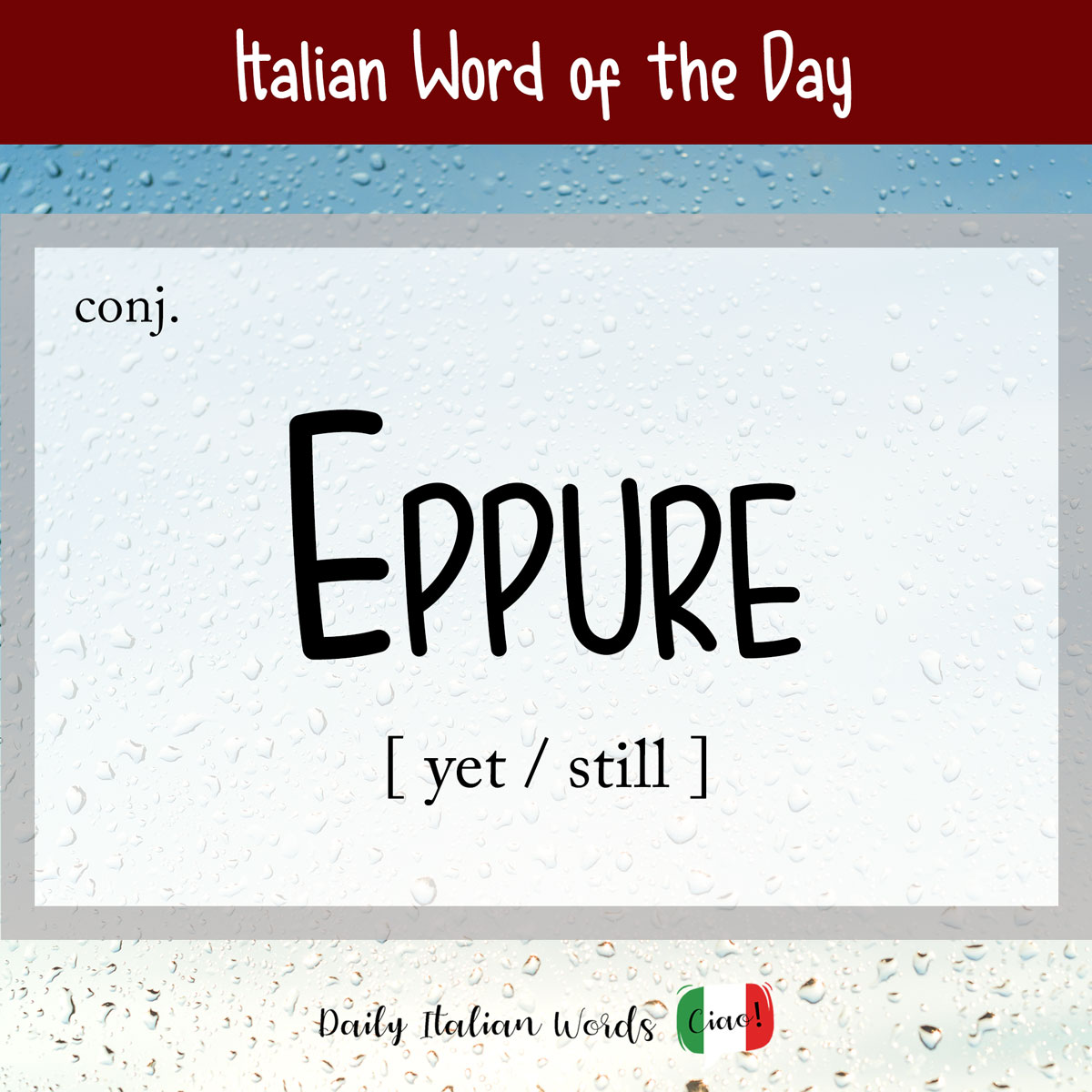
Italian Word of the Day: Eppure (yet / still / but)

If you find yourself tired of repeatedly using the conjunctions ma (but) and però (but / however), you might be interested in adding a more advanced conjunction to your vocabulary: eppure! In Italian, eppure is used to express a sense of contradiction or surprise. It is often translated as (and) yet, still or but in …

Read more

Italian Word of the Day: Bensì (but rather)

If you have started reading more advanced material in Italian, such as newspapers or journals, you will certainly have come across the word bensì. Composed of the words bene (good) and sì (yes), bensì is mainly used as a conjunction whose purpose is to introduce a statement that opposes or contradicts a previous statement. It …

Read more

Italian Word of the Day: Sogno (dream)

Dreams, those ethereal and enigmatic realms of our imagination, have captivated human minds for centuries. In the Italian language, the word for dream is sogno, which comes from the Latin word of the same meaning, somnium. Sogno, being a masculine noun, takes the following definite and indefinite articles: It is closely related to the verb …

Read more

Italian Word of the Day: Sovrappensiero (lost in thought)

Do you often find yourself a million miles away while listening to other people speak? Then today’s word is for you! Sovrappensiero is an adverb that means “lost in thought” “absent-mindedly” or “distractedly”. It is the combination of sovra- (a variant of sopra- meaning “above” or “over”) and pensiero (thought). The addition of the extra …

Read more

Italian Word of the Day: Carattere (character / personality)

In order to describe someone’s character, personality or disposition in Italian, you need to know the word carattere. Carattere has its etymology from the Latin word character and ultimately derives from the Greek term kharaktḗr, which means “a stamping tool”. It is a masculine noun that takes the following definite and indefinite articles: Bruno ha …

Read more

Italian Word of the Day: Giocoso (playful)

Italian word "giocoso"

In this article, we delve into the essence of the Italian adjective giocoso, which usually translates as playful or jovial. Giocoso is an adjective whose form changes depending on what it describes. In its masculine form, it ends in -o and in its feminine form, -a. The respective plurals are -i and -e. It comes …

Read more