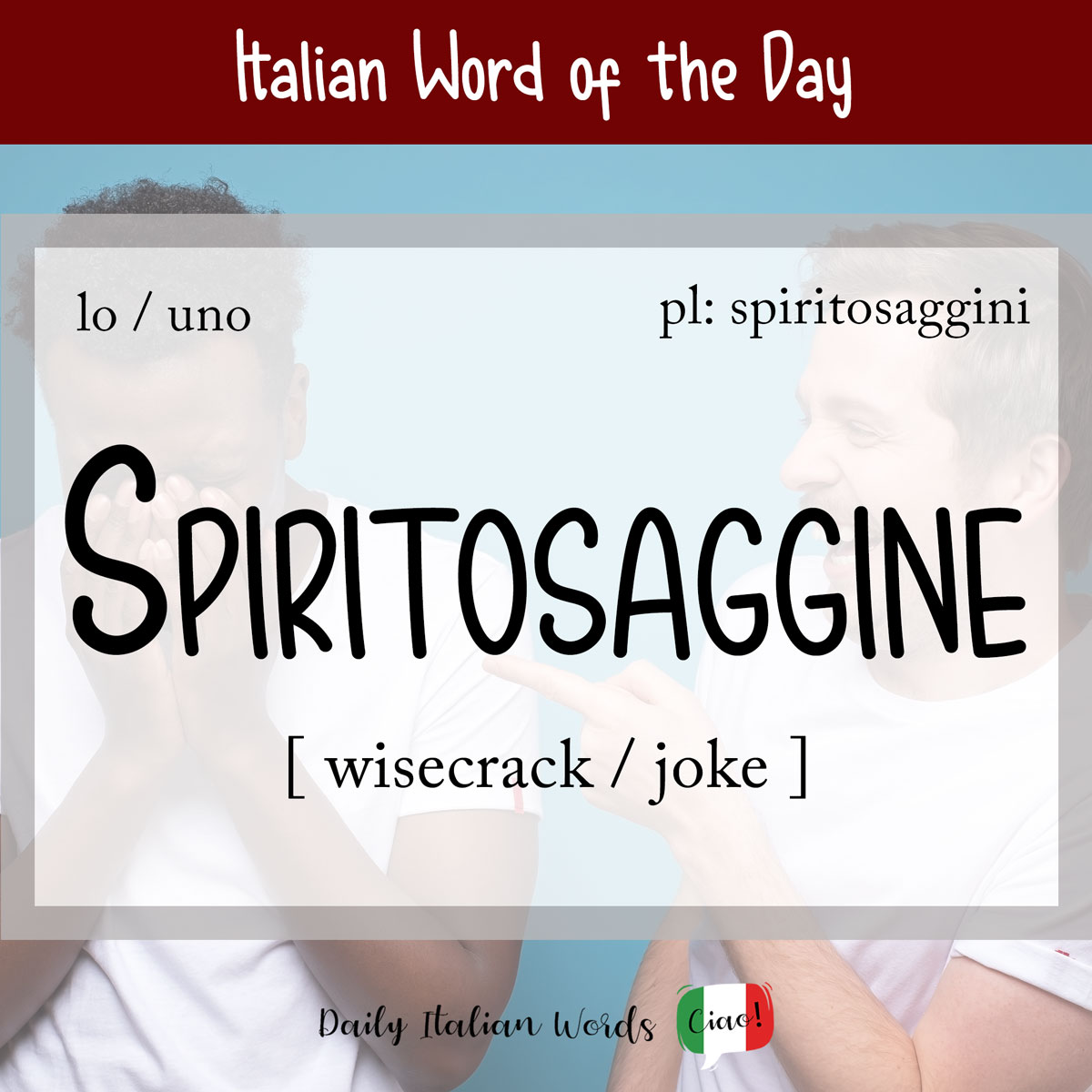
Italian Word of the Day: Spiritosaggine (wisecrack)

The Italian word for a joke that is silly or tasteless, or that is supposed to come off as witty but falls flat due to its inappropriateness, is the feminine noun spiritosaggine. Often used in its plural form spiritosaggini, it derives from the adjective spiritoso which can translate as either witty or smart-alecky depending on …

Read more

Italian Word of the Day: Senso (sense)

Today’s word of the day is senso which is a noun that derives from the Latin sensus meaning ‘faculty of thought, feeling and meaning’. Senso is masculine, and the plural is sensi. The definite and indefinite articles it takes are as follows: il sensothe sense un sensoa sense i sensithe senses dei sensi(some) senses Senso …

Read more

Italian Word of the Day: Etichetta (label / tag)

A term used to indicate “good manners” in many languages across Europe is etiquette, such as the Italian etichetta, the Spanish etiqueta and the French étiquette. It can be traced back to the old French estiquier / estiquer, meaning “to drive, affix, attach”. Owing to the addition of the diminutive suffix -etta in Italian, the …

Read more

Italian Word of the Day: Freddo (cold)

One of the very first Italian adjectives you should learn as a beginner is freddo, which means cold. ‘Freddo’ as an adjective As with all adjectives, the ending changes in accordance with the gender and/or number of the subject in question. Much like the English word cold, you can use freddo to describe anything characterised …

Read more

Italian Word of the Day: Spuntino (snack / bite to eat)

A spuntino in Italian can be defined as a quick, light snack eaten either between main meals or in place of one of them. According to Treccani, its etymology is unknown, whereas Il Devoto–Oli maintains that it derives from the word spunto. Spuntino is a masculine noun, and the plural is spuntini. lo spuntinouno spuntino …

Read more

Italian Word of the Day: Presentimento (feeling / presentiment)

Italian and English are full of cognates, but some are used more frequently in one language than in the other. This is certainly the case with the Italian word presentimento, which, unlike the English equivalent presentiment, occupies a valuable place in the core lexicon of most Italians. Presentimento, which can be defined as an intuitive …

Read more