
So, you’re heading to Italy and need to figure out how to catch a taxi without resorting to wild hand gestures and hopeful pointing? In this article, you’ll find some handy phrases and expressions to help you communicate with taxi drivers—things like how to give the directions, tell them that you want to get off, and engage in casual chit-chat along the way.
Dealing with taxis in Italy
Taxis in Italy are a true test of patience. While in other European cities you can get one in minutes, here you might find yourself standing in the rain for half an hour. Why? Well, there just aren’t enough taxis to meet demand.
The number of taxi licenses has been frozen for years. To give you an idea, Naples hasn’t issued new ones since 1998. Yes, that’s when Titanic was still in cinemas! The thing is, with a license costing over €150,000, existing drivers aren’t exactly cheering for more competition. More taxis on the road means lower license values, and no one wants to see their six-figure investment shrink. As for alternative services like Uber, let’s just say they’ve been met with strong resistance.
On top of this, unfortunately, some taxi drivers in Italy have a bit of a reputation, especially when it comes to tourists. If you’re not a local (or even if you are but hail from another region), there’s a chance they might try to scam you, like taking the “scenic route”… That said, there are also many wonderful taxi drivers who go above and beyond to make your ride pleasant and offer excellent service. For the purpose of this article, though, I’m generalising to make sure you’re aware of potential issues.
Moral of the story? Come prepared – with patience and a few key phrases!
Catching a taxi in Italy
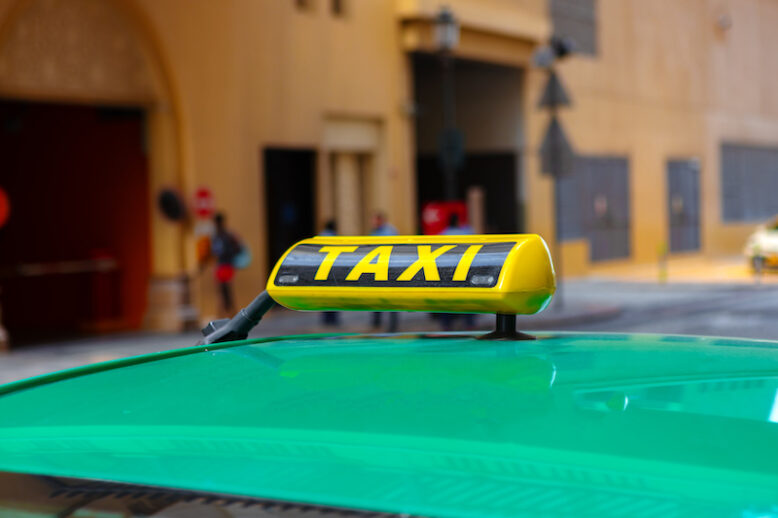
Forget standing on the street, arm raised, hoping for a cinematic taxi moment – this isn’t Sex and the City, and Italian cabs usually don’t work that way. The easiest way to get a taxi is to head to an official parcheggio taxi (taxi stand). You can usually find them outside stations, hotels, and major landmarks. Just look for a lineup of white cars with a TAXI sign.
Once you’ve spotted the stand, approach the first taxi in line and asks:
È libero?
Are you free?
If you can’t find a taxi stand nearby, you can ask someone:
Scusi, sa dirmi se c’è un parcheggio taxi qui vicino?
Excuse me, can you tell me if there is a taxi stand nearby?
How to book a taxi in Italy
If there’s no taxi stand in sight (or it’s the middle of the night and you’d rather not wander the streets), your next best bet is to call and book a taxi.
If you’re at a hotel or restaurant, you can ask the staff to do it for you by saying:
Può chiamarmi un taxi per favore?
Can you call a taxi for me, please?
And if you need to call yourself, here’s a handy phrase to memorize:
Salve, avrei bisogno di un taxi in + [specific address] / a [place of interest].
Hi, I need a taxi in [street name] / at [square, monument].
In most cases, they require to know your destination, in which case you can say:
Devo andare in + [specific address] / a [place of interest].
I need to go to…
Want to schedule a taxi for a specific time (like for an early morning flight)? Here’s the phrase to use:
Salve, vorrei prenotare un taxi per domani mattina alle 5:00.
Hi, I’d like to book a taxi for tomorrow at 5:00 AM.
Enquiring about the fare
For certain routes, such as between the city center and the airport or train station, taxis often have tariffe fisse (fixed fares). For instance, a ride from Rome Fiumicino Airport to the city center is currently a flat €55. That said, always double-check before hopping in to avoid any surprises:
C’è la tariffa fissa di 55 euro, vero?
There is a fixed fare of 55 euros, right?
In all other cases, you can ask how much the ride will cost with phrase like:
Quanto costa andare in + [specific address] / a [place of interest]?
How much does it cost to go to…?
If the driver hesitates, be cautious – it might mean they’re planning to cheat with the meter. In that case, you can politely insist:
Può dirmi la cifra approssimativa?
Can you give me the approximate price?
Giving directions to your Italian taxi driver
Once you’re in the taxi, it’s time to tell the driver where you’re headed. Keep it simple with one of these sentences:
Devo andare / Dobbiamo andare a + [place of interest]
I need / We need to go to…
Devo andare / Dobbiamo andare in + [specific address]
I need / We need to go to…
The more specific you are, the better. A general location might leave the driver guessing, which could mean extra questions or an inconvenient drop-off point. However, if you’re unsure of the exact address, keep an eye out through the window, and when you see your spot, simply say:
Mi lasci qui, per favore. / Ci lasci qui, per favore.
Please drop me off here. / Please drop us off here.
Scendo qui, grazie. / Scendiamo qui, grazie.
I’ll get out here, thanks. / We’ll get out here, thanks.
Talking with your taxi driver during the ride
If you find a chatty driver, the ride can be the chance to practice some Italian and score some precious tips you won’t find in your guidebook.
To break the ice, you could say:
Lei è di queste parti?
Are you from around here?
È da molto che fa il / la tassista?
Have you been a taxi driver for a long time?
Che traffico! È sempre così?
How much traffic, is it always like this?
Once you’re comfortable with your driver, you could ask:
Cosa mi / ci consiglia di vedere?
What do you recommend me/we see?
Mi / Ci può consigliare un buon bar / ristorante in zona?
Can you recommend me/us a good bar / restaurant in the area?
And here are other useful phrases you might need during the ride:
Potrebbe accendere/spegnere l’aria condizionata, per favore?
Could you turn on/turn off the air conditioning, please?
Potrebbe accendere/spegnere il riscaldamento, per favore?
Could you turn on/turn off the heating, please?
Come si apre/si chiude il finestrino?
How do you open/close the window?
Potrebbe abbassare il volume, per favore?
Could you lower the volume, please?
Le dispiace spegnere un attimo la radio, devo fare una telefonata.
Would you mind turning off the radio for a moment, I need to make a phone call.
Paying the taxi driver in Italy
You’ve reached your destination, now it’s time to settle the bill. Just ask:
Quant’è?
How much is it?
Quanto le devo?
How much do I owe you?
If you’re paying in cash and want to show your appreciation for a great ride by rounding up the fare, you can say:
Tenga pure il resto!
Keep the change!
And if you’re leaving a coin or a small note, simply say:
Tenga, questo è per lei!
Here, this is for you!
Instead, if you prefer to pay by card, you’ll need these phrases:
Posso pagare con la carta?
Can I pay by card?
Pago con carta.
I pay by card.
Quick heads up: While taxis are supposed to accept cards, some drivers might claim their machine is rotta (broken) or that la rete non va (the internet’s down)—which may or may not be true. If you want to pay by card, it’s always a good idea to mention it before starting the ride to avoid any surprises.
If you’re traveling for work and need a copy of the payment, just ask:
Ho bisogno di una ricevuta / fattura, per favore.
I need a receipt / invoice, please.
Some tips for catching a taxi in Italy
Never accept a ride from a driver who directly approaches you
This is a classic scam, especially around stations, airports, and tourist hotspots. A guy might approach you with a friendly smile, ask if you need a taxi, and then escort you to a regular car, far from the taxi stand. Or maybe you’ll hear a soft “Taxi, Taxi” as they silently try to catch your attention. These are unofficial taxis, often charging inflated prices and only accepting cash to keep the ride off the books. So, if a driver approaches you and is insistent, politely decline by saying:
No grazie, non ho bisogno.
No thanks, I’m okay.
Keep an eye on the meter
If you’ve called a taxi and notice the tassametro (meter) already shows a few euros when the car arrives, don’t worry, the driver is not trying to cheat. In Italy, once the driver accepts your call, the taxi meter starts, meaning you’re also paying for the time it takes for them to get to you. However, if you notice the meter isn’t on when you get in (a common trick), don’t let it slide and ask:
Ha acceso il tassametro?
Have you switched on the meter?
And if the driver claims the meter is rotto (broken – yes, they love using this word!), don’t buy it. In most cases, that’s an indication that they might be trying to overcharge you.
Using taxi apps
If you don’t feel confident with your Italian, a good idea is using a taxi app, which lets you type in your pickup location, destination, and get confirmation, all without the need for chatting. Some of the most popular taxi apps in Italy are FreeNow, WeTaxi, and InTaxi. If you’re in a major city, you might also find local options like Chiamataxi in Rome, but they are not always as effective as the big ones.
Tipping
Tipping the taxi driver in Italy is not compulsory nor expected. However, if the service is excellent or the driver is especially friendly and helpful, a small tip is always appreciated. Rounding up the fare or leaving €1 or €2 is perfectly fine.
Strikes
Strikes are another classic experience. Taxis in Italy aren’t only difficult to catch, they often go on strike, either locally or nationally, to protest against new regulations they think might increase competition. The good news is that strikes are usually announced in advance, so if you happen to be traveling on one of those days, try to avoid spostamenti (movement), or, if that’s impossible, consider booking a private driver (NCC service) instead.
Uber in Italy
Uber in available in bigger cities like Milan and Rome but only as Uber Black, a premium chauffeur service with upscale vehicles and higher fares compared to your usual Uber ride at home. Once again, it all comes down to taxi drivers and their concerns about competition. They claim that Uber is engaged in concorrenza sleale (unfair competition) because Uber drivers can simply use their private cars while taxi drivers have to invest in expensive licenses.

Valentina Nicastro is a travel writer in love with her home country, Italy. Having travelled widely around the globe, she realised there was more to explore closer to home and decided to put the passport aside for a while. When she is not immersed in documenting Italy, you’ll find her donning her communication consultant hat, weaving words as a content writer and bridging linguistic divides as a translator.