
Did you know that venire (to come) is the base for a series of everyday Italian verbs? By simply adding a prefix, we get words like intervenire (to intervene), prevenire (to prevent), or svenire (to faint). Today’s word, convenire, is part of this family of verbs, and it’s a very interesting one! Let’s explore all its meanings.
convenire
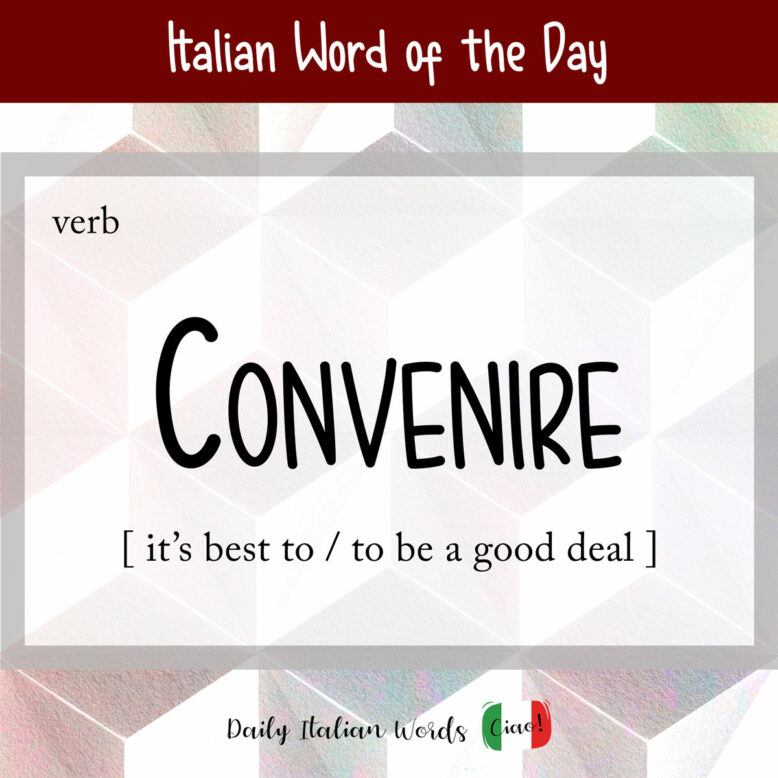
Before we begin, here is how convenire – which is an -IRE verb – conjugates in the present tense:
io convengo
tu convieni
lui / lei conviene
noi conveniamo
voi convenite
loro convengono
1. Convenire = To be a good deal, to be worth it (economically)
When we say something conviene, we mean it’s a good deal that saves us money or offers great value. So, when you spot a bargain, you can just say: Conviene! (It’s worth it!). You can use conviene in two main ways:
- By itself, to say something is or isn’t worth it, money-wise:
Fare il pieno qui non conviene: costa 10 centesimi in più al litro.
Filling up here isn’t worth it: it costs 10 cents more per litre.
Quei fondi non convengono più, meglio investire in altro.
Those funds aren’t a good deal anymore; it’s better to invest in something else.
- In the third person singular, followed by an infinitive to say it’s worth spending money on something:
Conviene comprare questa confezione, si risparmiano più di 3 euro!
It’s worth buying this pack, you save more than 3 euros!
Una volta conveniva acquistare le azioni di quella società, rendevano molto.
Buying that company’s shares used to be a smart move, they brought in a lot of profit.
2. Convenire = It’s best to
Besides talking about money, conviene is a handy verb for discussing the best thing to do. In this sense, it’s generally used impersonally in the third person singular (conviene). For example:
Conviene prendere la macchina, così arriviamo prima.
It’s best to take the car, we’ll get there faster.
Conveniva portare anche la giacca più pesante!
We should have brought the heavier jacket too!
Conviene chiamare e prenotare un tavolo perché quel ristorante è sempre pieno.
It’s better to call and book a table because that restaurant is always full.
Additionally, you can add an indirect object pronoun (like ti, vi, gli, le, etc.) before conviene to offer a friendly advice, similar to saying “it’s best for you…” or “you’d better…” in English.
Ti conviene dirle la verità, prima che venga a saperla da qualcun altro.
You’d better tell her the truth before she finds out from someone else.
Non vi conviene partire adesso, tra poco ci sarà il temporale.
It’s not a good idea to set off now; there’s a storm coming soon.
3. Convenire = To agree
In this usage, convenire conveys the idea of agreement, whether by going along with someone’s opinion or reaching a mutual understanding. It’s a more formal and elegant way to say essere d’accordo (to agree): while both verbs mean pretty much the same thing, essere d’accordo is common in everyday conversation, while convenire is used more in formal speech or writing.
Convengo con te che sarebbe stato meglio evitare quella battuta.
I agree with you that it would have been better to avoid that remark.
Procederemo come convenuto nel corso dell’ultima riunione.
We’ll proceed as agreed during the last meeting.
Durante la riunione abbiamo convenuto di organizzare incontri mensili con il nuovo cliente.
During the meeting, we agreed to organise monthly sessions with the new client.
It’s also frequently used impersonally, without a clear subject (like “it was agreed that…”), in phrases like:
Nel corso della conferenza si è convenuto di adottare misure più severe.
During the conference, it was agreed to adopt stricter measures.
Alla luce delle nuove normative, si conviene che tutte le pratiche vengano digitalizzate entro la fine dell’anno.
In light of the new regulations, it has been agreed that all procedures should be digitised by the end of the year.
Finally, convenire in this sense often appears with the particle ne (about it) to gently check if someone agrees with you, like saying “don’t you think?” or “wouldn’t you say so?” in English.
Questo ristorante ha perso un po’ di qualità ultimamente, ne conviene anche Lei?
The quality at this restaurant has dropped a bit lately, don’t you agree?
È l’unica cosa da fare per risolvere la situazione, ne convenite?
It’s the only thing to do to solve the situation, do you agree?
4. Convenire = To be suitable / appropriate
We also use convenire to talk about what’s appropriate or suitable in a situation, like someone’s behaviour, outfit, or choice of words. It’s a refined version of essere adatto (to be suitable).
In this sense, convenire generally appears in the reflexive form: si conviene (singular)or si convengono (plural).
Quel vestito non si conviene a un evento così formale.
That dress isn’t suitable for such a formal event.
Sono parole inaccettabili che non si convengono a un professionista del suo livello.
Those are unacceptable words, unbecoming of a professional of his level.
An elegant expression you may come across is come si conviene, which means “as is appropriate” or “as befits.” It’s a polished way to say something is done properly and fits the situation well.
È stato un discorso sobrio e misurato, come si conviene a un rappresentante delle istituzioni.
The speech was sober and measured, as befits a public official.
5. Convenire = To gather, to come together
Convenire can also mean people coming together in one place, usually for something official like a meeting, an event, or a ceremony. This meaning comes straight from its Latin roots: con- (together) and venire (to come), so it literally means “to come together.”
This meaning of convenire is less common in everyday conversation, but it’s still useful to know, especially when reading news, formal announcements, or official documents.
I capi di stato sono convenuti a Roma per il vertice internazionale.
The heads of state gathered in Rome for the international summit.
Nel pomeriggio, i cittadini sono convenuti in piazza per la processione.
In the afternoon, citizens gathered in the square for the procession.
From this formal use of convenire comes the term convenuto, which has two main meanings:
- A participant in a meeting or event.
Dopo i saluti ufficiali, i convenuti hanno preso posto.
After the official greetings, the participants took their seats.
- The defendant in a civil case.
Il convenuto deve presentarsi al processo secondo le modalità contenute nell’atto di citazione.
The defendant must appear in court according to the instructions in the summons.

The adjectives CONVENIENTE and SCONVENIENTE
From convenire, we get two adjectives that are common in everyday Italian: conveniente and sconveniente. Both have to do with the idea of something being suitable, fitting, or advantageous, but conveniente has a positive connotation, while sconveniente has a negative one.
Conveniente has two key meanings, depending on the situation:
- It can describe something that is a good deal or advantageous in general. In this sense, we use it for anything that gives us a clear gain, whether it’s saving some money, time, or effort.
Questo nuovo piano telefonico è davvero conveniente.
This new phone plan is really a good deal.
Something conveniente could be for instance:
- Un prezzo conveniente: a reasonable price
- Una proposta conveniente: an attractive offer
- Una soluzione conveniente: a good solution
- Un affare conveniente: a good deal
- Una posizione conveniente: a convenient location
- It can also refer to something that is appropriate for a particular situation.
Per questo tipo di evento, un abbigliamento formale è sicuramente più conveniente.
For this kind of event, formal attire is definitely more suitable.
On the other hand, sconveniente indicates something that crosses the line or makes us feel uncomfortable, like saying “inappropriate” or “improper” in English.
Trovo sconveniente parlare di soldi in una situazione del genere.
I find it inappropriate to talk about money in a situation like this.

Valentina Nicastro is a travel writer in love with her home country, Italy. Having travelled widely around the globe, she realised there was more to explore closer to home and decided to put the passport aside for a while. When she is not immersed in documenting Italy, you’ll find her donning her communication consultant hat, weaving words as a content writer and bridging linguistic divides as a translator.