
Depending on the context, cotto in Italian can refer to the food in your plate, your energy level, your crush or even your tiles at home. Pretty versatile, right?
cotto
cooked / exhausted / in love
Let’s explore the main meanings of this adjective and how it’s used:
1. COTTO = Cooked / baked
First, the “food” meaning because, well, this one is the easiest to digest (pun very much intended!).
In this context, cotto is the opposite of crudo (raw):
La bistecca è ben cotta, come piace a te!
The steak is well cooked, just the way you like it!
But cotto is also the past participle of the verb cuocere (to cook, to bake), which means you’ll often see it used when talking about things that have been cooked:
Le patate sono state cotte sulla brace.
The potatoes were cooked on the grill.
Some expressions you might hear include:
- Cotto a vapore: steamed
- Cotto in umido: slow-cooked / stewed
- Ben cotto: well-cooked
- Stracotto: overcooked; it can also be a noun referring to a specific dish, the beef stew
- Verdure cotte: steamed vegetables
- Mele cotte: steamed apples
- Panna cotta: the delicious creamy Italian dessert (literally “cooked cream”)
- Salame cotto: cooked salami
- Vin cotto: literally “cooked wine,” this is a sweet, thick grape syrup made by slowly cooking grape must

2. COTTO = Exhausted
Cotto can also describe how you feel when when your energy has completely run out. You can use it when you want to sound casual and just a little dramatic, as if you’ve been through an epic ordeal.
Siamo cotti, abbiamo lavorato tutto il giorno nell’orto.
We are wiped out, we’ve been working in the vegetable garden all day.
Sono ancora cotto dopo il trekking di ieri, è stato davvero tosto!
I’m still exhausted after yesterday’s hike, it was seriously tough!

3. COTTO = Smitten, madly in love
Now let’s move into sweeter territory: another meaning of cotto is being hopelessly, ridiculously in love. Think of someone walking around in a permanent daydream, doodling hearts in the margins and sighing dramatically – that’s how smitten someone cotto can be!
Stefano è cotto della sua compagna di classe.
Stefano is completely smitten with his classmate.
To emphasise just how in love someone is, you can pair cotto with innamorato:
Ammettilo, sei innamorato cotto!
Admit it, you’re totally head over heels!
In this context, you might also encounter cotta (feminine), which is a noun meaning “crush.”
Tua figlia è stata la prima cotta di Simone.
Your daughter was Simone’s first crush.
We typically use it in the expression avere una cotta per qualcuno (to have a crush on someone):
Al liceo avevo una cotta pazzesca per Marco, il mio compagno di banco.
Back in high school, I had a huge crush on Marco, my desk mate.

4. COTTO = Baked ham
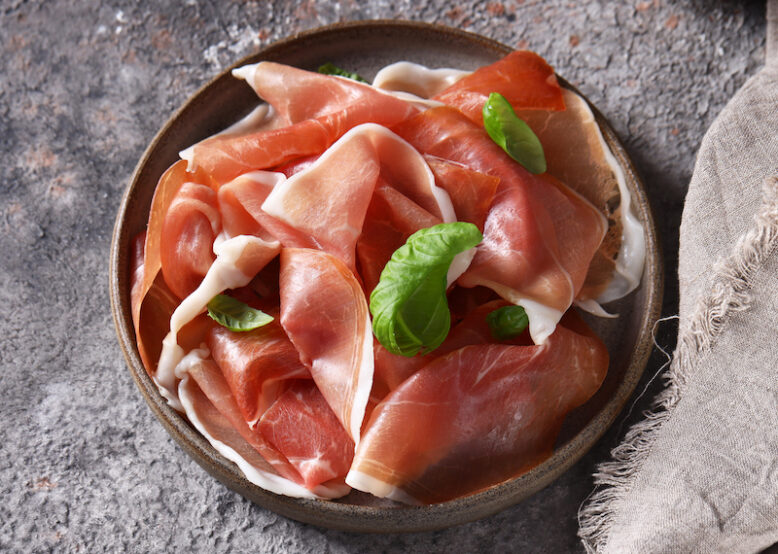
Cotto is also a useful word for your grocery adventures in Italy. It’s short for prosciutto cotto (baked ham) and it’s super common to hear it at deli counters or in sandwich shops.
Quando vai al supermercato, ricordati di prendere anche un etto di cotto.
When you go to the supermarket, remember to grab 100 grams of ham too.
When it comes to sandwiches, the classic choice is usually between cotto (cooked ham) and crudo (cured ham):
Come lo vuoi il panino? Con il crudo o con il cotto?
How do you want your sandwich? With cured ham or with cooked ham?
Some common expressions include:
- Una fetta di cotto: a slice of ham
- Un panino al cotto: a ham sandwich
- Cubetti di cotto: diced ham
5. COTTO = Cotto tile
Cotto also appears in the world of interior design. Here, it refers to terracotta tiles or objects with that warm, earthy reddish-brown hue that instantly add charm.
La casa che abbiamo acquistato ha dei bellissimi pavimenti in cotto antico.
The house we bought have beautiful antique terracotta floors.
Some typical uses:
- Pavimento in cotto: terracotta floor
- Piastrelle in cotto: terracotta tiles
- Mattoni in cotto: terracotta bricks
- Vaso in cotto: terracotta pot
Other common expressions with “cotto” in Italian
Last but not least, we use cotto in a number of funny expressions:
Di cotte e di crude: literally “of cooked and raw things,” this colloquial expression means “all sorts of things” – usually the bad, messy, chaotic kind that makes you sigh and roll your eyes! It’s commonly used with these verbs:
- Farne di cotte e di crude: to get up to all sorts of things
- Combinarne di cotte e di crude: to get up to all sorts of things
- Dirne di cotte e di crude: to say all sorts of things
- Sentirne di cotte e di crude: to hear all sorts of things
- Vederne di cotte e di crude: to see all sorts of things
Erano molto arrabbiate con lei, gliene hanno dette di cotte e di crude.
They were very angry with her and told her all sorts of things.
Facendo questo lavoro, ne ho viste veramente di cotte e di crude!
Doing this work, I’ve really seen all sorts of things!
Cascare come una pera cotta: literally “to fall like a cooked pear.” We use this to describe falling completely, either physically (in a clumsy way) or figuratively, in the sense of being easily fooled.
Abbiamo fatto uno scherzo a Paolo e lui ci è cascato come una pera cotta!
We played a prank on Paolo, and he completely fell for it!
Cotto e mangiato: literally “cooked and eaten,” this expression usually describes simple recipes. Thanks to this cooking show, it’s basically become a way of saying “instantaneous culinary magic!”

Valentina Nicastro is a travel writer in love with her home country, Italy. Having travelled widely around the globe, she realised there was more to explore closer to home and decided to put the passport aside for a while. When she is not immersed in documenting Italy, you’ll find her donning her communication consultant hat, weaving words as a content writer and bridging linguistic divides as a translator.