In Italian, danno can be a masculine noun (il danno in the singular form, i danni in the plural) or a verb. The trick to figuring out which one you’re dealing with is context, and especially the article: if you see il or un danno, you’re looking at a noun. No article, then it’s a verb.
danno
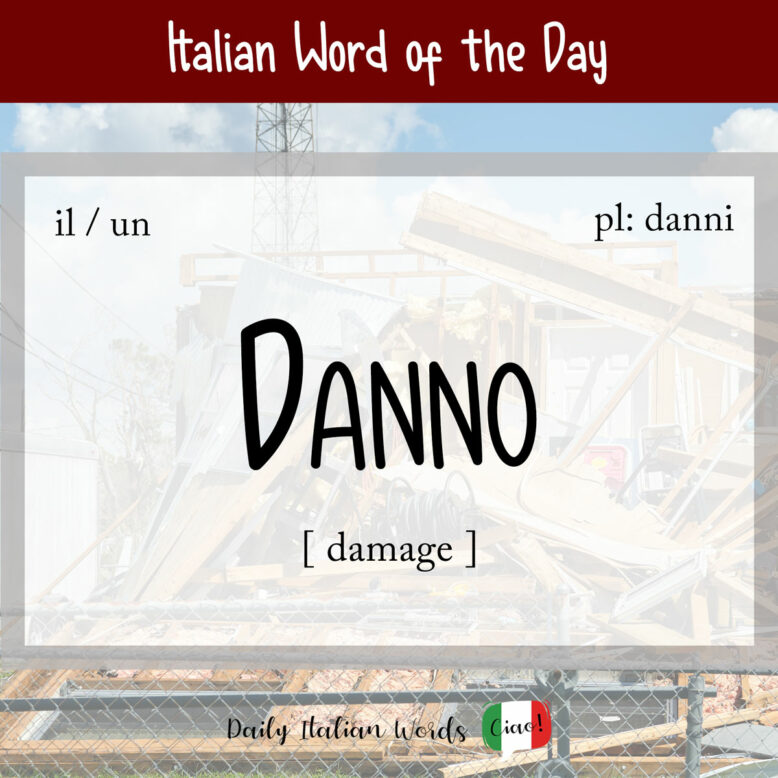
Let’s explore the main ways this word is used:
1. DANNO = Damage, harm
At its core, danno means some kind of damage, anything from a minor headache to a total disaster.
Il danno all’antenna è stato causato da un fulmine.
The damage to the antenna was caused by lightning.
You’ll commonly see it combined with adjectives like:
- Danno lieve: minor damage
- Danno grave: serious damage
- Danno collaterale: collateral damage
- Danno irreparabile: irreparable damage
- Danno ingente: massive damage
- Danno incalcolabile: incalculable damage
- Danno d’immagine: damage to one’s image/reputation
You can talk about causing or suffering un danno with expressions like:
- Causare un danno: to cause damage
L’incendio di ieri ha causato danni ingenti alle case vicino al parco.
Yesterday’s fire caused major damage to the houses near the park.
- Procurare un danno: to cause damage (similar to causare)
La caduta del ramo ha procurato danni alla recinzione del vicino.
The fall of the branch caused damage to the neighbour’s fence.
- Arrecare danno: to cause damage, to harm
Certi prodotti possono arrecare danni all’ambiente.
Certain products can harm the environment.
- Subire un danno: to suffer damage
L’azienda ha subito un danno reputazionale non indifferente.
The company suffered significant reputation damage.

2. DANNO = Damage / offence (in the legal sense)
In legal contexts, danno refers to harm caused to someone else by behavior that goes against the law.
Some of the most common categories include:
- Danno materiale: material/physical damage
- Danno morale: moral damage
- Danno fisico: physical damage
- Danno biologico: biological damage
- Danno esistenziale: existential damage
- Danno ambientale: environmental damage
- Danno economico: economic, financial loss
- Danno contrattuale: contractual damage
- Danno patrimoniale: property damage
- Danno reputazionale: reputation damage
And here are some very common expressions you’ll hear in this context:
- Chiedere i danni: to claim damages
Il lavoro è stato fatto male e adesso ho perdite in tutta la casa. Chiederò i danni!
The work was done poorly and now I have leaks all over the house. I’ll claim damages!
- Risarcire i danni: to pay damages, to compensate for damages
Dopo il nubifragio, il comune ha promesso di risarcire i danni alle case allagate.
After the storm, the municipality promised to compensate for the damages to the flooded houses.
- Risarcimento danni: damage compensation
Il tribunale ha condannato al risarcimento danni l’azienda che ha licenziato ingiustamente il dipendente.
The court ordered the company that unfairly fired the employee to pay compensation for damages.
3. DANNO = Impairment (in medicine)
The word danno is also very common in medical language. Here, it’s used as a general term to indicate damage or injury to a part of the body, whether caused by illness, an accident, medical error, or what we call malasanità (poor healthcare).
Typical expressions include:
- Danno permanente: permanent damage
La malattia gli ha causato un danno permanente al braccio sinistro.
The illness caused permanent damage to his left arm.
- Danno a carico di: damage affecting (a specific system/organ)
In seguito all’incidente, Anna ha riportato un grave danno a carico dell’apparato muscolo-scheletrico.
Following the accident, Anna suffered serious damage to her musculoskeletal system.
- Danno funzionale: functional impairment
Il medicinale può provocare un danno funzionale ai reni.
The medicine can cause functional impairment of the kidneys.
4. DANNO = They give
And now, the verb: danno is the third person plural, present tense of dare (to give).
In quella profumeria danno sempre tanti campioni gratuiti.
In that perfumery they always give out lots of free samples.
Sono bravi ragazzi, danno sempre una mano quando c’è bisogno.
They’re good guys, they always lend a hand when needed.

5. DANNO = I damn
Less common, but still worth knowing: danno can also be the first person singular of dannare (to damn), meaning “I damn.” In everyday Italian, though, you’ll mostly encounter this verb in reflexive or idiomatic forms like dannarsi (to torment oneself, to get worked up) or far dannare (to drive someone crazy).
Non dannarti l’anima per problemi che non puoi controllare.
Don’t torment yourself over problems you can’t control.
I bambini litigano in continuazione, mi fanno dannare!
The children fight constantly, they drive me crazy!
Other expressions with DANNO in Italian
In Italian, we have a few expressions built around danno, such as:
- Oltre il danno, la beffa: adding insult to injury. We use this phrase to express frustration when, on top of damage or loss, something happens that makes the situation even worse.
Il giudice gli ha dato ragione, ma nel frattempo l’azienda è fallita e non potrà risarcirlo – oltre al danno, la beffa!
The judge ruled in his favor, but in the meantime the company went bankrupt and can’t compensate him – adding insult to injury!
- Fare danni: to cause trouble or mess things up. We typically use this expression jokingly with friends.
Tu stai fermo lì e non toccare niente, che fai solo danni!
Stay right there and don’t touch anything, you’ll only mess things up!
- Ormai il danno è fatto: literally, “the damage is done,” or in everyday English, “what’s done is done.” It’s used to say the harm is already done, and there’s no point dwelling on it because there’s just no going back. Fun fact: in casual chats, we also like to say ormai la frittata è fatta (the omelet is done), because, well, once the eggs are broken, you can’t put them back together, right?
Ormai il danno è fatto, cerchiamo almeno di limitare le conseguenze.
What’s done is done, let’s at least try to limit the consequences.
- A danno di qualcuno o qualcosa: to the detriment of / at the expense of someone or something
La nuova norma rischia di favorire le aziende più grandi a danno dei piccoli artigiani.
The new rule risks favouring larger companies at the expense of small artisans.
- Chi dice donna, dice danno: literally, “who says woman, says damage.” This is an old proverb that some men still throw around, more or less jokingly, to suggest that women spell trouble. Obviously inappropriate, but worth knowing in case you come across it.
Lastly, from danno come some other useful words:
- danneggiare: to damage
I forti temporali degli ultimi giorni hanno danneggiato il tetto della casa.
The recent storms damaged the roof of the house.
- danneggiato: damaged
La mia valigia è arrivata danneggiata in aeroporto.
My suitcase arrived damaged at the airport.
- dannoso: harmful
Passare ore al sole senza protezione è dannoso per la salute.
Spending hours in the sun without protection is harmful to your health.

Valentina Nicastro is a travel writer in love with her home country, Italy. Having travelled widely around the globe, she realised there was more to explore closer to home and decided to put the passport aside for a while. When she is not immersed in documenting Italy, you’ll find her donning her communication consultant hat, weaving words as a content writer and bridging linguistic divides as a translator.