It can sum up a point, show hesitation, express annoyance, or even say “not really” without saying it. Insomma, do you know how to use insomma in Italian?
If you’ve been learning Italian or simply love the language and culture, chances are you’ve stumbled across this curious adverb. We use it everywhere, but it doesn’t have just one meaning. In fact, it can mean quite a few different things, depending on the situation and the way it’s said.
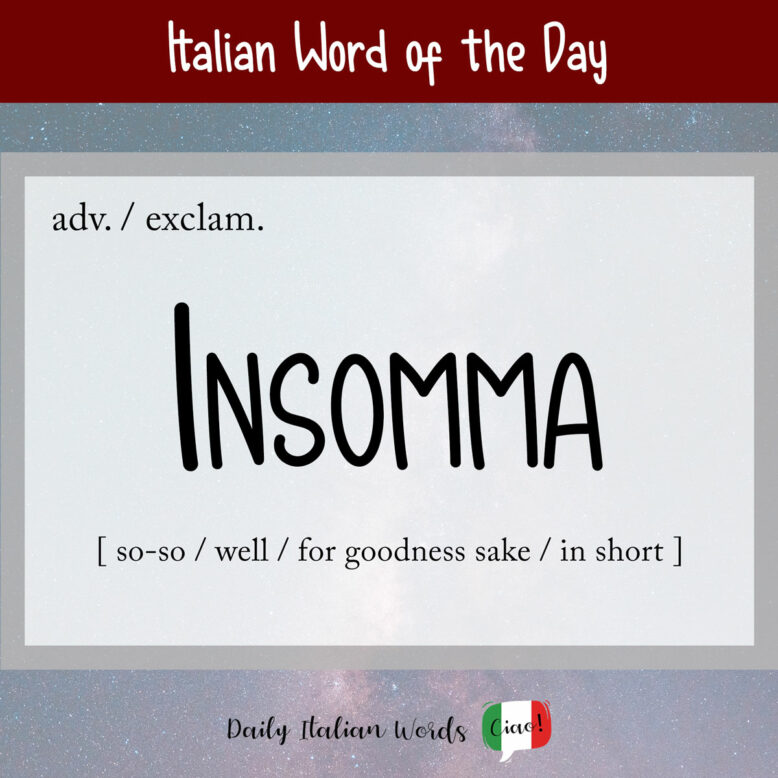
1. Insomma = So-so
One of the most common uses of insomma in Italian is to give a mild or not-so-enthusiastic opinion about something. Think of it as the Italian way of saying “meh.” We say it when we’re not totally satisfied with something, like in this exchange:
A: Ti è piaciuto il libro? (Did you like the book?)
B: Insomma… il finale è stato un po’ una delusione. (So-so… the ending was kind of a letdown.)
Or maybe we sort of liked something, but not enough to rave about it:
A: Ti è piaciuta la bistecca? (Did you like the steak?)
B: Insomma… si sente che la carne è buona, ma l’hanno cotta un po’ troppo (So-so… you can tell the meat is good quality, but they overcooked it a bit)
In this meaning, insomma is also a typical answer to the classic Come stai? (How are you?) in everyday conversations with friends, coworkers, or family. Basically, it’s a way of saying that you’re fine but not amazing. Maybe you’re just tired or having one of those days, like in this example:
A: Ehi, come va? (Hey, how’s it going?)
B: Insomma… potrebbe sempre andare meglio! (So-so… it could always be better!)
On a cultural note, we often pair this kind of insomma with a specific hand gesture: we keep the hand open and then gently swing it to the right and left, as if to visually say “so and so.”
2. Insomma = In short, basically, to sum up
Another common (and more literal) use of insomma is to wrap things up. This meaning is the closest to the original roots of the word: in (in) + somma (sum, total). We usually say it at the end of a list of points or ideas to tie everything together and express the main point that sums them all.
A: Com’è andata ieri sera con Cristina? (How was last night with Cristina?)
B: Davvero bene! Lei è gentile, simpatica, bellissima… insomma, è perfetta! (Really great! She’s kind, funny, beautiful… basically, she’s perfect!)
3. Insomma = For goodness sake / Come on
Now we’re entering the land of exasperation and impatience. In this third meaning, insomma is an exclamation, often delivered with raised eyebrows and a sharp tone. We use it to express irritation or frustration about something that’s bothering us and that we want to point out. Think of it like saying “For goodness’ sake!”, “Seriously?”, or even just “Ugh, come on!” in English.
Insomma! Fate un po’ di silenzio per favore, non si sente niente!
For goodness’ sake! Please be quiet, we can’t hear a thing!
Even though the tone of voice conveys most of the message here, we often add a ma (but) before insomma to make the expression more dramatic.
Ma insomma, smettetela di lamentarvi sempre per ogni cosa!
Oh come on, stop complaining about every little thing!
However, this version of insomma isn’t always negative. It can also express impatience mixed with curiosity or excitement, especially when you’re dying to know something and can’t wait anymore:
Insomma, mi dite dove stiamo andando?
Come on, will you tell me where we’re going?
4. Insomma = So?
Sometimes insomma can be used as a quick, standalone question to push for an answer. It’s usually delivered with an expectant and slightly pushy tone, like saying “So?” or “Well?”. The word Quindi? (So?) is often used in the same way.
For example, if you’ve been waiting too long for an explanation or just a clear answer, you might say:
Insomma? Mi vuoi rispondere o no?
So? Are you going to answer me or not?
Or maybe someone is building suspense, and you are dying to know what happened:
A: E poi? Vi siete baciati o no? (And then? Did you kiss or not?)
B: …
A: Insomma?! (So?!)
5. Insomma = Well
Finally, insomma can act as a filler word, similar to “well” or “you know” in English. In this role, it helps keep the conversation flowing when we need a second to think and choose our words, or want to be a little vague or diplomatic. It can be positioned pretty much anywhere in a sentence, there are no strict rules.
A: E tu cosa pensi della sua idea? (And what do you think of her idea?)
B: Ma… insomma… non lo so… potrebbe funzionare, ma non senza qualche rischio (Mmm…well… I don’t know… it might work, but there’s some risk involved)

Valentina Nicastro is a travel writer in love with her home country, Italy. Having travelled widely around the globe, she realised there was more to explore closer to home and decided to put the passport aside for a while. When she is not immersed in documenting Italy, you’ll find her donning her communication consultant hat, weaving words as a content writer and bridging linguistic divides as a translator.