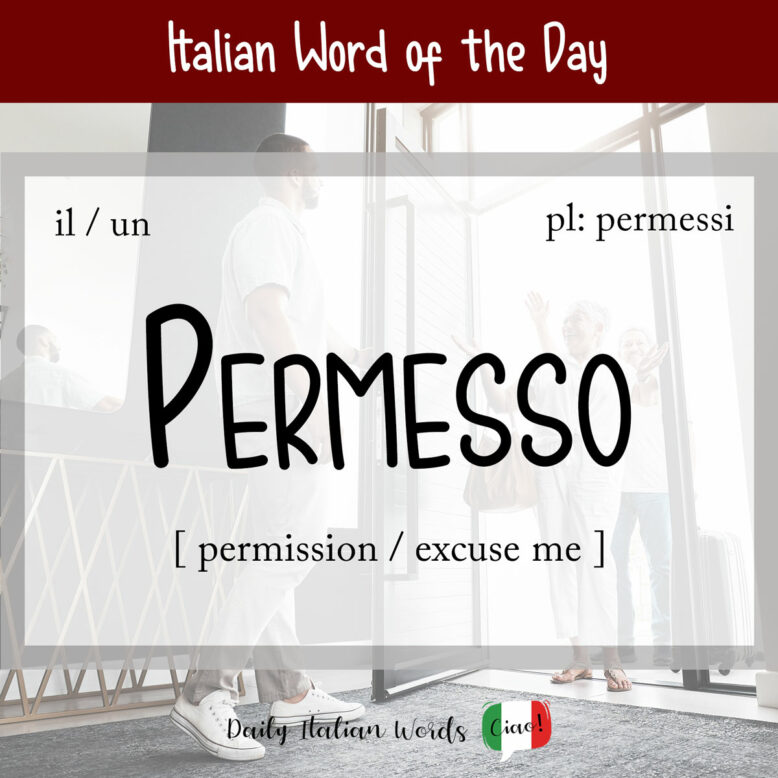
Permesso looks and sounds a lot like the English permission, and yes, they’re related. But this word has a couple more layers to explore.
permesso
permission / excuse me / may I…?
Grammatically speaking, permesso is the past participle of the verb permettere, which means to allow, to authorise, or, when used reflexively as permettersi, even to afford.
It’s a masculine noun, and its plural is permessi. It’s used with the following definite and indefinite articles:
- il permesso
- un permesso
- i permessi
- dei permessi
Now, let’s explore the three main ways permesso can be used in Italian.
1. Permesso = permission to do something
At its core, permesso means permission, a verbal or written authorisation to do something. Just like in English, it refers to that little green light from someone in charge that says “go ahead,” whether it’s permits, authorisations, or licenses.
You’ll hear it in phrases like:
- Chiedere un permesso – to ask for permission
- Concedere un permesso – to grant permission
- Ottenere un permesso – to obtain permission
- Negare un permesso – to deny permission
- Ritirare il permesso – to revoke permission
- Essere in permesso – to be on leave
Abbiamo chiesto i permessi al comune per iniziare i lavori di ristrutturazione.
We asked the municipality for the permits to start the renovation work.
I professori non ci danno il permesso di usare il cellulare in classe.
The teachers don’t allow us to use our phones in class
Le autorità hanno negato il permesso per la manifestazione.
The authorities denied permission for the demonstration.
And here are some types of permessi (permits) you might come across:
- Permesso di circolazione – traffic permit (for instance for those dreaded ZTL zones in Italian cities!)
- Permesso di soggiorno – residency permit (a must-have for many planning to live in Italy)
- Permesso di lavoro – work permit (for non-EU citizens seeking legal employment)
- Permesso di caccia – hunting license
- Permesso di pesca – fishing license
- Permesso retribuito– paid leave
- Permesso non retribuito – unpaid leave
- Permesso premio – bonus leave, usually granted for good behavior (often used in prison contexts, but also applies in some work or military settings)
- Giorno di permesso – day off
Just a heads up: When you want to ask permission to do something, you don’t use permesso. Instead, you need to use the verb potere (can, to be able to), for example: Posso uscire prima oggi? (Can I leave early today?).
2. Permesso = Excuse me, coming through!
The second way to use permesso in Italian is to excuse yourself when you need to squeeze past someone, like on packed buses, crowded markets, or between tables at a busy café. It’s the equivalent of saying “excuse me” in English. Depending on how you say it, it can sound super polite or a bit impatient, like “Hey, move it!”
For example, when you’re trying to get off a crowded bus and there’s someone blocking the door, you can say:
- Permesso! – Excuse me!
- Permesso, posso passare? – Excuse me, may I pass?
- Permesso, mi fa passare per favore? – Excuse me, could you please let me through?
To make it even more polite, try:
- Permesso, mi scusi – Excuse me, sorry
- Permesso, scusate – Same idea, but plural
Permesso, scusate, devo solo raggiungere il mio tavolo laggiù in fondo.
Excuse me, sorry, I just need to get through to reach my table there at the back.

You might also come across con permesso (which literally means “with permission”), but it’s a bit on the formal side. It’s what you’d say before doing something that might seem impolite if you didn’t ask first, like stepping away from a conversation at a professional event because you’re needed elsewhere. In casual, everyday moments, though, permesso is all you need: short and perfectly polite.
Con permesso, devo raggiungere il mio collega per la presentazione.
Excuse me, I need to join my colleague for the presentation.
3. Permesso = May I come in?
The third way of using permesso in Italian is when you’re about to enter someone’s home or office, whether it’s your best friend’s place, your manager’s office, or the doctor’s studio. It’s the Italian way of politely asking, “May I come in?”
Here are a few common ways to say it:
- Permesso? – May I come in?
- Permesso, si può? – May I? Is it allowed?
- È permesso? – Is it allowed?
Now, there’s a slight difference depending on the situation:
- If you’re entering a friend’s home, permesso is more of a friendly ritual than a real question. You say it while stepping inside, no need to wait for a reply (your hosts will probably just smile and say Prego, entra pure! – Go ahead, come in!).
- In a formal setting, though, you should pause and wait for a response before walking through the door. The classic reply you’ll hear is: Avanti! (Come in!)
Permesso… – Prego, entra pure!
Can I come in? – Of course, come on in!


Valentina Nicastro is a travel writer in love with her home country, Italy. Having travelled widely around the globe, she realised there was more to explore closer to home and decided to put the passport aside for a while. When she is not immersed in documenting Italy, you’ll find her donning her communication consultant hat, weaving words as a content writer and bridging linguistic divides as a translator.