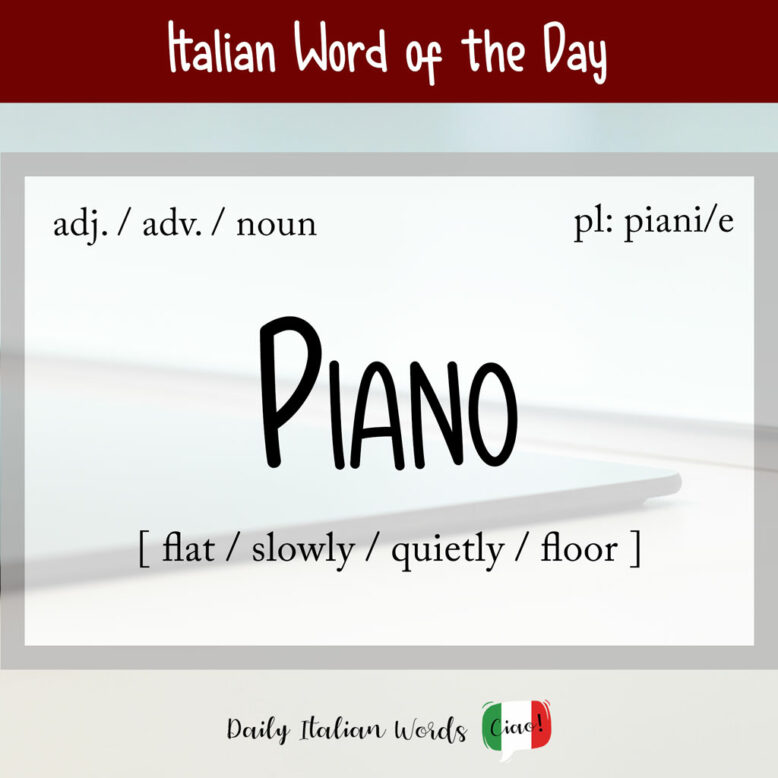
If the first thing that pops into your head when you hear piano in Italian is tinkling keys and sweet melodies—fair enough. After all, piano is used in the English too! But in Italian, it plays many different roles: it’s an adjective, an adverb, and a noun too (il piano masculine singular and i piani masculine plural).
piano
Let’s break its usages down pian piano (step by step):
1. Piano = even, flat (adjective)
When piano is an adjective, it describes something smooth, even, and blissfully bump-free.
Per montare questo mobile, serve una grande superficie piana.
To assemble this piece of furniture, we need a large, flat surface.
From this meaning of piano comes the word pianeggiante, which is the word for “flat” in a geographical sense. You’ll see it when talking about landscapes, for example:
Il territorio qui intorno è molto pianeggiante e facile da percorrere in bici.
The area around here is really flat and easy to get around by bike.
You’ll also hear the expression in piano, which can be used both as an adjective (meaning “flat”) and an adverb (meaning “horizontally,” “on a flat surface”).
Da qui il percorso diventa più semplice, la strada è tutta in piano.
From here the route gets easier, the road is completely flat.
Per fotografare bene l’opera, dobbiamo metterla in piano sul tavolo.
To photograph the artwork properly, we need to lay it flat on the table.
2. Piano = Slowly, gently (adverb)
Now we move from flatness to slowness. As an adverb, piano is all about slowing things down, whether that means taking your time, being careful, or moving with a little extra gentleness.
Potete parlare più piano per favore? Non riesco a seguire se parlate così in fretta.
Can you speak more slowly, please? I can’t follow if you speak so fast.
Mi raccomando, apri piano quel cassetto perchè è rotto!
Make sure to open that drawer gently, it’s broken!
Some everyday expressions:
- Andare piano: to go slow, to slow down
Vai piano, ci sono molte telecamere per il controllo della velocità qui.
Slow down, there are lots of speed cameras here.
- Andarci piano: to go easy on
Vacci piano con il sale, non ti fa bene!
Go easy on the salt, it’s not good for you!
- Chi va piano va sano e va lontano: Slow and steady wins the race
Non cercare di fare sempre tutto in fretta. Ricorda: chi va piano va sano e va lontano!
Don’t always try to do everything in a rush. Remember: slow and steady wins the race!
- Pian piano: little by little, gradually. We also have a softer, sweeter version — pian pianino — mainly used when showing care.
La consistenza va bene, adesso aggiungi la farina piano piano.
The texture looks good, now add the flour little by little.
Non preoccuparti tesoro, pian pianino tutto si sistemerà.
Don’t worry sweetheart, everything will get sorted out little by little.
3.Piano = Quietly (adverb)
As an adverb,pianocan also mean “quietly,” like keeping your voice down or moving without making a sound. It often overlaps with the “slowly/gently” sense, because, well, you usually have to do both to be quiet.
Ragazzi, per favore fate piano che i bambini stanno dormendo!
Guys, please be quiet, the babies are sleeping!
4. Piano = Flat surface (noun)
Now let’s look at piano as a noun. First of all, it can mean a flat surface you can use for a specific purpose, such as a countertop or a workbench.
Abbiamo comprato un nuovo piano in marmo per la cucina.
We bought a new marble countertop for the kitchen.
Some everyday types of piano include:
- Piano cottura: stovetop
- Piano di appoggio: support surface
- Piano di lavoro: workbench
5. Piano = Floor (noun)
Another use of piano as a noun is to talk about the floors of a building—not the ground itself (that’s pavimento), but the different levels.
Il laboratorio di informatica è al piano di sopra.
The computer lab is upstairs.
Here are some handy expressions:
- Al piano interrato: in the basement
- Al piano terra: on the ground floor
- Al primo piano: on the first floor
- Al piano nobile: on the piano nobile (the grand floor in historic buildings, where the fancy salons were located!)
- All’ultimo piano: on the top floor
- Al piano di sopra / di sotto: upstairs / downstairs (literally, “on the floor above / below”
- Un autobus a due piani: a double-decker bus
- Consegnare al piano: to deliver to a specific floor
6. Piano = Level (noun)
Beyond physical levels, piano also works in a figurative sense: we use it to talk about professional, emotional, or abstract “levels.”
Stefano è cresciuto molto sul piano professionale.
Stefano has grown a lot on a professional level.
Common expressions include:
- Essere sullo stesso piano: to be on the same level
Eleganza e semplicità sono sullo stesso piano nella filosofia dello stilista.
Elegance and simplicity are on the same level in the designer’s philosophy.
- Passare in secondo piano: to become secondary, less important
La cosa più importante è la salute, tutto il resto passa in secondo piano.
The most important thing is health, everything else becomes secondary.
- Di primo piano: leading, key
L’attrice avrà un ruolo di primo piano nel nuovo film.
The actress will have a leading role in the new movie.
7. Piano = Plan, program, schedule (noun)
Piano can also refer to an organized set of actions to achieve something.
Devo finire le slide per la presentazione del nuovo piano di marketing.
I have to finish the slides for the presentation of the new marketing plan.
Common uses:
- Piano di studi: study plan
Ho bisogno di aiuto per organizzare il piano di studi, non so da dove cominciare.
I need some help organizing my study plan, I don’t know where to start.
- Piano di rientro: repayment plan
L’azienda ha presentato un piano di rientro per saldare le banche.
The company presented a repayment plan to pay off the banks.
- Piano regolatore: town-planning scheme
Il Comune ha finalmente approvato il nuovo piano regolatore.
The municipality finally approved the new town-planning scheme.
- Piano B: plan B (always good to have one!)
Abbiamo un bel piano B nel caso in cui il tempo rovini la festa all’aperto.
We have a nice plan B in case the weather ruins the outdoor party.
- Andare secondo i piani: To go according to plan
Non c’è da preoccuparsi, tutto sta andando secondo i piani.
No need to worry, everything is going according to plan.
8. Piano = Framing, angle (noun)
In cinema, photography, and visual arts, piano means the way a scene is captured.
Nel film ci sono molti piani sequenza complessi.
The film has many complex tracking shots.
Common types of piano include:
- In primo piano: in the foreground
- In secondo piano: in the background
- Fare un primo piano: to take a close-up
- Piano americano: medium shot
- Piano sequenza: long take
9. Piano = Piano (noun)
And finally, the meaning you probably thought of first: piano is the musical instrument, short for pianoforte.
Finalmente ho iniziato a prendere lezioni di piano.
I finally started taking piano lessons.
Useful phrases:
- Suonare il piano: to play the piano
- Prendere lezioni di piano: to take piano lessons
- Imparare a suonare il piano: to learn to play the piano
- Esercitarsi al piano: to practice on the piano

Valentina Nicastro is a travel writer in love with her home country, Italy. Having travelled widely around the globe, she realised there was more to explore closer to home and decided to put the passport aside for a while. When she is not immersed in documenting Italy, you’ll find her donning her communication consultant hat, weaving words as a content writer and bridging linguistic divides as a translator.