Still staring at the map after the guy on the Italian weather forecast warned about a strong swirl of cold air coming from la Manica, and you have no idea where that is? Read on to find out!
manica
sleeve / bunch / English Channel
1. MANICA = Sleeve
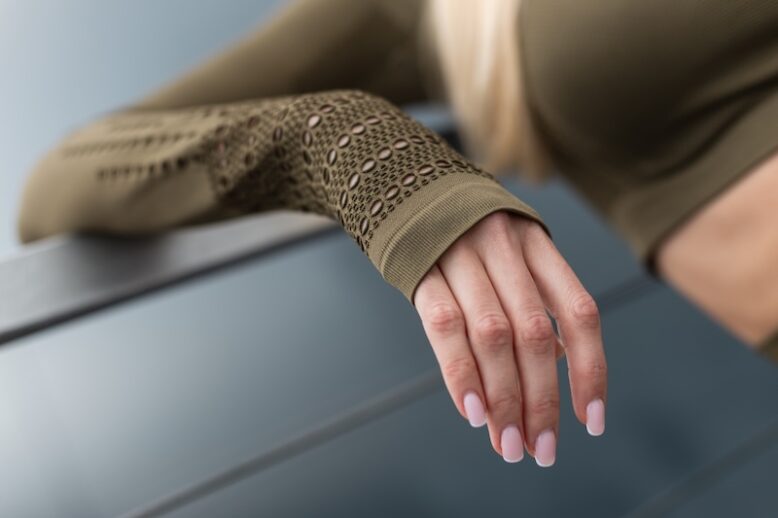
The word manica in Italian comes from the Latin manus (hand), and its first meaning is closely related. It’s the part of a piece of clothing that covers our arm, from the shoulder down: the sleeve.
Manica in Italian is a feminine noun, so we say:
- la manica = the sleeve
- le maniche = the sleeves
Le maniche di questa giacca sono troppo lunghe, devo farle accorciare.
The sleeves of this jacket are too long, I need to have them shortened.
There are some specific adjectives to describe what kind of manica it is:
- La manica lunga: the long sleeve
- La manica corta: the short sleeve
- La mezza manica: the short sleeve (literally “the half sleeve”)
You’ll hear these phrases in both the singular and the plural in everyday Italian, though the plural — le maniche lunghe, le maniche corte, le mezze maniche — tends to come up more often.
Moreover, depending on what we’re describing, these phrases pair with the preposition a or in:
- If we’re describing the sleeves of a piece of clothing, we stick a in front of the phrase:
Indosso sempre magliette a maniche lunghe sotto il maglione.
I always wear long-sleeved t-shirts under my sweater.
Ho comprato un vestito a maniche corte per la festa di domani.
I bought a short-sleeved dress for tomorrow’s party.
- If we’re talking about someone being in short or long sleeves, rather than describing the clothing itself, we swap a for in (and here, only the plural works):
Oggi si sta bene anche in maniche corte.
Today it’s warm enough to just wear short sleeves.
A little trivia: Mezze maniche is also the name of a popular short, tube-shaped pasta:
Vieni a cena da me stasera? Faccio le mezze maniche alla carbonara.
Want to come over for dinner tonight? I’m making carbonara with mezze maniche pasta.
Now, for fashion addicts, here are some common maniche styles worth adding to your vocabulary:
- Manica a sbuffo: puff sleeve
- Manica a pipistrello: batwing sleeve
- Manica a kimono: kimono sleeve
- Manica a palloncino: balloon sleeve
- Manica a campana: bell sleeve
- Manica ad aletta: flutter sleeve
- Manica staccabile: detachable sleeve
And finally, some handy verbs to pair with our sleeves:
- Arrotolare le maniche: to roll up the sleeves
Devo arrotolare queste maniche perché sono troppo lunghe.
I need to roll up these sleeves because they’re too long.
- Tirarsi su le maniche: to roll up your sleeves (literally and as in, get ready to work)
Dai bambini, tiratevi su le maniche e lavatevi le mani che è ora di mangiare!
Come on kids, roll up your sleeves and wash your hands, it’s time to eat!
Ok, basta chiacchiere: tiriamoci su le maniche e finiamo questo lavoro.
Okay, enough chatting: let’s roll up our sleeves and finish this job.
- Tirare qualcuno per la manica: to pull someone by the sleeve (usually to get their attention)
C’era un bambino che continuava a tirarmi per la manica per farmi vedere il suo giocattolo nuovo.
There was a kid who kept tugging on my sleeve to show me his new toy.
2. MANICA = Bunch, group
In everyday language, manica can also mean a bunch, or a group of people.
This meaning is said to date back to 16th-century military slang. Back then, armies often lined up two protective rows of soldiers on either side of a central group. And since these rows looked a bit like arms of a body, they got called maniche.
Over time, the word just came to mean “a bunch of (people),” though these days it’s almost always used in a negative or sarcastic way (however, depending on our tone, it can also come across as more of an affectionate tease).
Ma come si fa a lavorare così? Sono tutti una manica di incapaci!
How can anyone work like this? They’re all a bunch of incompetents!
As you can see, the key construction to memorize is una manica + di + a plural noun. Here are some common combos you’ll hear us use:
- Una manica di matti: a bunch of crazies
- Una manica di deficienti: a bunch of idiots
- Una manica di imbecilli: a bunch of morons
- Una manica di incompetenti: a bunch of incompetents
- Una manica di buffoni: a bunch of clowns
- Una manica di ladri: a bunch of thieves
- Una manica di imbroglioni: a bunch of swindlers
Siete una manica di buffoni, non si prende in giro la gente così!
You’re a bunch of clowns, you can’t treat people like this!
Similarly, we also say una manica di to indicate a large quantity of something, typically in expressions like the ones below, which can be used either as a humorous threat or a very literal promise:
- Una manica di sberle: a bunch of slaps
- Una manica di botte: a bunch of blows
Se non la smetti, ti arriva una manica di sberle!
If you don’t stop, you’re gonna get a bunch of slaps!
3. MANICA = The English Channel
Finally, la Manica is the English Channel that separates southern England from northern France. We call it that because its shape somehow reminds us of a sleeve on a piece of clothing.
Invece di prendere l’aereo, abbiamo deciso di attraversare la Manica in traghetto da Calais a Dover.
Instead of flying, we decided to take the ferry across the Channel from Calais to Dover.
We also often use the expression oltremanica (literally “beyond the sleeve”) to refer specifically to the UK, which, for us continental Europeans, sits “beyond the Channel.”
A settembre mi trasferisco oltremanica.
I’m moving to the UK in September.

Expressions with MANICA in Italian
As often happens, one simple word can lead to all kinds of everyday expressions. Here are some with manica worth knowing.
- In maniche di camicia: in shirtsleeves. It’s an informal way to say someone is just wearing a shirt, no jacket.
A Palermo c’era un sole fantastico, si poteva passeggiare tranquillamente in maniche di camicia anche se era novembre.
It was beautifully sunny in Palermo, you could easily walk around in just a shirt, even though it was November.
- Avere un asso nella manica: to have an ace up your sleeves. This one is borrowed from gambling, where dishonest players would hide an ace up their sleeve to pull out when needed. These days, we use it to describe a clever move or hidden skill kept in reserve for when we need it most.
Aspetta ad accettare la loro offerta al ribasso, abbiamo ancora un asso nella manica.
Don’t accept their lower offer just yet, we’ve still got an ace up our sleeve.
- Essere di manica larga: this means being understanding and not overly strict. The story goes that monks and friars who wore robes with wide sleeves were known for being extra generous when granting forgiveness, and that’s where the phrase comes from.
La prof di storia è di manica larga con i voti.
The history teacher is pretty generous with grades.
- Essere di manica stretta: being rigid and strict — in other words, the opposite of the previous expression. Following the same theory, tighter sleeves were linked to stricter religious orders.
La commissione è stata di manica stretta nelle valutazioni dei candidati.
The committee was strict in the evaluations of the candidates.
- Un altro paio di maniche: a different story. We use it to say that a topic or situation is completely different from what was just mentioned. The expression dates back to the Middle Ages, when sleeves were detachable and people would change them depending on the occasion (what style hackers our medieval ancestors were!).
A parole sono tutti bravi, ma quando bisogna tirare fuori i soldi è un altro paio di maniche.
It’s easy for everyone to talk, but when it’s time to open the wallet, it’s a different story.

Valentina Nicastro is a travel writer in love with her home country, Italy. Having travelled widely around the globe, she realised there was more to explore closer to home and decided to put the passport aside for a while. When she is not immersed in documenting Italy, you’ll find her donning her communication consultant hat, weaving words as a content writer and bridging linguistic divides as a translator.