Stato is one of those words you’ll hear everywhere, and sooner or later, you’ll need it too. Take a look at this sentence:
Siamo arrivati nello stato di New York proprio il giorno in cui è stato dichiarato lo stato di emergenza.
We arrived in the state of New York on the very day the state of emergency was declared.
Yep, that’s three uses of stato in a single sentence, each with a different meaning. The first refers to a political entity (the state of New York), the second is part of a passive verb construction (è stato dichiarato —”was declared”), and the third describes a condition (stato di emergenza).
stato
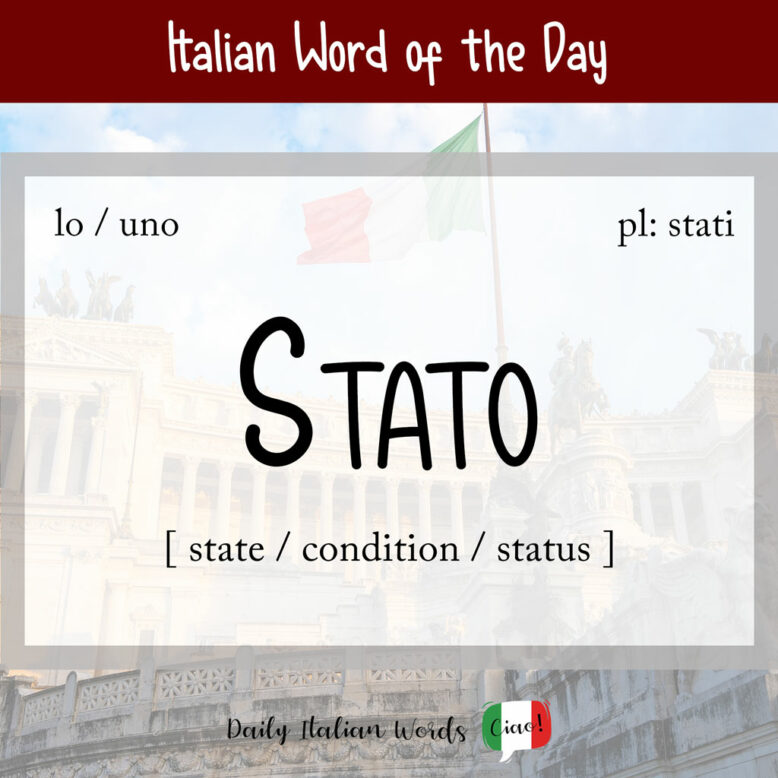
This five-letter word carries all of those meanings and many others, from politics to grammar. Ready to explore them all?
But first, the basics: stato is a masculine word, so here’s how it works:
- Lo stato – the state
- Uno stato – a state
- Gli stati – the states
- Degli stati – some states
1. Stato = State, government
The first meaning of stato in Italian belongs to the political world: it refers to the state as a political entity or governing authority —you know, the kind that runs countries and makes laws.
When referring to the government as an institution or to official state authorities, we generally capitalize it (Stato). You’ll spot it in expressions linked to public roles, offices, and institutions, like:
- Il Capo dello Stato – Head of state
- Una carica dello Stato – A state official
- Gli aiuti di Stato – State aid
- Le istituzioni dello Stato – State institutions
- La zecca di Stato – State mint
- L’archivio di Stato – State archive
- Un esame di Stato – An official national exam
Alla cerimonia di inaugurazione erano presenti tutte le più alte cariche dello Stato.
All the highest state officials were present at the inauguration ceremony.
Gli aiuti di Stato hanno salvato molte piccole imprese durante la crisi economica.
State aid saved many small businesses during the economic crisis.
You’ll also see capitalized Stato when talking about companies and services that are fully or partially state-owned, such as:
- Le ferrovie dello Stato – The state railways
- Un’azienda partecipata dallo Stato – A government-backed company (basically, a business in which the government owns all or part of the shares, like RAI or Poste Italiane)
When we use the lowercase version, stato, we’re usually describing a country’s political form or talking more generally about states as entities. This shows up a lot in news headlines, history books, and political discussions, for example:
- Uno stato fantoccio – A puppet state
- Uno stato cuscinetto – A buffer state
- Uno stato totalitario – A totalitarian state
- Uno stato democratico – A democratic state
- Uno stato federale – A federal state
- Uno stato sovrano – A sovereign state
- Uno stato laico – A secular state
- Uno stato monarchico – A monarchy / monarchical state
- Uno stato indipendente – An independent state
- Uno stato sociale – A welfare state (fun fact: this is also the name of an Italian band with some catchy tunes like this one!)
- Un colpo di stato – A coup
Dopo il colpo di stato, il paese è diventato uno stato totalitario.
After the coup, the country became a totalitarian state.
La Svezia è considerata un modello di stato sociale.
Sweden is considered a model welfare state.
Here’s a quick takeaway: Stato with capital S is the serious one, meaning “the government” and its official institutions. Lowercase stato, on the other hand, is more relaxed and general, mainly referring to a type of state. Same word, but different levels of formality!
2. Stato = Condition
Another way we use stato in Italian is to talk about a condition, as in the state something or someone exists, appears, or feels at a given moment. This is probably the meaning you’ll hear most often in everyday Italian.
For example, when you’re describing the state of something physical, these expressions may come in handy:
- In buono / ottimo stato – In good / excellent condition
- In pessimo stato – In very poor condition
- Allo stato brado – In the wild / untamed
- Allo stato grezzo – In raw form
- Allo stato naturale – In its natural state
- Stato di conservazione – State of preservation
- Stato di usura – State of wear
Nonostante gli anni, l’appartamento della nonna è ancora in ottimo stato.
Despite the years, grandma’s apartment is still in excellent condition.
Il legno allo stato grezzo deve essere levigato prima di poterlo verniciare.
Raw wood must be sanded before it can be varnished.
Instead, if you’re discussing how someone feels, you could use expressions like:
- Lo stato d’animo – The mood
- Lo stato mentale – The mental state
- Essere in stato confusionale – To be in a state of confusion
- Essere in stato di agitazione – To be in a state of agitation
- Essere in uno stato pietoso – To be a complete mess (a great phrase for when someone look or feel absolutely wrecked)
- Essere in uno stato comatoso — Literally, to be in a comatose state (technically, this is medical terminology, but it’s not uncommon to hear it as a slang for a state of extreme exhaustion)
In questi giorni il mio stato d’animo è un po’ ballerino: a volte sono felice, altre mi sento triste.
These days my mood has been all over the place: sometimes I feel happy, other times I’m sad.
Dopo aver lavorato tutto il giorno sotto il sole, eravamo in uno stato pietoso.
After working under the sun all day, we were a complete mess.
Then there are specific expressions to describe broader situations, such as:
- Stato di crisi– State of crisis
- Stato di emergenza – State of emergency
- Stato di allerta – State of alert / readiness
- Stato dell’arte – State of the art
Il presidente della regione ha prorogato lo stato di emergenza.
The regional president has extended the state of emergency.
Sto preparando una presentazione sullo stato dell’arte dei lavori al vecchio colorificio.
I’m preparing a presentation on the state of the art of the restoration work at the old paint factory.
And finally, a couple of expressions worth mentioning:
- Allo stato attuale is another way of saying “currently” or “as things stand now.” You’ll hear this in formal contexts, news reports, or when someone wants to sound rather official.
Allo stato attuale, la coalizione mantiene livelli di consenso stabili nei sondaggi.
Currently, the coalition is maintaining stable approval ratings in the polls.
- In che stato(what a state) is what we sometimes say when commenting on someone or something that looks like an absolute mess. It can be sympathetic, dramatic, or funny depending on the tone.
Hai visto Marco in che stato è? Non dorme da tre giorni per preparare quell’esame.
Have you seen what a state Marco’s in? He hasn’t slept for three days preparing for that exam.
3. Stato = Status
Now we’re entering bureaucracy territory. Stato can also refer to someone’s formal position in society, like our marital status or economic situation. Basically, it’s a word that shows up pretty much every time we fill out official paperwork, so we can be properly categorized.
Here are some common phrases you might encounter:
- Lo stato civile – The marital status
- Lo stato di famiglia – The family status certificate
- Lo stato patrimoniale– The financial status / assets
- Lo stato giuridico– The legal status
- Lo stato di disoccupazione – The unemployment status
Nel modulo bisogna indicare nome, cognome e stato civile.
On the form you must indicate your name, surname and marital status.
Per richiedere il bonus, dovete presentare il vostro stato di famiglia aggiornato.
To apply for the bonus, you have to submit your updated family status certificate.
4. Stato = State (science)
In scientific contexts, stato refers to the physical form of matter—you know, like solid or liquid. Not the most thrilling use of the word, I know, but hey, if you’re reading a science textbook or watching a documentary in Italian, you won’t be lost.
These are some frequent expressions:
- Lo stato solido / Allo stato solido – The solid state / In solid form
- Lo stato liquido / Allo stato liquido – The liquid state / In liquid form
- Lo stato gassoso / Allo stato gassoso – The gaseous state / In gaseous form
L’azienda è specializzata nel trasporto di azoto allo stato liquido.
The company specializes in transporting nitrogen in liquid form.
You might also come across passaggio di stato (change of state), which describes when an element transforms from one form to another, like ice melting into water.
5. Stato = Been (past participle)
Let’s wrap this up with a little grammar. Stato is also the past participle of two important Italian verbs, essere (to be) and stare (to be, to stay). Quick refresher: the past participle is the form of a verb used to build compound tenses (like “eaten” in “I have eaten” in English).
Now, both essere and stare use essere (to be) as their auxiliary verb in compound tenses, which means that the past participle has to agree in gender and number with the subject. That’s why stato changes its ending depending on who we’re talking about:
- stato – masculine singular
- stata – feminine singular
- stati – masculine plural
- state – feminine plural
Ho sentito che Marco è stato male, sai qualcosa?
I heard Marco has been ill, do you know anything?
Maria è stata in Germania per lavoro.
Maria has been in Germany for work.
I miei figli sono stati fortunati a trovare degli insegnanti così bravi.
My kids were lucky to find such good teachers.
Le ragazze sono state a casa tutto il giorno.
The girls stayed at home all day.
You’ll also hear this stato in the saying Quel che è stato è stato(literally, “what has been has been”), basically our own version of “what’s done is done.”
A: Mi pento di non aver accettato quel lavoro.
B: Dai, quel che è stato è stato. Il destino ha altri piani per te!
A: I regret not accepting that job.
B: Come on, what’s done is done. Destiny has something else in store for you!

Valentina Nicastro is a travel writer in love with her home country, Italy. Having travelled widely around the globe, she realised there was more to explore closer to home and decided to put the passport aside for a while. When she is not immersed in documenting Italy, you’ll find her donning her communication consultant hat, weaving words as a content writer and bridging linguistic divides as a translator.