When learning Italian, it’s easy to get caught up in grammar rules and forget about real-life situations… like getting your hair done! Say that you’re traveling through Italy and need a last-minute touch-up, or maybe you’re in the mood for a bold new look to celebrate your trip. Would you know how to talk about hair lengths, colors, and styles in Italian? Miscommunication with your hairdresser could lead to some interesting (and potentially disastrous) results, so better to be well equipped with the right vocabulary.
And if you’re feeling nervous at the idea of visiting a hairdresser in Italy, don’t worry! I think it’s actually a super interesting cultural experience that can help you connect with the locals, especially in small towns—and it could end up being one of your best travel memories!
Hair colour and texture in Italian
The literal translation of “hair” in Italian is capello, but we usually use the plural form capelli when talking about hair in general.
Here’s some basic vocabulary to describe what your hair looks like in Italian. It will come in handy not only when you visit the hairdresser but also for casually chatting about your look:
Hair colour
- Biondi – Blonde
- Biondo cenere – Ash blonde
- Castani – Brown
- Castano chiaro / scuro – Light / dark brown
- Neri – Black
- Rossi – Red
- Grigi – Gray
- Bianchi – White
- Brizzolati – Streaked with gray
Hair length and texture
- Capelli corti – Short hair
- Capelli lunghi – Long hair
- Capelli lisci – Straight hair
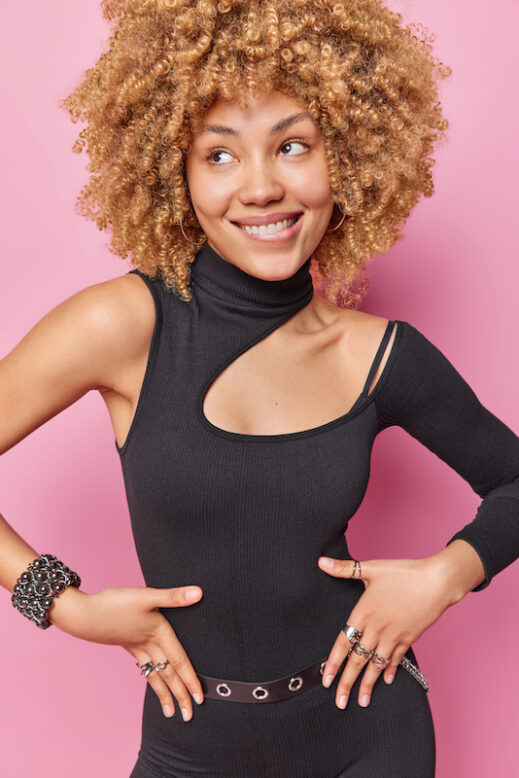
- Capelli ricci – Curly hair
- Capelli sottili – Fine/thin hair
- Capelli spessi – Thick hair
- Capelli voluminosi – Voluminous hair
- Stempiato – Balding
- Calvo/a – Bald
- Pelato/a – Bald. This term can sound a bit rude or offensive, so use it carefully. However, it’s good to know in case you hear it. Fun fact: in Italian, the plural pelati not only refers to bald heads but also means “peeled tomatoes”!
Hair problems in Italian
These are some Italian words and expressions you can use when shopping for hair products or discussing things with the hairdresser:
- Capelli che si spezzano – Hair that breaks easily
- Capelli che cadono – Hair that falls out
- Capelli fragili – Fragile hair
- Capelli crespi – Frizzy hair
- Capelli secchi – Dry hair
- Capelli spenti – Dull, lifeless hair
- Capelli grassi – Oily hair
- Capelli fini e sfibrati – Thin and damaged hair
- Doppie punte – Split ends
- Forfora – Dandruff
- Cute secca – Dry scalp
So, if you’re at the hairdresser and want to mention a hair concern, you can simply say things like Ho i capelli crespi (I have frizzy hair), Ho la cute secca (I have a dry scalp), or I miei capelli si spezzano facilmente (My hair breaks easily).
Now that you’ve got the basic vocabulary down, it’s time to tackle the hairdresser experience, step by step!
Step 1: Booking a hair appointment
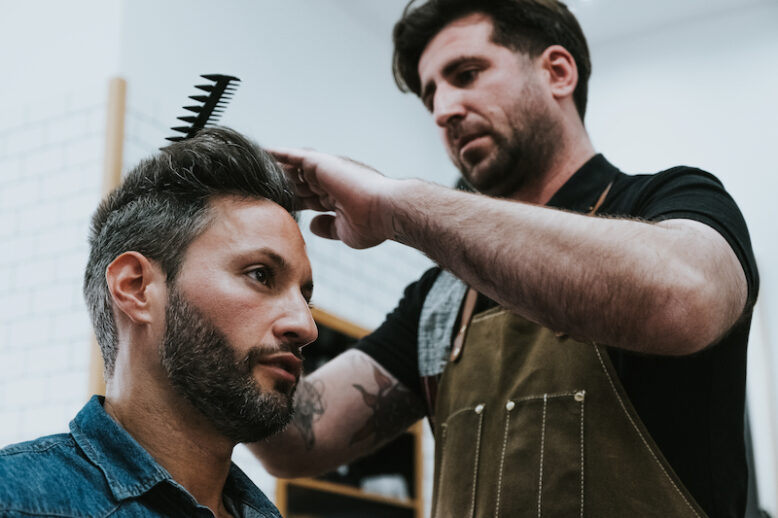
First things first, you need to find a parrucchiere / parrucchiera (hairdresser) or a barbiere (barber). Both men and women can get their hair done at a parrucchiere, while a barbiere is for men only, as it also specializes in shaving and beard care.
In some places, you can simply walk in, but many shops require an appuntamento (appointment). Make sure to familiarise yourself with the days of the week and how to tell the time in Italian, as these will be helpful when booking. Quick tip: in Italy, hairdressers and barber shops are usually closed on Mondays, unless they’re located in shopping centers, in which case they’ll be open every day.
Here are some useful phrases to help you book an appointment:
Vorrei prendere un appuntamento per tagliare i capelli.
I’d like to book an appointment for a haircut.
Devo tagliare i capelli e fare la tinta.
I need a haircut and colour.
Ho solo bisogno di una piega.
I just need a blow-dry.
Non ho un appuntamento, avete tempo oggi?
I don’t have an appointment, do you have time today?
Ha posto per una piega veloce?
Do you have time for a quick blow-dry?
Step 2: Getting your hair dyed
If you’ve booked an appointment to fare il colore / fare la tinta (get your hair dyed), the first thing your hairdresser will ask is what you’d like to do.
Here are some possible answers:
- Coprire la ricrescita – To cover your roots
- Coprire i capelli bianchi – To cover gray hair
- Ritoccare il colore – To freshen up your current colour
- Diventare bionda/mora – To go blonde/brunette
- Schiarire i capelli – To lighten your hair
- Scurire i capelli – To darken your hair
- Fare dei riflessi – To add highlights
- Fare i colpi di sole – To add sun-kissed highlights
- Fare le meches – To get streaky highlights
- Tornare al proprio colore naturale – To return to your natural colour
- Decolorare i capelli – To bleach your hair
When it comes to choosing the colore/tinta (colour), you can either stick to basic shades like biondo (blonde), castano (brown), nero (black), or rosso (red), or be more specific by choosing the exact shade from the tabella colori (colour chart) the hairdresser will show you.
Here are a few examples of what you can say:
Vorrei schiarire i capelli con delle meches.
I’d like to lighten my hair with highlights.
Vorrei coprire i capelli bianchi, magari con dei colpi di sole?
I’d like to cover my grey hair, maybe with some highlights?
Vorrei diventare bionda, devo prima decolorare i capelli?
I’d like to go blonde, do I need to bleach my hair first?
Vorrei tornare al mio colore naturale, castano scuro. Cosa si può fare?
I’d like to return to my natural colour, dark brown. What can you do?
Step 3: Washing your hair
After the colouring is done, they will take you to the lavatesta (shampoo station) to wash your hair. First, they’ll apply some shampoo (yep, same word in Italian!) and massage your scalp. Then, they’ll use some balsamo (conditioner) to keep your hair soft and hydrated. For a little extra care, they might offer a maschera (hair mask), but if you’d rather skip it (it can be a bit pricey), a simple No, grazie (No, thank you) will do.
If the water is too hot or too cold during the wash, you can say:
Scusi, potrebbe usare l’acqua un po’ più calda?
Excuse me, could you use a little warmer water?
L’acqua è un po’ troppo calda, può raffreddarla per favore?
The water is a little too hot, can you cool it down please?
And if you’ve got a little acqua nelle orecchie (water in your ears), just say:
Scusi, mi sta andando l’acqua nelle orecchie.
Excuse me, the water is going into my ears.
Finally, once your hair is thoroughly washed, the hairdresser will proceed to sciacquare (rinse) it out and wrap it up in an asciugamano (towel) to get ready for the next step.
Step 4: Cutting your hair
Now comes the big question: Come li facciamo? (How would you like your hair?).
If you’re unsure and open to a change, you can say:
Vorrei cambiare pettinatura. Cosa mi consiglia?
I’d like to change my hairstyle. What do you recommend?
And if you’re feeling adventurous and prefer to leave the decision to the hairdresser, just say:
Faccia lei! / Fai tu!
I’ll leave it to you!
But if you have a specific idea in mind, you’ll need to explain what kind of cut you’re after, and this is where things get a bit more technical. Having a picture may help, in which case you can say:
Vorrei questo taglio.
I’d like this haircut.
No picture? No problem, here’s some handy haircut vocabulary in Italian to help you describe what you want:
- Tagliare due dita – To cut two fingers’ worth (a small amount)
- Accorciare – To shorten
- Alleggerire – To lighten (reduce bulk)
- Scalare – To layer
- Sfilare – To thin (reduce thickness)
- Sfoltire – To thin out (reduce volume)
- Spuntare – To trim
- Spuntare la frangia – To trim the fringe
- Sfumare – To blend
- Rasare – To shave
- Fare la frangia – To get a fringe
- Dare una sistemata – To tidy up
- Caschetto – Bob (the classic short cut)
- Una spuntatina – A little trim (typically a couple of centimeters)
- Un taglio facile da gestire – A cut that’s easy to manage
- Un taglio corto – A short haircut
- Un taglio scalato – A layered cut
- Un taglio sfilato – A textured or choppy cut
- Un taglio pari – A blunt cut
- Un taglio a caschetto – A bob cut
Example phrases:
Vorrei un taglio corto, qualcosa di semplice da gestire.
I’d like a short cut, something easy to style.
Vorrei dare solo una spuntatina.
I’d like just a little trim.
Vorrei alleggerire i capelli, pensavo a un taglio scalato.
I’d like to lighten my hair, I was thinking a layered cut.
Vorrei fare un caschetto con la frangia.
I’d like a bob with a fringe.
Vorrei scalarli ai lati.
I’d like to layer the sides.
Step 5: Styling your hair
Once your hair is cut, it’s time for the messa in piega(blow dry). This is when you get to decide how you want your hair styled.
The hairdresser will likely ask Come li asciughiamo? (How do you want to dry it?). You can go for lisci (straight), mossi (wavy) or opt for some fabulous ricci (curls) with a bit of permanente (perm).
For a basic blow-dry, they will usually apply some schiuma (foam) to give your hair some volume and texture.
Another thing they’ll ask is Dove vuole la riga?, where riga literally means “line”, but in this case they’re asking where you usually part your hair. You can respond with:
Di solito, faccio la riga in mezzo.
I usually part it in the middle.
La faccia a destra / sinistra.
Part it right / left.
Mi piace la riga in mezzo, ma con questa rosa proprio non funziona.
I like to part it in the middle, but with this hair whorl, it just doesn’t work.
To finish off, they might spritz some lacca (hairspray) or apply some gel for a bit of extra shine and definition.
If you’re looking for a more styled pettinatura (hairdo), here’s some classic options you can ask for:
- Coda – Ponytail
- Codini – Pigtails
- Chignon alto – HIgh bun
- Chignon basso – Low bun
- Treccia – Braid
- Cresta – Mohawk
- Effetto spettinato – Messy hairstyle
Key hair tools in Italian
Keep this list of hair tools in Italian handy for your visit to the hairdresser:
- La mantella– Hairdressing cape
- Il nebulizzatore – Spray bottle
- Le forbici – Scissors
- Il pettine – Comb
- La spazzola – Brush
- La spazzola rotonda – Round brush
- La spazzola piatta – Flat brush
- Il tagliacapelli – Hair clippers
- Le forcine – Hairpins
- La pinza per capelli – Hair clip
- Il pennello per la tinta – Tint brush
- La stagnola – Foil
- I bigodini – Curlers
- L’asciugacapelli / il phon – Hairdryer
- Il diffusore – Diffuser
- Il casco asciugacapelli – Hood dryer
- La piastra – Flat iron
- L’arricciacapelli – Curling iron
- Lo specchio – Mirror
Some additional Italian hair vocabulary for men
Let’s finish off with some additional hair-related Italian vocabulary just for men:
- Basette – Sideburns
- Baffi – Mustache
- Barba – Beard
- Barba incolta – Stubble
- Barba sfumata – Faded beard
- Fare la barba – To shave
- Rasoio – Razor
- Lametta – Razor blade
- Schiuma da barba – Shaving foam
- Pennello da barba – Shaving brush
- Sistemare le basette – To tidy up the sideburns
- Sfumatura alta/media/bassa – High/medium/low fade
- Taglio a spazzola – Crew cut
- Collo – Back of the neck
- Rasoio elettrico – Clippers
- Colonia – Aftershave
Here are some example phrases that could help when visiting the barber shop:
- Devo tagliare solo un pochino qui sopra.
I need to trim just a little bit off the top here. - Vorrei sfumare i lati.
I’d like to blend the sides. - Vorrei un taglio a spazzola.
I’d like to have a crew cut. - Vorrei rasarmi.
I’d like to shave. - Voglio accorciare la barba.
I want to shorten my beard. - Vorrei sistemare i baffi.
I’d like to shape my mustache.

Heather Broster is a graduate with honours in linguistics from the University of Western Ontario. She is an aspiring polyglot, proficient in English and Italian, as well as Japanese, Welsh, and French to varying degrees of fluency. Originally from Toronto, Heather has resided in various countries, notably Italy for a period of six years. Her primary focus lies in the fields of language acquisition, education, and bilingual instruction.