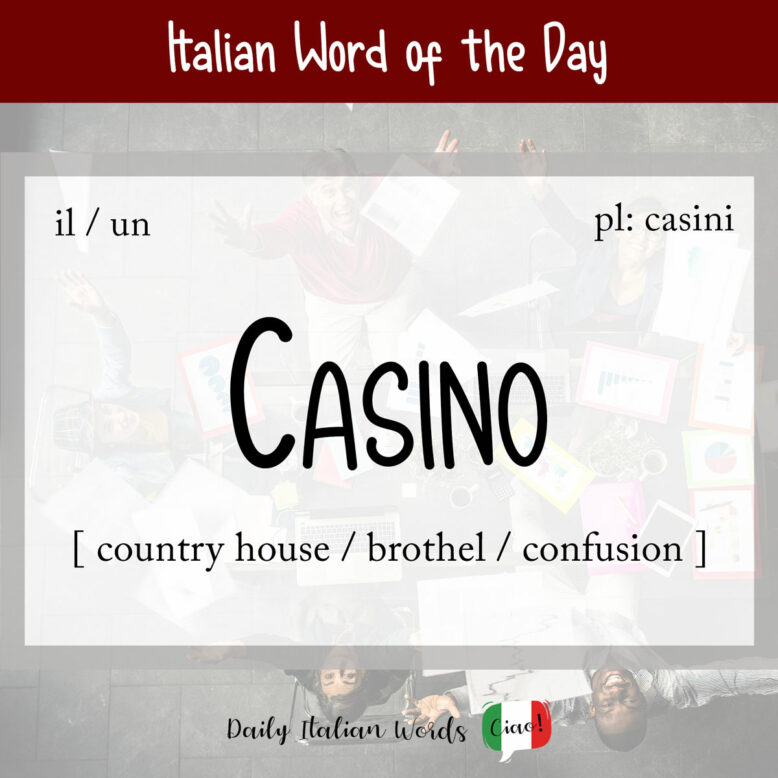
Casino is a word we use a lot in everyday Italian. But unlike in English, it has (almost) nothing to do with slot machines and James Bond. It comes from casa (house) combined with the diminutive suffix -ino, so it literally means “little house.” Sounds simple, right? Not really. This Italian word has a surprising number of meanings. Let’s uncover them together!
casino
country house / brothel / confusion…and more!
1. Casino as “country house”
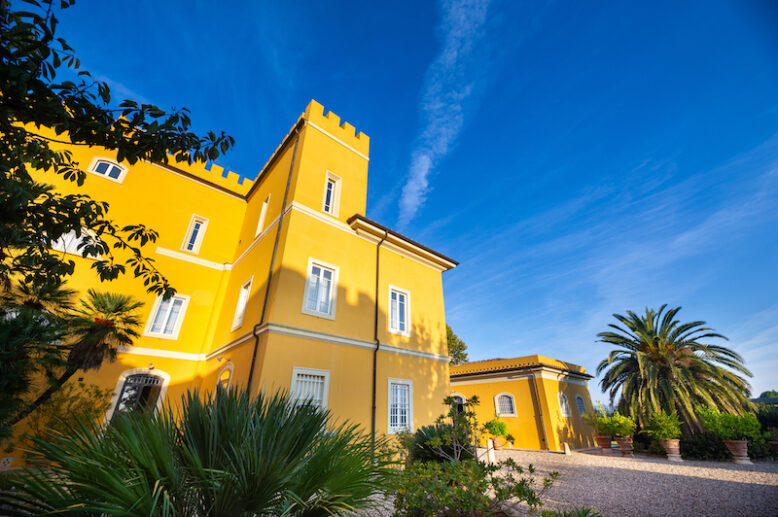
Originally, casino referred to a fancy country house where noblemen would retreat to escape city life and enjoy a bit of hunting or fishing. It makes perfect sense when you think about it: the word comes from casa (house), so it literally meant a small, elegant building tucked away in the countryside.
Italy is full of these gems, like the 15th-century Casino di Caccia Borromeo in the village of Oreno, famous for its lovely Gothic frescoes, or Villa Cafaggiolo up north of Florence, once a favorite playground of the Medici family.
Over time, the casino evolved from meaning a hunting or fishing lodge to a more general spot for social gatherings, similar to a club where nobles could kick back, have fun, and indulge in all sorts of pleasures.
2. Casino as “brothel”
The second meaning of casino in Italian takes a literal turn in the “pleasure” department. At one point in its evolution, the word came to mean a brothel: a “little house” where prostitution took place. As a result, casino was long considered una parolaccia (a vulgar word) and was generally avoided in conversation.
An interesting history note: for quite some time, these casini in Italy were state-run. It all began in 1859 when Cavour (Italy’s first prime minister after unification) authorised the opening of state-regulated brothels. These venues operated under strict rules: they had to be located far from churches and public buildings, their windows had to remain firmly shut (earning the nickname case chiuse, meaning “closed houses”), and the women working there were registered and subjected to regular medical examinations. Then in 1949, the United Nations adopted a convention calling for the suppression of the exploitation of prostitution, but Italy didn’t act right away. It wasn’t until nearly a decade later, in 1958, that Senator Lina Merlin championed a law that shut down all state-run casini across the country.
3. Casino as “confusion”
This is where casino cements its place in daily Italian slang: to describe a mess, a noisy and chaotic kind of situation. The shift from “brothel” to “confusion” actually makes a lot of sense when you think about it: those places probably weren’t exactly quiet and orderly! And so, over time, the word casino shook off that more “intimate” meaning and came to be used for pure disorder.
Common expressions include:
Che casino! = What a mess! / What a disaster!
Che casino per arrivare qui, c’era un incidente in tangenziale.
Getting here was such a nightmare, there was an accident on the ring road.
C’è (troppo) casino = It’s (too) noisy / There’s (too) much going on
Non sento quello che dici, c’è troppo casino qui dentro!
I can’t hear what you’re saying, it’s way too loud in here!
Fare casino = To make a racket
I vicini hanno fatto casino tutta la notte.
The neighbours made a racket all night.
And then there’s the adjective incasinato, born straight from this meaning of casino. It can mean “messy,” “chaotic,” or just totally “snowed under”. For example:
Sono troppo incasinato in questi giorni, non posso uscire.
I’m way too swamped these days, I can’t go out.

4. Casino as “screwing up”
In daily Italian slang, casino also refers to tricky situations or problems, the kind of moments when you’ve accidentally caused a little chaos and need to figure out how to fix it.
The classic expression we use is fare un casino, which is basically the Italian way of saying “to screw up.” It’s super versatile and can apply to everything, from dropping an egg to accidentally emailing a client instead of your colleague. For example, you could say:
Ho fatto un casino con i file della presentazione, ora è tutto da rifare.
I totally messed up the presentation files, now I have to redo everything.
With this meaning, casino can also be used in the plural form to refer to multiple problems or a generally messy situation, like in this example:
Lucia ha un sacco di casini in questo periodo.
Lucia has got a lot on her plate these days.
5. Casino as “a ton”
Casino can also mean “a lot” or “a ton” when you want to emphasise something, similar to saying “loads of” or “tons of” in English.
You’ll often hear us say:
Un casino = a ton
Ho mangiato un casino di pasta a mezzogiorno, sono ancora pieno!
I ate a ton of pasta at lunchtime, and I’m still full!
For the romantics out there, a classic phrase is:
Ti amo un casino.
I love you a ton.
Un casino di = a ton of
Arrivo tardi, ho ancora un casino di cose da finire.
I’m gonna be late, I still have a ton of things to finish.
6. Adding the accent: when Casino becomes Casinò (gambling house)
Finally, here’s the one meaning that actually does have something to do with James Bond and slot machines – but only if you add one key element: the accent!
When you place the stress on the ò (casinò), you get the Italian word for a gambling house, the place where dice roll and slot machines light up, just like the English “casino.”
One last fun fact: because of Italy’s strict gambling laws, there are only four official casinò in the country: Sanremo, Venice, Campione d’Italia (near Como), and Saint-Vincent in the Aosta Valley region.

Valentina Nicastro is a travel writer in love with her home country, Italy. Having travelled widely around the globe, she realised there was more to explore closer to home and decided to put the passport aside for a while. When she is not immersed in documenting Italy, you’ll find her donning her communication consultant hat, weaving words as a content writer and bridging linguistic divides as a translator.