
Are you a fellow plant enthusiast (success rate irrelevant)? Then pianta is one Italian word you’ll want to add to your vocabulary! But while it’s rooted in the botanical word, this little word has much more to offer, extending into other meanings, expressions, and useful related terms.
pianta
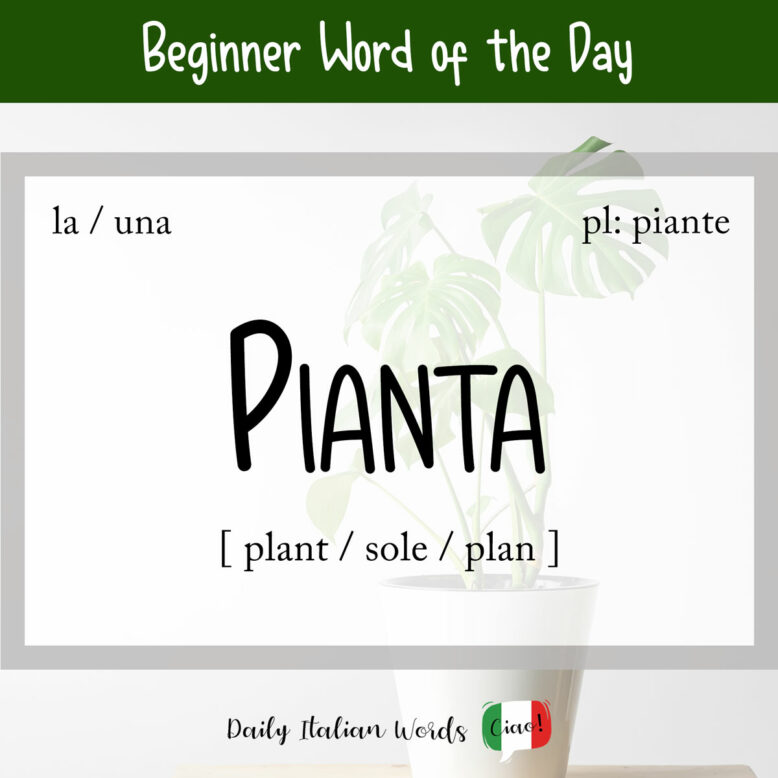
Grammatically, it’s a feminine noun: la pianta in the singular and le piantein the plural. And it’s one of those Italian words that change their meaning based on gender:
- La pianta (feminine): plant (and other things we’ll explore shortly)
- Il pianto (masculine): the act of crying
So, ready to discover all the meanings of pianta in Italian? Lets’ start!
PIANTA = Plant
In its most common meaning, pianta refers to a plant in the broadest sense.
Perché le mie piante appassiscono sempre?
Why do my plants always wilt?
In everyday Italian, we often use it as a synonym for “tree.”
Cerco di parcheggiare sotto una pianta, così la macchina resta all’ombra.
I’m trying to park under a tree so the car stays in the shade.
Just like in English, Italian has a whole group of adjectives to describe plants depending on their characteristics. For example, a plant can be:
- Una pianta sempreverde: an evergreen plant
- Una pianta perenne: a perennial plant
- Una pianta grassa: a succulent
- Una pianta carnivora: a carnivorous plant
- Una pianta ornamentale: an ornamental plant
- Una pianta tropicale: a tropical plant
- Una pianta officinale: a medicinal plant
You can also get more specific by using pianta+ di (of) or pianta+ da (for):
- Una pianta di limoni: a lemon tree
- Una pianta di avocado: an avocado tree
- Una pianta da frutto: a fruit plant
- Una pianta da interno: an indoor plant
- Una pianta da esterno: an outdoor plant
- Una pianta da appartamento: a houseplant
And for young plants, there are two adorable diminutives we like to use: piantina and pianticella.
- Una piantina di salvia: a young sage plant
- Una piantina di pomodori: a young tomato plant
- Una pianticella di menta: a young mint plant
PIANTA = Bottom of the foot
A second meaning of pianta in Italian refers to the sole of the foot. It may seem totally unrelated to the previous meaning, but if you think about it, it actually makes sense: a plant puts its roots in the ground, the sole of a foot touches the ground, and… voilà! Both are about making contact with the earth. A bit poetic, yes, but thinking of it this way can make the meaning easier to remember.
Ho un’infiammazione alla pianta del piede e non riesco a camminare bene.
I have an inflammation in the sole of my foot and I can’t walk properly.
When used in this sense, pianta can also extends to describe the inner part of a shoe where the foot rests:
- Una scarpa a pianta stretta: a narrow-fitting shoe
- Una scarpa a pianta larga: a wide-fitting shoe
This comes in handy if you’ll be shopping for shoes in Italy and want to make sure your feet stay comfortable during all the sightseeing. For example, you could say:
Preferisco scarpe a pianta larga così posso camminare comodo tutto il giorno.
I prefer wide-fitting shoes so I can walk comfortably all day.
And closely related to this meaning is the word plantare, which can function both as an adjective (plantar) or a noun (insole):
Ho una brutta infiammazione plantare.
I have a bad plantar inflammation.
Devo comprare i plantari ortopedici per le scarpe nuove
I need to buy orthopaedic insoles for my new shoes.
PIANTA = Plan, drawing, layout
In Italian, we use the word pianta also to talk about the visual and structural arrangement of a space. This meaning is common in the world of geometry, architecture, and design, where it indicates the scaled graphic representation of something, such as a room, a building, or an entire architectural complex.
L’architetto ci ha mostrato la pianta della casa con la nuova camera.
The architect showed us the floor plan of the house with the new room.
In this sense, pianta could be used to refer to things like:
- La pianta della città: the city map
- La pianta dell’ufficio: the office layout
- La pianta della classe: the classroom seating chart
- La pianta del locale: the venue layout
You could also hear the diminutive piantina as a more informal or colloquial way to refer to a plan, for instance:
Ho disegnato una piantina del salotto per scegliere i nuovi mobili.
I drew a little floor plan of the living room to choose the new furniture.
Beyond the literal drawing, pianta can additionally describe the shape of the space itself. For example, when you are exploring Italy’s streets, churches or historic buildings, your guide will probably use expressions like:
- A pianta longitudinale: with a longitudinal plan
- A pianta ortogonale: with an orthogonal plan
- A piantaquadrata: with a square layout
- A piantarettangolare: with a rectangular layout
- A pianta circolare: with a circular layout
- Pianta a croce greca / latina: Latin / Greek cross floor plan (common in church architecture)
- Pianta a due navate: two-aisle floor plan
Expressions with PIANTA in Italian
Sometimes, you’ll hear pianta used in a conversations that have nothing to do with gardening, feet or architectural plans. That’s because this word forms the basis of a couple of figurative expressions that come up quite often in everyday Italian:
In pianta stabile:this literally translates to “in a stable plant,” but it’s used to describe something permanent, long-term. Think of a tree with deep, solid roots that isn’t going anywhere… that’s the kind of stability this expression conveys!
La mia amica Sara si è trasferita in pianta stabile a Como.
My friend Sara has permanently moved to Como.
It’s quite frequent to hear when talking about jobs or employment situations, for example:
Stefano è stato assunto in pianta stabile dopo anni di contratti temporanei.
Stefano was hired on a permanent basis after years of temporary contracts.
Di sana pianta: this translates literally as “of a healthy plant,” but its real meaning is “from scratch.” The image behind it is that of growing something anew from a healthy seed. We commonly use it with verbs like:
- Rifare di sana pianta: to redo something entirely from scratch
- Copiare di sana pianta: to copy something word-for-word
- Inventare di sana pianta: to invent or make something up completely
I giornali hanno inventato di sana pianta quella storia, non c’è alcuna prova!
The newspapers completely made up that story, there’s no evidence!
Words coming from PIANTA in Italian
Finally, pianta gives rise to a number of common words that we like to use in everyday chats. These include:
1. Piantare: to plant, or informally, to ditch someone
The primary meaning is exactly what you’d think: to plant a tree, a flower, or a vegetable. But there’s also a more informal, figurative use when someone ditch someone else:
Il suo fidanzato l’ha piantata senza spiegazioni.
Her boyfriend ditched her without explanation.
From this figurative meaning comes the idiompiantare in asso, which basically means to abandon someone, to leave them high and dry:
L’autista ci ha piantato in asso e abbiamo dovuto cercare un taxi.
The driver left us high and dry, and we had to look for a taxi.
2. Piantarla: to stop it
This one is an informal expression we use when we want to tell someone to stop doing something annoying. It’s a pronominal verb, formed from piantare (to plant) combined with la (it), literally meaning “plant it,” like putting an end to the action.
Ragazzi, piantatela di fare casino!
Guys, stop making such a mess!
3. Piantonare: to watch over, to keep something or someone under surveillance
This verb conveys the image of a person standing still, almost rooted like a plant, while keeping a close eye on someone or something. It’s often used in contexts related to police or security, for example:
La polizia ha piantonato l’edificio tutta la notte.
The police kept guard over the building all night.
4. Soppiantare: to supplant, to replace
Literally, it’s like saying “to plant over,” but we use it figuratively to mean replacing someone or something, generally because the new thing is stronger or better. Think of it like a new, stronger plant slowly growing over another one: the old one is still there at first, but eventually, it’s completely replaced.
Il nuovo locale ha soppiantato la storica libreria di via Dante.
The new place has supplanted the historic bookshop on Via Dante.
Sometimes there can be a hint of sneakiness, like quietly elbowing someone out of their spot:
Carlo ha soppiantato il collega approfittando di un suo momento di difficoltà.
Carlo took advantage of his colleague’s rough patch and supplanted him.
5. Piantagione: plantation
This word is pretty straightforward; it refers to a large farm where crops like coffee, tea, or tobacco are grown.
Non vedo l’ora di visitare le famose piantagioni di tè dello Sri Lanka!
I can’t wait to visit Sri Lanka’s famous tea plantations!
6. Piantagrane: troublemaker
A piantagrane is literally a “trouble-planter” (in Italian, grane is a casual word for “troubles” or “problems”). It’s the perfect description for someone who creates problems and starts drama wherever they go.
Non mi dire che hai invitato anche quel piantagrane di Angelo alla festa!
Don’t tell me you invited that troublemaker Angelo to the party too!
7. Spiantato: broke, penniless
Spiantato comes from the verb piantare (to plant). Adding the prefix s- gives spiantare, which literally means “to uproot.” We use it as an informal term to describe someone who is financially “uprooted”, like broke or financially unstable.
Il protagonista del libro è un giovane spiantato che riesce a trovare la sua strada.
The main character of the book is a young, broke guy who manages to make his way in life.

Valentina Nicastro is a travel writer in love with her home country, Italy. Having travelled widely around the globe, she realised there was more to explore closer to home and decided to put the passport aside for a while. When she is not immersed in documenting Italy, you’ll find her donning her communication consultant hat, weaving words as a content writer and bridging linguistic divides as a translator.