
Recently my son has become obsessed with the iconic film Muppet Treasure Island, which is celebrating its 30 year anniversary this year. Come vola il tempo! (How time flies!) If you haven’t seen it, it is definitely worth watching for Tim Curry’s performance. alone.
One adorable mistake he always makes when talking about the pirates in the film is that he automatically assumes pirata should become *pirato when referring to a male pirate. In fact, this “mistake” is actually a sign of his intuitive grasp of Italian grammar – he understands that masculine nouns typically end in -o, while feminine nouns usually end in -a.
pirata
pirate
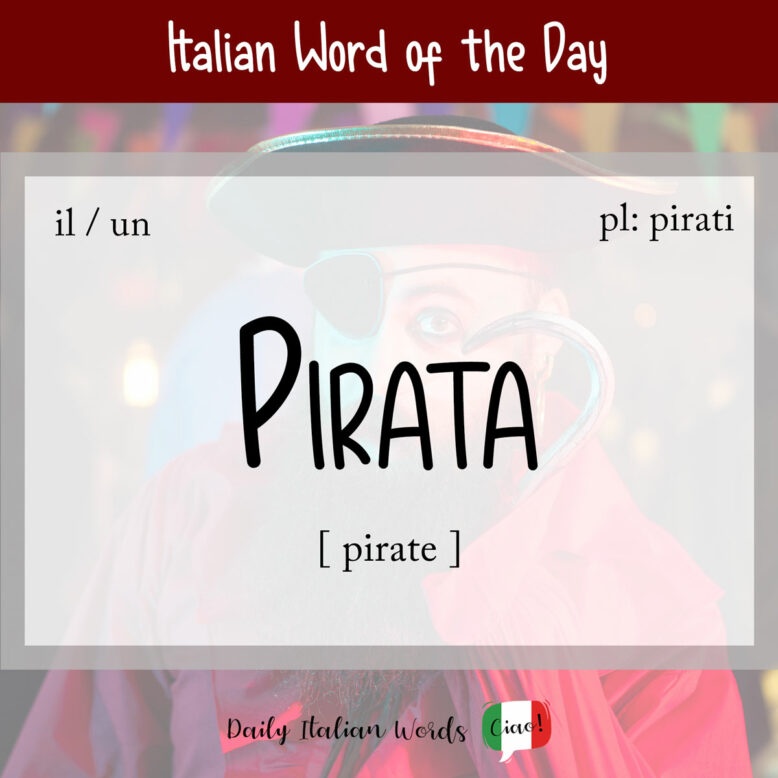
In actual fact, pirata is always pirata, regardless of the gender of the pirate in question. All that changes is the definite or indefinite article. The plural becomes pirati with an -i on the end.
- il pirata = the pirate
- i pirati = the pirates
- un pirata = a pirate
- dei pirati = some pirates
Things get a little more interesting when female pirates come into question. According to the ever-reliable Devoto-Oli dictionary, the correct feminine forms are as follows:
- la pirata = the female pirate
- le pirati = the female pirates
- una pirata = a female pirate
- delle pirati = some female pirates
That said, you may hear some variation. For instance, it’s not uncommon for Italians to say le pirate instead of le pirati, and the feminine form piratessa is widely accepted, even appearing in dictionaries such as Lo Zingarelli. This follows the same pattern as established noun pairs like il poeta / la poetessa and il duca / la duchessa.
All right, I know what you’re thinking: female pirates aren’t exactly a hot topic of conversation. Still, this example offers an interesting glimpse into the flexibility of Italian when it comes to forming feminine nouns.
Il pirata urlò “Terra in vista!”
The pirate yelled out “Land-ho!”
The origin of pirata is pretty straightforward – it comes directly from the Latin pirata, which in turn can be traced back to the Greek πειρατής (peiratēs). The Greek word comes from πειράω (peiráō) meaning “to attempt, try, or attack.”
A synonym for pirate is bucaniere, which of course shares the same etymology as our buccaneer.
At this point, it’s worth taking a look at some pirate-related vocabulary that you might encounter when talking about these sea-bound scoundrels:
- la nave = the ship
- la spada = the sword
- il tesoro sepolto = the buried treasure
- il mare = the sea
- la polvere da sparo = the gunpowder
- il moschetto = the musket
- la pistola = the pistol
- l’asse (di legno) = the plank
- la benda sull’occhio = the eyepatch
- la gamba di legno = the wooden leg
- Capitan Uncino = Captain Hook
Interestingly, in Italian, pirata isn’t limited to swashbucklers on the high seas. It can describe other types of lawbreakers, like il pirata della strada (hit-and-run driver), il pirata dell’aria (plane hijacker) and il pirata informatico (hacker), as well as anyone who can be classified more generally as a thief or swindler. And just like in English, pirata can also function as an adjective to describe illegal or pirated goods, such as CDs and DVDs.


Heather Broster is a graduate with honours in linguistics from the University of Western Ontario. She is an aspiring polyglot, proficient in English and Italian, as well as Japanese, Welsh, and French to varying degrees of fluency. Originally from Toronto, Heather has resided in various countries, notably Italy for a period of six years. Her primary focus lies in the fields of language acquisition, education, and bilingual instruction.