In Italian, if you want to say that something is easy to do, you might say è facile / semplice (it’s easy), è molto facile / semplice (it’s very easy), or è facilissimo / semplicissimo (it’s very easy). All these expressions are just fine, but if you want to go for something a bit more colourful, I’d suggest trying out the idiomatic È un gioco da ragazzi!
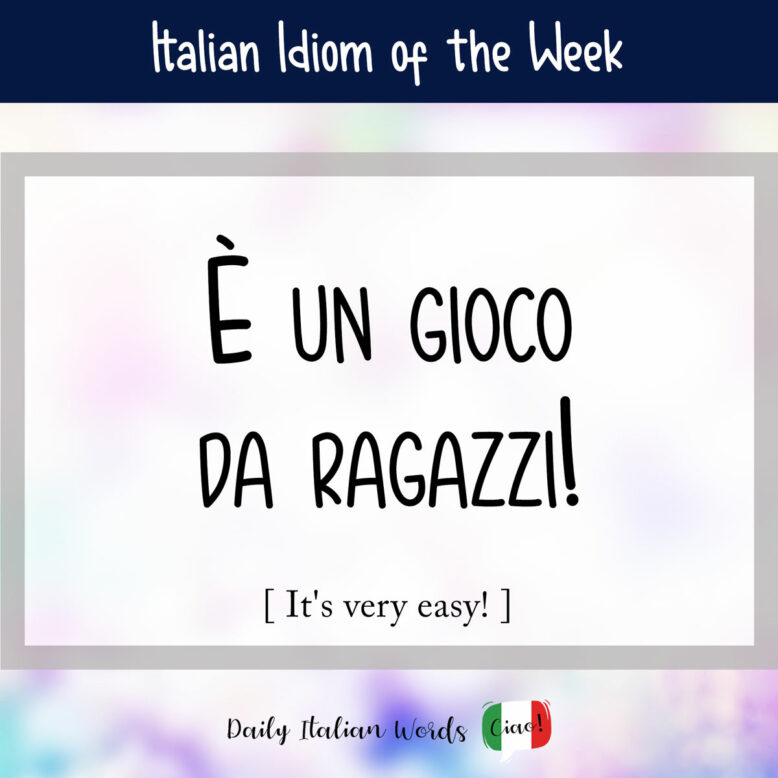
È un gioco da ragazzi!
It’s very easy!
Gioco is the Italian word for game, toy, gambling and occasionally prank, while ragazzi is the plural form of ragazzo, meaning young man, boy, child, guy, or youth depending on the context. Link the two with the preposition da – which in this case translates as for, designed for, or meant for – and you get “a child’s game” or more literally, “a game meant for a child.”
The closest equivalent expressions we have in English including the very similar “it’s child’s play,” “as easy as pie,” “a piece of cake,” or “as easy as ABC.”
Here are a few expressions in Italian that mean the same thing:
- È un gioco da bambini! –> this simply replaces ragazzi with bambini (children)
- È una passeggiata! –> This literally means “It’s a walk” but it is similar to the English “it’s a walk in the park”
- È una cavolata! –> The word cavolata, which derives from cavolo (cabbage), means “stupid thing” and “simple thing.”
Quell’esame era veramente un gioco da ragazzi – chiunque avrebbe potuto superarlo.
That exam really was a piece of cake – anyone could pass it.
The song that won the 2025 edition of the Sanremo song contest was called Volevo essere un duro by Lucio Corsi. If you want an easy way to remember this idiom, just listen to the chorus a few times – it contains the line Vivere la vita, è un gioco da ragazzi… (Living life, it’s as easy as pie).


Heather Broster is a graduate with honours in linguistics from the University of Western Ontario. She is an aspiring polyglot, proficient in English and Italian, as well as Japanese, Welsh, and French to varying degrees of fluency. Originally from Toronto, Heather has resided in various countries, notably Italy for a period of six years. Her primary focus lies in the fields of language acquisition, education, and bilingual instruction.