
A curious fact about the noun ospite in Italian is that is has a double meaning – it can refer to either a guest or a host. This is because, in Latin, the word hospes, from which ospite derives, alluded to the “reciprocity of the pact of hospitality” – or in other words, the idea that the relationship between guest and host was so close that they were almost one and the same. Indeed, the host would often become the guest at some point since it was expected that the invitation be reciprocated.
ospite
guest / host
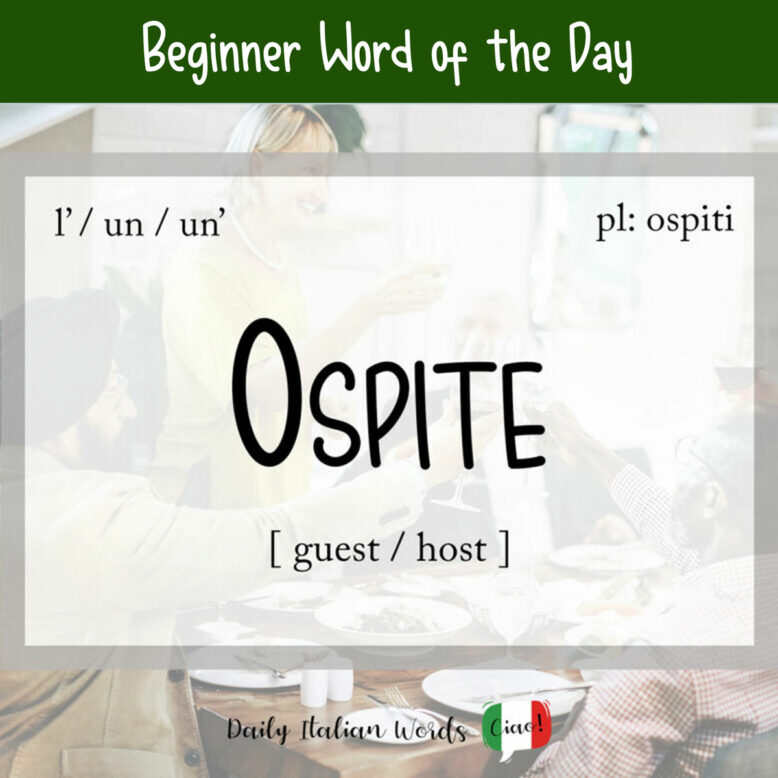
Due to this confusing overlap in meaning, ospite is seldom used in modern day Italian to refer to a host, with terms such as padrone/a di casa, oste, or ospitante being preferred.
Ospite can be either a masculine or feminine noun. All that changes is the article, as you can see below. The only article that remains the same for both is l’ (the definite singular article = the).
- l’ospite = the guest (m)
- un ospite = a guest (m)
- gli ospiti = the guests (m)
- degli ospiti = some guests (m)
- l’ospite = the guest (f)
- un’ospite = a guest (f)
- le ospiti = the guests (f)
- delle ospiti = some guests (f)
Ospiti are usually cortesi (courteous) and graditi (welcome), especially if they are a ospite d’onore (guest of honour), but occasionally you might end up with an ospite indesiderato (unwelcome guest) who pushes the limits of your ospitalità (hospitality).
Questa è la stanza degli ospiti.
This is the guest room.
Ospite can also function as an adjective, as in words such as famiglia ospite (host family), squadra ospite (visiting team) or tifosi ospiti (visiting supporters).
Below are some additional terms that share the same etymology:
- ospitare = to host / house
- ospitale = hospitable / cosy / inviting
- ospitante = hosting / host
Entra, accomodati, sei mio ospite.
Come in, make yourself comfortable, you’re my guest.


Heather Broster is a graduate with honours in linguistics from the University of Western Ontario. She is an aspiring polyglot, proficient in English and Italian, as well as Japanese, Welsh, and French to varying degrees of fluency. Originally from Toronto, Heather has resided in various countries, notably Italy for a period of six years. Her primary focus lies in the fields of language acquisition, education, and bilingual instruction.