An everyday object we would struggle to live without is the humble busta. Let’s discover all the different meanings associated with this word!
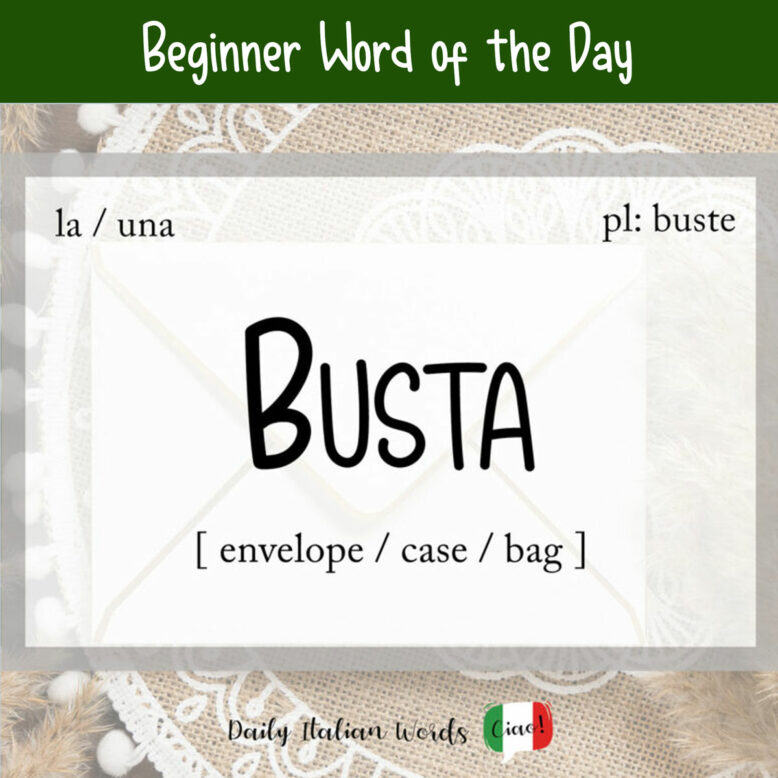
busta
envelope / case / bag
According to Treccani, the word busta derives from the Old French word boiste (which evolved into the modern French boîte, meaning box). This, in turn, comes from the Late Latin buxis, which referred to a small box.
Busta is a feminine noun, meaning that it takes the following definite and indefinite articles:
- la busta = the envelope
- le buste = the envelopes
- una busta = an envelope
- delle buste = (some) envelopes
The first meaning for busta is envelope, as in the flat paper container with a sealable flap, used to enclose lettere (letters). A sealed envelope can be described as una busta sigillata, or simply, una busta chiusa (a closed envelope), whereas for an unsealed envelope, you’d simply say una busta aperta (an open envelope).
Non dimenticarti di incollare il francobollo sulla busta!
Don’t forget to stick the stamp on the envelope!
If you work in Italy on a subordinate contract, you will receive a document called busta paga (pay check, also known as a wage slip or salary statement) from your employer at the end of each month. It addition to showing the salary you must receive for the work you’ve done, it is also proof that you have a regular job.
Historically, employees in Italy were paid their wages in cash directly inside a small envelope, which explains the reference to busta in the term busta paga. This word is often used figuratively to indicate a person’s salary as well – for example, you might hear the expression fuori dalla busta paga, which refers to unrecorded or untaxed money given to you outside of your regular salary.
Here are a few more terms associated with envelopes:
- busta a / con finestra = windowed envelope (the kind with a plastic window)
- busta affrancata = stamped envelope
- busta intestata = headed envelope
More broadly, busta can refer to any envelope or folder made of paper, cardboard, leather, or plastic whose purpose is to hold documents.

Of course, envelope isn’t the only translation for busta. Another common translation is bag or pouch, as in busta per / degli occhiali (eyeglass pouch) or busta portatrucco (make-up bag). It may also denote a small handbag without handles, similar to the French pochette.
Rimetti gli occhiali nella busta.
Put your glasses back in their pouch.
Finally, you can expect to hear busta, or more commonly the diminutive bustina, to refer to small paper or plastic bags, or to a sachet containing a product in liquid or powder form. For example, we have la bustina del tè (tea bag), la bustina dello zucchero (sugar sachet) or medicinale in bustine (medicine in packets).
Si dice che sia meglio non schiacciare la bustina del tè contro il bordo della tazza.
They say it’s better not to squish the tea bag against the side of the mug.
Bustina may also refer to a type of military cap, known as un berretto a bustina. Other names in English for this kind of cap include garrison cap or side cap.

Heather Broster is a graduate with honours in linguistics from the University of Western Ontario. She is an aspiring polyglot, proficient in English and Italian, as well as Japanese, Welsh, and French to varying degrees of fluency. Originally from Toronto, Heather has resided in various countries, notably Italy for a period of six years. Her primary focus lies in the fields of language acquisition, education, and bilingual instruction.