
The meaning of the Italian noun partita changes depending on whether it appears in a sporting, accounting or business context. Let’s discover all the possible translations now!
partita
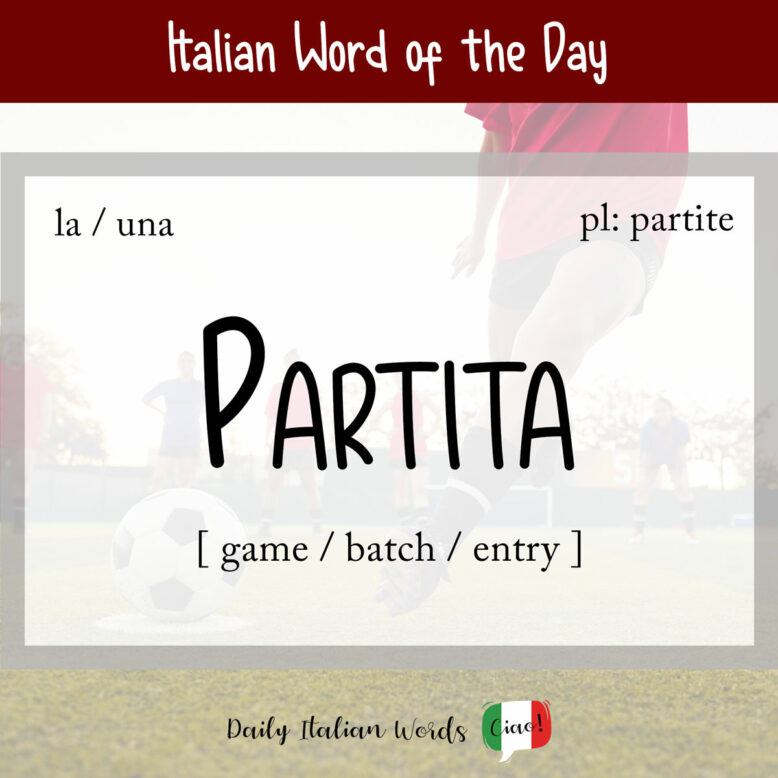
As you’ve probably guessed, partita is a feminine noun that takes the following definite and indefinite articles:
- la partita = the game
- le partite = the games
- una partita = a game
- delle partite = (some) games
The translation with which most learners will be familiar is game or match. A few common examples include una partita di calcio (a soccer match), una partita a carte (a card game), and una partita di tennis (a tennis game).
Partita di calcio or partita a calcio?
Both versions are correct, but using the preposition di usually refers to the sporting event itself, as in Dove posso guardare la partita di calcio? (Where can I watch the soccer game?).
Partita a calcio, on the other hand, refers to the practical act of playing, so, for instance, you’d say to your friends Facciamo una partita a calcio (Let’s play soccer).
È stata una partita meravigliosa!
It was a wonderful match!
From this usage comes the expression essere della partita, meaning “to take part/participate” or “to be in the game.” Truccare una partita means to fix a match – something that could ultimately result in una partita di recupero, or a rematch.
Matches and games don’t always have to be formal. A community of close-knit people might enjoy una partita amichevole (a friendly match) of soccer on the weekends.
The meaning also extends to the word of hunting, where a hunting party is known as una partita di caccia.

A lesser known translation, used in a business context, is lot, batch, order or consignment. You will hear workers talk about una partita di caffè (an order of coffee) in a coffee shop, or una partita di latte scaduta (an expired batch of milk) in a supermarket.
Questa partita di cioccolato è più grande di quanto pensassi.
This batch of chocolate is bigger than I thought it would be.
Finally, we arrive at its use in an accounting context. One term that will likely sound familiar – especially if you’ve ever worked as a freelancer in Italy – is la partita IVA, the Italian equivalent of a VAT number. But that’s just one example; partita appears in several other contexts as well. You may also come across:
- partita contabile = accounting entry
- partita catastale = land registry record/plot
- partita tavolare = land registry number
- partita aperta = open debit payment entry
- partita semplice = single entry
- partita doppia = double entry
- partita di giro = clearing entry
- saldare una partita = to pay a bill
Devo aprire la partita IVA.
I have to register for VAT.

One meaning I haven’t yet mentioned is its use as the past participle of partire, meaning “to leave.” It appears as partita when the person or thing that has left is feminine – for example:
- Maria è partita = Maria has left
- La moto è partita = The motorcycle has left
Lara è partita dopo di me.
Lara left after me.
Partita shouldn’t be confused with partito. While partito is the masculine form of the past participle, it also functions as a noun meaning political party, among other things we’ll explore in a future article!

Heather Broster is a graduate with honours in linguistics from the University of Western Ontario. She is an aspiring polyglot, proficient in English and Italian, as well as Japanese, Welsh, and French to varying degrees of fluency. Originally from Toronto, Heather has resided in various countries, notably Italy for a period of six years. Her primary focus lies in the fields of language acquisition, education, and bilingual instruction.