When you’re faced with a seemingly insurmountable task or challenge, it’s easy to want to throw your hands up and walk away. And yes, sometimes it really is best to let certain things go. But if you genuinely want to succeed, remember: non darti per vinto – don’t give up!
darsi per vinto
to give up
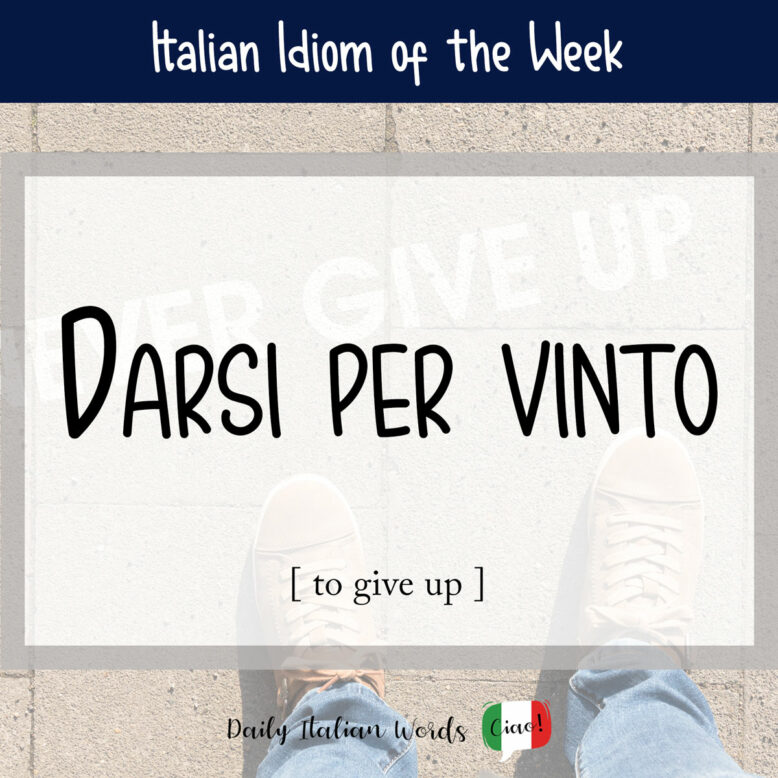
Darsi per vinto is an Italian idiomatic expression that literally means something along the lines of “to give oneself for defeated”, but in natural English the best translations are to give up or to consider oneself defeated.
Non darti per vinto – hai appena cominciato!
Don’t give up – you’ve just started!
Here’s the breakdown of the grammar:
- darsi = This is the verb darsi, which is a reflexive form of dare (to give). Si is a reflexive pronoun and means oneself.
dare = to give
darsi = to give oneself / to submit oneself
- per = A preposition meaning for or as and in this expression, it introduces a state or condition someone considers themselves to be in
- vinto = The past participle of vincere (to win), as well as being a noun that means loser / defeated person
vincere = to win
vinto = won / defeated (the context determines which side you’re on) but in this case, it clearly means defeated. Keep in mind that the gender of vinto will change depending on the subject. So, for example, if you are talking about a woman, you need to say darsi per vinta, with the feminine ending -a.
Paola è il tipo di persona che non si dà mai per vinta.
Paola is the type of person who never gives up.
Here are a few useful synonyms for this expression:
- arrendersi (the closest synonym)
- desistere (formal)
- cedere (formal)
- mollare (informal)


Heather Broster is a graduate with honours in linguistics from the University of Western Ontario. She is an aspiring polyglot, proficient in English and Italian, as well as Japanese, Welsh, and French to varying degrees of fluency. Originally from Toronto, Heather has resided in various countries, notably Italy for a period of six years. Her primary focus lies in the fields of language acquisition, education, and bilingual instruction.