A few days ago, we learned everything there is to know about the word dopo, and today, we’re going to investigate its contrario (opposite): prima. Suffice it to say, it has just as many (if not more) translations as dopo!
If you’re struggling to remember this word, just think of the operatic term prima donna, which literally translates as first lady!
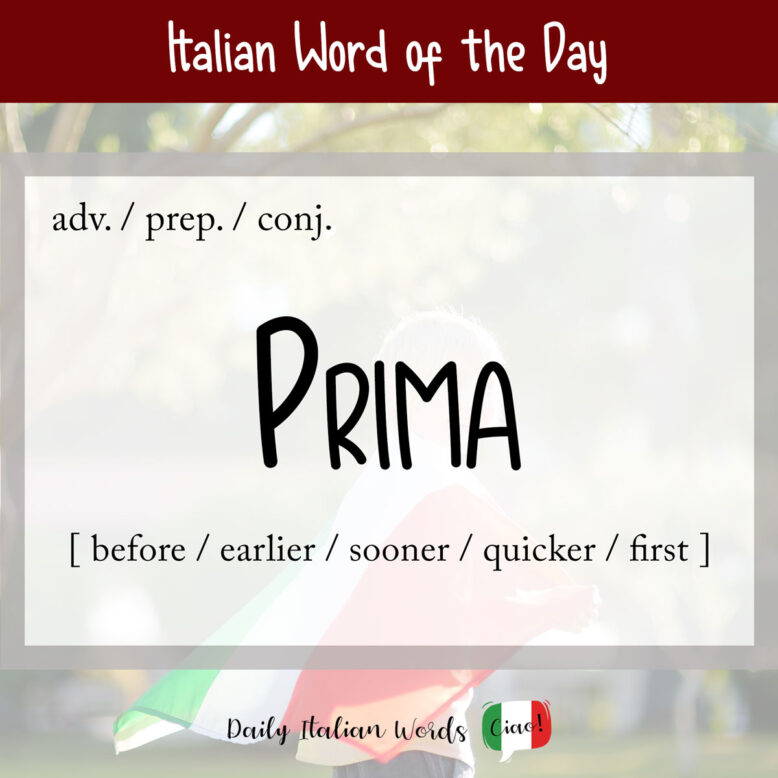
prima
before / earlier / sooner / quicker / first
1. PRIMA = Before
The primary translation with which you’ll probably be familiar is before.
Prima non lo sapevo ma adesso lo so.
I didn’t know before, but now I do.
Giorgia non è più la stessa ragazza di prima.
Giorgia is no longer the same girl as before.
When before is the meaning, you will often see it accompanied by the preposition di (of) followed by a pronoun, noun, or verb, or the conjunction che (that) followed by a subordinate clause.
Keep in mind that che requires the verb that follows it to be in the subjunctive mood (il congiuntivo), and di will change its form if followed by an article (e.g. della, degli, dello, etc.). Let’s look at a few examples:
Marco è arrivato prima dell‘inizio dello spettacolo.
Marco arrived before the show started.
Dobbiamo lavarci le mani prima di cenare.
We must wash our hands before having dinner.
Lui era prima di me sulla lista.
He was before me on the list.
Vai a cambiarti prima che arrivino gli ospiti!
Go and change before the guests arrive!
Up until now, we’ve discussed prima meaning before in a temporal sense, but it can also be used in a spacial sense. In this case, it’s best translated as back.
La scuola era due chilometri prima.
The school was two kilometres back.
2. PRIMA = In advance / Beforehand
Prima can also mean in advance or beforehand. A possible synonym in this case is in anticipo or con anticipo.
Puoi dirmelo prima la prossima volta?
Can you tell me in advance next time?
Purtroppo, mi hanno avvisato solo tre giorni prima.
Unfortunately, they told me just three days beforehand.
3. PRIMA = At one time / Used to / Formerly
You may also see prima translated as at one time, used to, or formerly to talk about customs or habits of people from a bygone era.
Prima i giovani non si vestivano così.
Young people didn’t use to dress like that.
At one time, young people didn’t dress like that.
Erano belle le usanze di prima ma ora tutto è cambiato.
The former customs were beautiful, but now everything has changed.
4. PRIMA = Earlier / Sooner / Quicker / Faster
Now we come to one of the more confusing meanings for learners. Not only can prima mean earlier, but it can also be translated as sooner, quicker or faster. As is often the case, it’s context that plays a key role in helping you discover the best translation!
Perché non sei arrivato prima?
Why didn’t you arrive earlier / sooner?
Ti conviene finire prima, altrimenti perderai il treno.
You’d better finish faster, otherwise you’ll miss the train.
A very common expression is si fa prima, which is used when you feel that one option would be easier or quicker than a different option, or that it would save you time.
Che barba, il treno è di nuovo in ritardo! Si fa prima ad andare a piedi!
What a drag, the train is late again! It would be faster to walk!
Secondo me si fa prima a chiamare il ristorante che compilare il modulo sul loro sito… è complicatissimo!
In my opinion, it’s quicker to call the restaurant than to fill out the form on their website… it’s incredibly complicated!
5. PRIMA = First / First of all
Another very common translation for prima is first, or first of all. When running through a list of things you plan to do, you’ll often see prima followed by poi (then), as in the following example:
Prima facciamo colazione, poi andiamo a fare una passeggiata, ok?
First (of all), we’ll have breakfast, then we’ll go for a walk, okay?
This same pattern appears in the idiomatic expression prima il dovere e poi il piacere (duty before pleasure, or literally “first duty, and then pleasure”).
Ho sempre detto a me stesso: prima la famiglia e poi il lavoro.
I have always told myself: family first, then work.
Prima also appears in a number of other expressions that contain first in English:
- in prima (classe) = in first class (viaggiare in prima = to ride in first class)
- la prima = first gear (ingranare/innestare la prima = to put the car into first gear)
- la prima elementare = first grade (of elementary school) (andare in prima = to go into first grade)
- la prima media = sixth grade (first grade of middle school)
- la prima superiore/liceo = tenth grade (first grade of secondary school) (fare la prima liceo = to be a freshman in high school)
- la prima = première of a film / opening night at the theatre
- prima di tutto = first of all
- amore a prima vista = love at first sight
- di prima mano = first-hand
- in prima fila = in the front/first row

Common expressions featuring ‘prima’
Amici come prima!
English meaning: Let’s make up! / Let’s be friends again!
Literal translation: Friends like before!
Prima o poi
English meaning: Sooner or later
Literal translation: Before or then
Il prima possible
English meaning: As soon as possible
Literal translation: The first possible
In prima persona
English meaning: Personally
Literal translation: In first person

Heather Broster is a graduate with honours in linguistics from the University of Western Ontario. She is an aspiring polyglot, proficient in English and Italian, as well as Japanese, Welsh, and French to varying degrees of fluency. Originally from Toronto, Heather has resided in various countries, notably Italy for a period of six years. Her primary focus lies in the fields of language acquisition, education, and bilingual instruction.