There are a few “mild” Italian curse words that I would happily use in front of mia suocera (my mother-in-law) without feeling the slightest bit guilty, and mannaggia is definitely one of them!
mannaggia
darn / shoot / blast
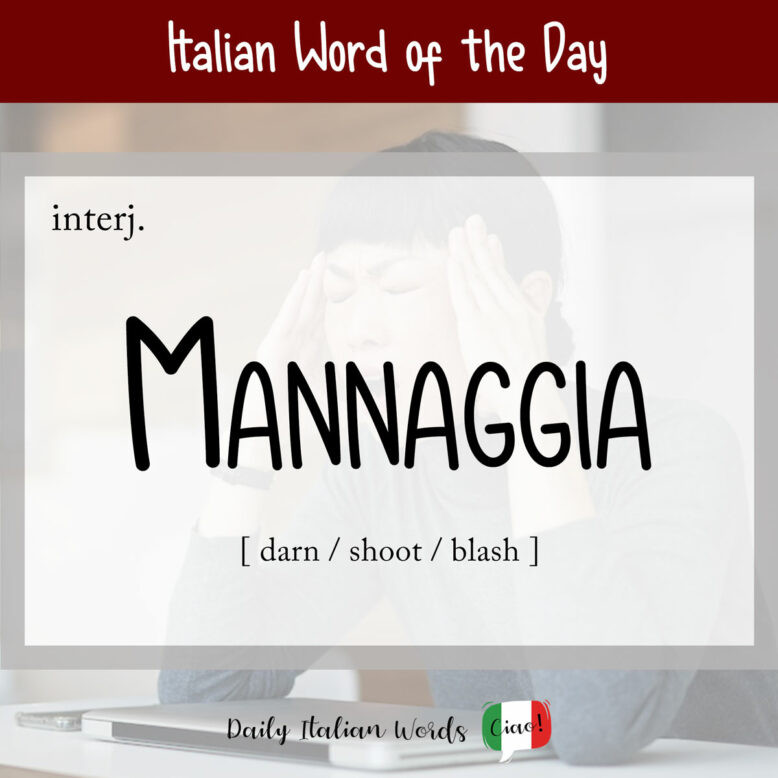
Mannaggia is an exclamation, or more specifically an interjection, used when someone is being annoying or a situation is frustrating. It communicates just the right amount of mild anger without crossing over into genuinely offensive territory. You can say it when you’ve perso il treno (missed the train), fatto cadere qualcosa (dropped something), dimenticato cosa stavi facendo (forgotten what you were doing), or simply reached the end of your pazienza (patience).
If you spend enough time listening to Italians, sooner or later you are almost certain to hear mannaggia. (And in fact, if you ask an Italian which words they remember from their childhood, this one is often high on the list!)
Depending on the situation and tone of voice, it can mean anything from damn! to the much milder drat! Here is an incomplete list of all the translations I can think of! (I’m sure there are more but you get the drift!)
- Damn!
- Darn!
- Dammit!
- Blast!
- Drat!
- For goodness’ sake!
- Curse it!
- Oh, come on!
Mannaggia! Ho dimenticato le chiavi.
Damn! I forgot my keys.
You can use it on its own, or you have the option of attaching something to it to make the source of the frustration more specific, or for pure dramatic effect. Here are a few common examples:
- Mannaggia a te! = Damn you! / Blast you!
- Mannaggia la miseria! = literally “Damn the misery!”
- Mannaggia la polenta! = literally “Damn the polenta!”
- Mannaggia la marosca! = marosca is a euphemism for Madonna (mostly used in Rome and southern Italy)
Mannaggia a te, mi hai fatto prendere uno spavento!
Damn you, you gave me such a fright!
The expression is generally much less harsh than other curse words you’ll encounter in the average Italian lexicon. It can be used seriously, sure, but it is also very common in humorous or exaggerated speech. For example, if my son were to lose an important Lego piece for the hundredth time – true story – I might exclaim in a joking yet exasperated tone:
Oh mannaggia, hai perso di nuovo quel pezzo? Cosa facciamo con te!
Oh, for goodness’ sake, did you lose that piece again? What are we going to do with you!
According to Accademia della Crusca, there is more than one explanation for the word’s origin, so its etymology isn’t completely clear.
One explanation traces mannaggia back to a southern Italian expression formed from three parts: mal(e) n(e) aggia. Here, aggia is a southern form corresponding to standard Italian abbia, the subjunctive form of avere (“to have”).
Another possibility, and the one linguist Giuseppe Patota favours, is that mannaggia developed as a shortened form of malannaggia, the combination of mal anno (misfortune, bad thing, literally a bad year in the older expression) and aggia.
Mannaggia! Dove ho messo gli occhiali?
Dammit! Where did I put my glasses?


Heather Broster is a graduate with honours in linguistics from the University of Western Ontario. She is an aspiring polyglot, proficient in English and Italian, as well as Japanese, Welsh, and French to varying degrees of fluency. Originally from Toronto, Heather has resided in various countries, notably Italy for a period of six years. Her primary focus lies in the fields of language acquisition, education, and bilingual instruction.