
I have many faults, including being an incurable perfectionist and horribly self-critical, but one thing I am not and will never be is a spendthrift. In fact, I am quite the opposite – with the exception of my dad, I am probably the most frugal person in my family.
Someone who spends money like water is said to have le mani bucate in Italian, or literally, holes in their hands.
avere le mani bucate
to be a spendthrift
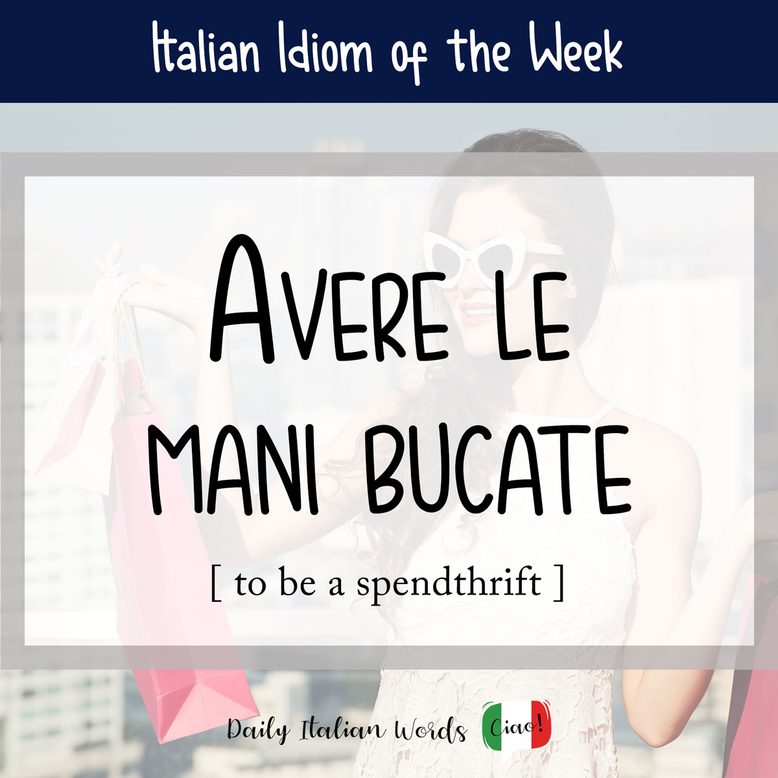
A good example of this kind of behaviour is a traveller arriving in Firenze and, within a single hour in Piazza della Signoria, completely transforming their wardrobe with a new vestito (dress), borsa (bag), and a stylish pair of scarpe (shoes).
Mia zia ha le mani bucate. Ecco perché non ha più un soldo in banca!
My aunt is a spendthrift. That’s why she doesn’t have a single penny left in the bank!
La mano is a feminine noun in Italian, despite ending in -o, and becomes le mani in the plural form. It is one of many nouns that descends from Latin, specifically the feminine noun manus. Its -o ending is an exception to the usual pattern.
Bucato, on the other hand, is an adjective meaning perforated, punctured, pierced, or more simply, with a hole. It becomes bucate because it has to agree with the feminine plural noun mani.
At the other end of the spectrum is parsimonioso, someone who is very careful with their money, and tirchio, someone who crosses the line from thrifty to outright stingy.


Heather Broster is a graduate with honours in linguistics from the University of Western Ontario. She is an aspiring polyglot, proficient in English and Italian, as well as Japanese, Welsh, and French to varying degrees of fluency. Originally from Toronto, Heather has resided in various countries, notably Italy for a period of six years. Her primary focus lies in the fields of language acquisition, education, and bilingual instruction.