
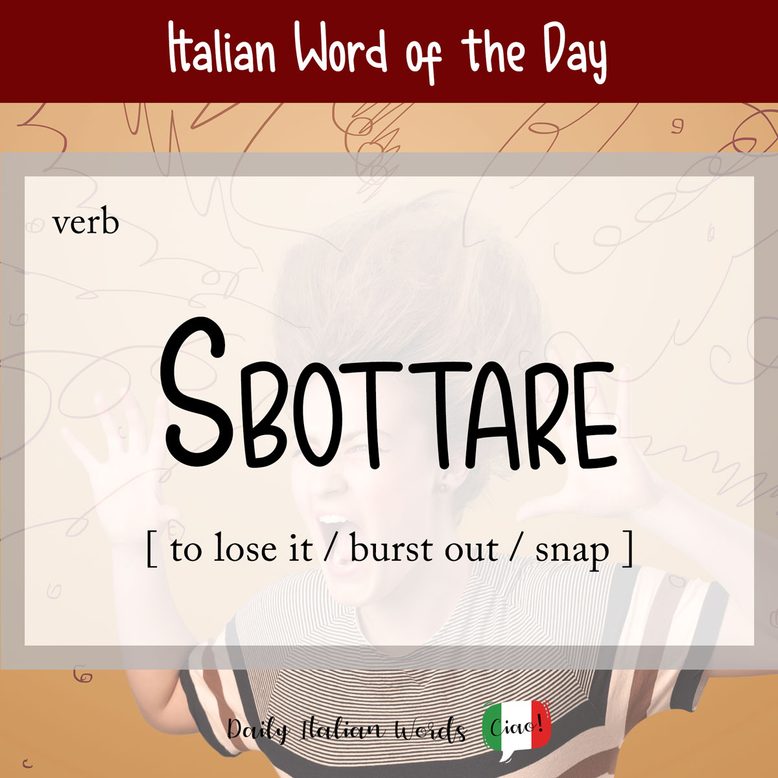
I’m generally a very patient individual, but if you push me too far, I am liable to lose my composure. The verb to describe someone who suddenly becomes unable to control their temper or emotions is sbottare, and that’s our word of the day!
sbottare
to lose it / burst out / snap
According to the ever-reliable Treccani dictionary, the Italian verb sbottare is a derivative of botta, meaning blow, hit, or sudden shock (from the Vulgar Latin būttis, related to striking or a sudden impact). The suffix is -ARE, the first-conjugation infinitive ending. Here is how it conjugates in the present tense:
- io sbotto = I lose it
- tu sbotti = you lose it (singular / informal)
- lui sbotta = he loses it
- lei sbotta = she loses it
- Lei sbotta = you lose it (singular / formal)
- noi sbottiamo = we lose it
- voi sbottate = you lose it (plural)
- loro sbottano = they lose it
Sbottare is an intransitive verb conjugated with the auxiliary verb essere (to be). This means that, when using the present perfect, for example, you need to use essere + sbottato and the ending -o must change to match the gender and number of the subject.
- io sono sbottato/a = I lost it
- tu sei sbottato/a = you lost it (singular / informal)
- lui è sbottato = he lost it
- lei è sbottata = she lost it
- Lei è sbottato/a = you lost it (singular / formal)
- noi siamo sbottati/e = we lost it
- voi siete sbottati/e = you lost it (plural)
- loro sono sbottati/e = they lost it
Stufa di essere provocata, alla fine è sbottata.
Tired of being provoked, she lost it in the end.
Usefully, sbottare can replace dire as a dialogue tag following quotes in stories, but – as you can imagine – only if the speaker is suddenly venting a pent-up emotion or losing their temper.
“Lasciami in pace!”, sbottò Enrico.
“Leave me alone!”, snapped Enrico.
You’ll also see sbottare used to describe uncontrollable laughter or tears, as in the following phrases:
Ha raccontato una barzelletta così buffa che sono sbottato in una grossa risata.
He told such a funny joke that I burst out laughing.
Romina e Maria sono sbottate a piangere quando hanno sentito la notizia.
Romina and Maria burst into tears when they heard the news.


Heather Broster is a graduate with honours in linguistics from the University of Western Ontario. She is an aspiring polyglot, proficient in English and Italian, as well as Japanese, Welsh, and French to varying degrees of fluency. Originally from Toronto, Heather has resided in various countries, notably Italy for a period of six years. Her primary focus lies in the fields of language acquisition, education, and bilingual instruction.