I can’t quite remember the first time I heard the Italian word ambaradan, but I do remember quite clearly how it made me smile from ear to ear. It’s taken me until now to finally look into its origins properly, and having discovered its history, I’ve fallen even more in love with this wonderfully quirky word!
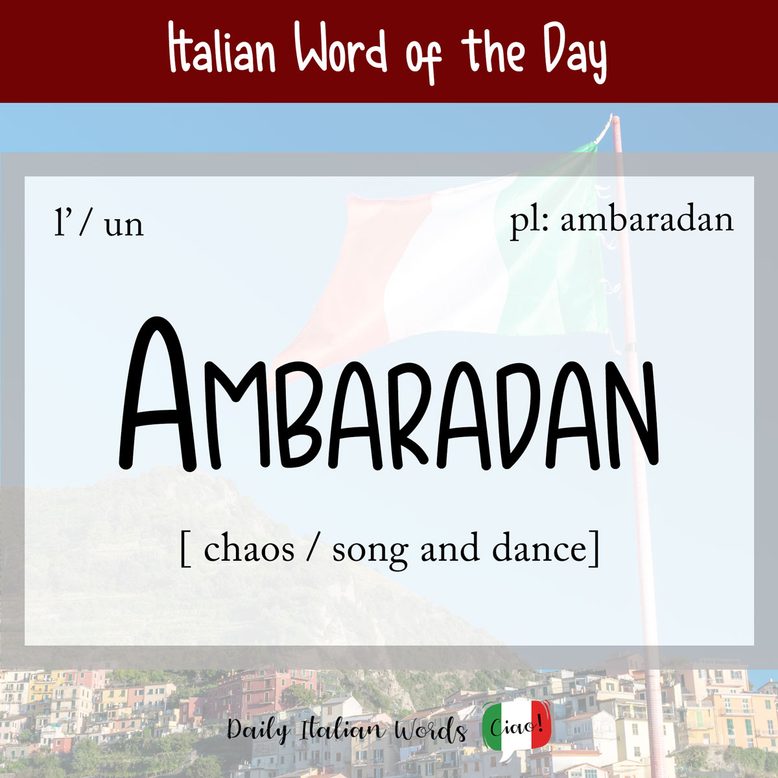
ambaradan
chaos / song and dance
Ambaradan, as it turns out, most likely comes from Amba Aradam, the name given to a steep table mountain and surrounding region in northern Ethiopia. The word amba means a flat-topped mountain or plateau in the Amharic language.
In February 1936, during the Second Italo-Ethiopian War, Italian troops fought a chaotic battle against Ethiopian forces at Amba Aradam, known as the Battle of Enderta. It is said that the fighting was confusing, bloody, and difficult to manage, so much so that when Italian soldiers eventually returned home, they began using the name of the location to describe any tangled, disordered, or chaotic situation. (Source: Accademia della Crusca)
Today, it is used a masculine invariable noun that can mean either a complete mess, chaos or shambles, or a complicated or convoluted procedure that requires a great amount of effort to sort out – what we might call a “song and dance” in English.
- l’ambaradan
- gli ambaradan
- un ambaradan
- degli ambaradan
Che ambaradan!
What a mess / palaver!
There’s no shortage of synonyms for this word, a couple of which have already featured in our word of the day series:
Per arrivare fin qui abbiamo dovuto fare un ambaradan assurdo.
We had to go through an absurd amount of hassle to get here.
C’era un ambaradan incredibile alla stazione ieri.
There was an incredible amount of chaos at the station yesterday.
Despite its bloodstained origins, ambaradan is certainly worth adding to your vocabulary – if you can manage to say it, that is. I still find it a bit of a tongue-twister to this day!


Heather Broster is a graduate with honours in linguistics from the University of Western Ontario. She is an aspiring polyglot, proficient in English and Italian, as well as Japanese, Welsh, and French to varying degrees of fluency. Originally from Toronto, Heather has resided in various countries, notably Italy for a period of six years. Her primary focus lies in the fields of language acquisition, education, and bilingual instruction.