
It is common practice in all countries, including Italy, to add le spezie (spices) and le erbe (herbs) to dishes to add extra flavour, heat or brightness. One of the most popular herbs in Italy is prezzemolo, which is why we’ve decided to feature it as our word of the day.
prezzemolo
parsley
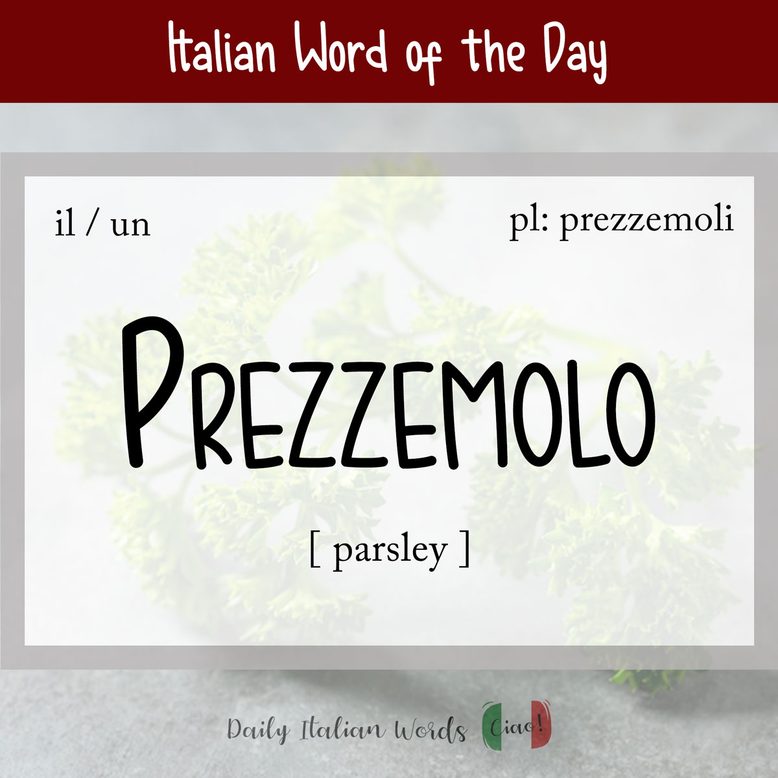
Prezzemolo is a masculine noun whose plural form is prezzemoli. However, it is also an uncountable mass noun, so you rarely need to use the plural in normal cooking contexts, just as you wouldn’t say parsleys in English. It takes the following definite and indefinite articles:
- il prezzemolo
- un prezzemolo
- i prezzemoli
- dei prezzemoli
According to Treccani, prezzemolo originates from the Latin word petroselīnum, which itself was borrowed from the Ancient Greek πετροσέλινον (petrosélinon). The Greek root can be broken down into two components: pétra (πέτρα) meaning stone or rock and sélinon (σέλινον) meaning celery. So literally, the word translates as something along the lines of “celery that grows among the stones,” referencing the plant’s tendency to grow wild in rocky crevices. Fascinating, non pensi (don’t you think)?
Ricordati di aggiungere un pizzico di prezzemolo fresco sulla pasta prima di servirla!
Remember to add a pinch of fresh parsley to the pasta before serving it!
Here are some verbs you might see used with prezzemolo in recipes:
- tritare = to chop / to mince
- tagliare = to cut
- mettere = to put
- aggiungere = to add
- lavare = to wash
- asciugare = to dry
- congelare = to freeze
- spolverare = to sprinkle / dust
- insaporire = to flavour / to season
You may also encounter words such as manciata (a handful) or un pizzico (a pinch) when talking about rough quantities of prezzemolo.
Aggiungi una manciata di prezzemolo alla fine per dare colore al piatto.
Add a handful of parsley at the end to give colour to the dish.
Prezzemolo fresco (fresh parsley) is by far the tastiest, especially if it’s just been picked from your garden, but prezzemolo secco / essiccato (dried parsley) also works in a pinch.
A very common idiomatic expression in Italian is essere come il prezzemolo, which literally translates as to be like parsley. It is used to comment on someone or something that can be found everywhere, just like parsley in Italian cuisine.
Vado in palestra, e c’è Marco; vado al supermercato, e c’è Marco: è proprio come il prezzemolo!
I go to the gym, and Marco is there; I go to the supermarket, and Marco is there: he pops up all over the place!

Heather Broster is a graduate with honours in linguistics from the University of Western Ontario. She is an aspiring polyglot, proficient in English and Italian, as well as Japanese, Welsh, and French to varying degrees of fluency. Originally from Toronto, Heather has resided in various countries, notably Italy for a period of six years. Her primary focus lies in the fields of language acquisition, education, and bilingual instruction.