
I dedicate today’s word of the day to my dear old papà (dad), a fellow language enthusiast whose favourite French word is libellule. You can imagine his delight when he discovered that the Italian equivalent is almost identical in both spelling and pronunciation!
libellula
dragonfly
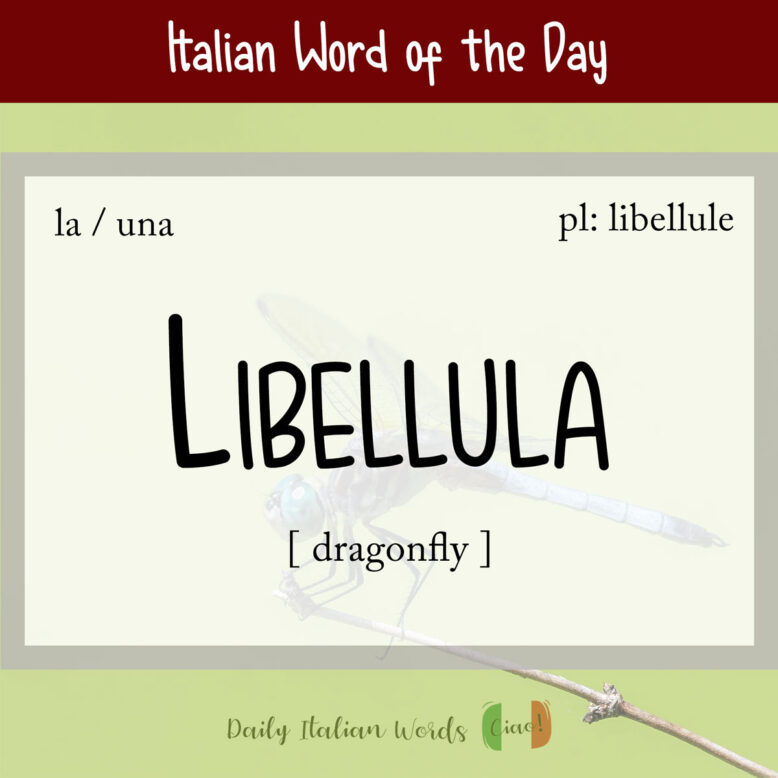
The etymology of libellula is definitely more interesting than its English counterpart. According to Treccani, it derives from the scientific Latin Libellula, which is a diminutive of classical Latin libella (a spirit level). Libella, in turn, is a diminutive of libra, meaning scales or balance. The name was supposedly inspired by the dragonfly‘s horizontal wings when flying, which resemble a spirit level!
Libellula is a feminine noun whose plural form is libellule. It takes the following definite and indefinite articles:
- la libellula = the dragonfly
- le libellule = the dragonflies
- una libellula = a dragonfly
- delle libellule = some dragonflies
The dragonfly’s chosen habit is any still body of fresh water, be that uno stagno (a pond), una palude (a swamp), un lago (a lake), or a slow-moving ruscello (stream) or fiume (river). They require this kind of tranquil environment because they spend most of their lives underwater before emerging as flying adults.
The verb you will most frequently need to use when talking about libellule is, of course, volare (to fly), but you may also benefit from memorising more advanced verbs such as:
- librarsi = to hover (keep in mind that it is reflexive!)
- planare = to glide
- sfrecciare = to dart / whiz past
- posarsi = to land / settle (this verb is also reflexive!)
- danzare = to dance
- ronzare = to buzz / hum
La libellula si libra sopra lo stagno, poi sfreccia via e si posa su una foglia.
The dragonfly hovers over the pond, then darts away and lands on a leaf.
Dragonflies are some of the fastest flying insects on la Terra (Earth), with some of the larger species boasting speeds of up to 35 miles per hour (56 km/h). They benefit from nearly 360-degree vision, have a 95% hunting success rate, and can eat up to 100 zanzare (mosquitoes) in a single day.
Even more incredibly, dragonfly ancestors, called Meganeura, had a wingspan of up to 75cm, roughly the size of a gabbiano (seagull)! I wouldn’t want to bump into one of them in a dark alley, that’s for sure.


Heather Broster is a graduate with honours in linguistics from the University of Western Ontario. She is an aspiring polyglot, proficient in English and Italian, as well as Japanese, Welsh, and French to varying degrees of fluency. Originally from Toronto, Heather has resided in various countries, notably Italy for a period of six years. Her primary focus lies in the fields of language acquisition, education, and bilingual instruction.