
There are many things we hope to avoid in life – feeling stressati (stressed), being ammalati (unwell), and experiencing infelicità (unhappiness) – but one situation that can lead to all of these is finding oneself al verde, completely broke and without a penny.
essere al verde
to be broke
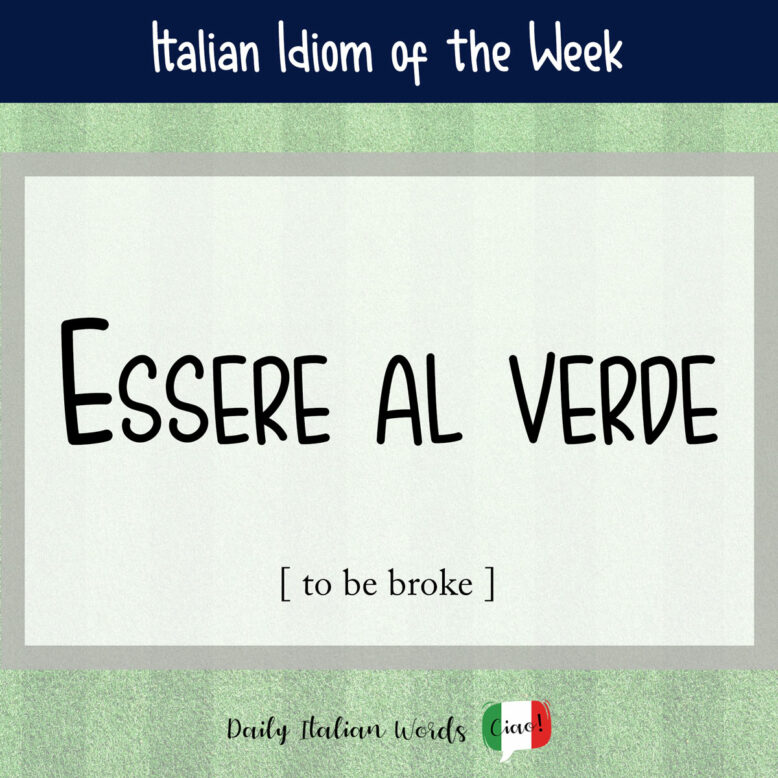
The literal translation is “to be at the green,” with al being the combination of the preposition a (to/at), and il (the). Verde is simply the colour green.
Sono al verde: ti prego, prestami 100 euro!
I’m broke: please, lend me €100!
Unfortunately, the exact origin of this expression is uncertain, but that hasn’t stopped people from speculating what it might be. Here are some of the main theories:
- In public auctions in Firenze, candles were painted green at the base. When the flame reached the green part, the auction ended. This led to “being in the green,” meaning time had run out.
- In the olden days, poor people would burn candles all the way to their green base so as to make them last as long as possible. Once they reached the green, they had nothing left.
- The inside lining of purses was often green, so when you weren’t left with a lira to your name, you would only see the green interior.
- It could have links to a sort of Medieval punishment, where bankrupt people were allegedly made to wear a green cap as a sign of public shame.
- In Medieval times, a green lantern signalled that food was available for a specific group of “ashamed poor,” allowing them to enter discreetly – possibly linking green with need or lack.
- If you live in Padova, you probably believe the “green room” theory. In Caffè Pedrocchi, there was once a green room where people could sit without buying anything, associating green with having no money.
- One theory suggests that the idiom may have links to gambling. When gamblers lost everything, they were left staring at the green table surface.
Overall, the most widely accepted explanations are the candle and empty purse theories since both are closely associated with the idea of resources being used up. You can see a complete list of possible theories here, some of which are quite entertaining!
Another word you can use to describe someone who is penniless is squattrinato, a derivative of quattrino, meaning farthing but also money in informal speech. The s- prefix changes the meaning of the word to its opposite, so if you call someone squattrinato, you are literally saying they have no money.

Heather Broster is a graduate with honours in linguistics from the University of Western Ontario. She is an aspiring polyglot, proficient in English and Italian, as well as Japanese, Welsh, and French to varying degrees of fluency. Originally from Toronto, Heather has resided in various countries, notably Italy for a period of six years. Her primary focus lies in the fields of language acquisition, education, and bilingual instruction.