
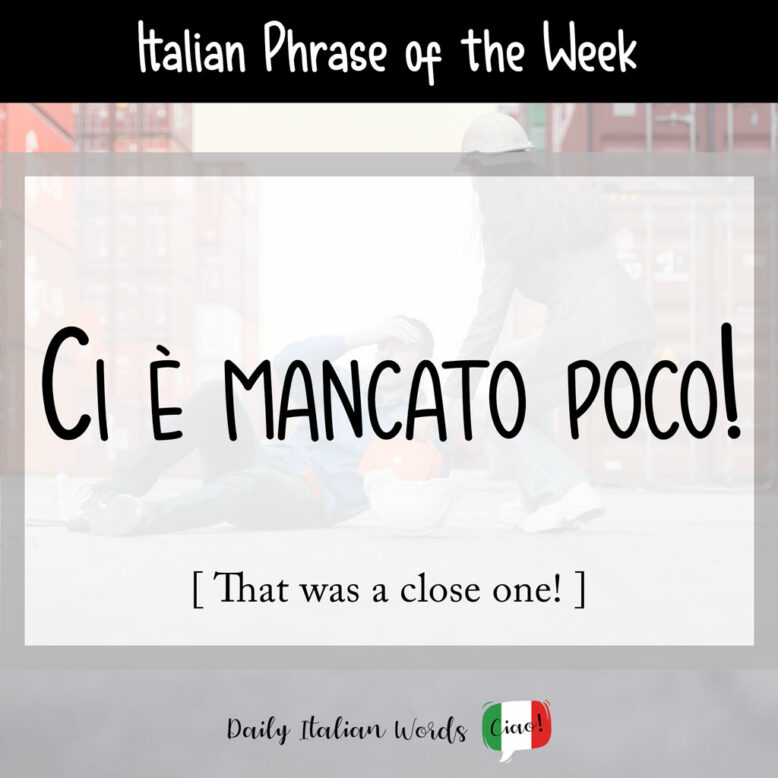
Ci è mancato poco is a common Italian expression used to indicate that an event, often negative, was narrowly avoided. It corresponds perfectly to the English idiom “a close one” or “a close call”.
Ci è mancato poco!
That was a close one!
Let’s break it down into its component parts:
Let’s start with the verb mancare. It literally means “to miss” in both the sense of noticing the loss or absence of someone, and the sense of failing to hit, reach or come in contact with something. It is also used to refer to a remaining amount of time.
- Mi manca Maria. = I miss Maria.
- Ho mancato il bersaglio. = I missed the target.
- Manca un’ora alla destinazione. = We’re an hour away from our destination.
In this expression, it refers to the idea of just avoiding contact with something dangerous or unfortunate.
Now we can move on to that tricky little particle ci. In ci è mancato poco, the ci is a demonstrative pronoun, or in other words, it replaces di quello / in quello / su quello / a quello (of it / in it / on it / to it). Though no one would ever say this, we can technically reword the phrase as: È mancato poco a quello – which is literally like saying “it was missed/avoided by this much”.
Poco simply means “a little” and is often shortened to po’ in the expression un po’ (a little).
Ci è mancato poco, ma il poliziotto è riuscito a prendere il ladro.
It was a close call, but the policeman managed to catch the thief.
Here are some example sentences where ci è mancato poco might appear. As you can see, when this expression is followed by additional information, we quite often simplify things in English by using “almost/nearly” or “was/were this close” as the translation. Note that che is always followed by the subjunctive, and the pleonastic non may also make an appearance.
- Ci è mancato poco che (non) cadessi. = I almost fell. / I was this close to falling.
- Ci è mancato poco che (non) prendessimo la multa. = We almost got fined. / We were this close to getting fined.
- Ci è mancato poco che (non) andassi giù pure io insieme a lui. = I almost went down with him too.
- Ci è mancato poco che (non) venissi ucciso da un cacciatore che mi ha preso per un cervo. = I nearly got killed by a hunter who mistook me for a deer.
- Ci è mancato poco che (non) spaccasse tutto dalla rabbia. = He almost broke everything in anger.
You may also see this expression followed by per (for), in which case you need the infinitive form of the verb or a noun instead.
- Ci è mancato poco per vincere. = We almost won. / We were this close to winning.
- Ci è mancato poco per una tragedia. = We were very close to a tragedy.
Keep in mind that ci è is often shortened to c’è in speech and writing.
In alternative expressions, you might see poco replaced by un pelo (a hair), un soffio (a breath) or un miracolo (a miracle) but they all mean the same thing. Below are a few other expressions that have a similar meaning:
- L’ho scampata bella. = I had a lucky escape
- Me la sono cavata per un pelo. = I had a close call.
- Ce l’ho fatta per un soffio. = I just made it
- Mi sono salvata per un pelo. = I narrowly escaped with my life
- Me la sono vista brutta. = I had a narrow escape
- Me la sono cavata per un miracolo. = I had a close call.


Heather Broster is a graduate with honours in linguistics from the University of Western Ontario. She is an aspiring polyglot, proficient in English and Italian, as well as Japanese, Welsh, and French to varying degrees of fluency. Originally from Toronto, Heather has resided in various countries, notably Italy for a period of six years. Her primary focus lies in the fields of language acquisition, education, and bilingual instruction.