If there is one thing that stops us from becoming more confident speakers of Italian, it’s that ever-looming sense of doubt in our own abilities. Doubt in Italian can be translated as dubbio, which should be easy to remember given how similar they look and sound.
dubbio
doubt
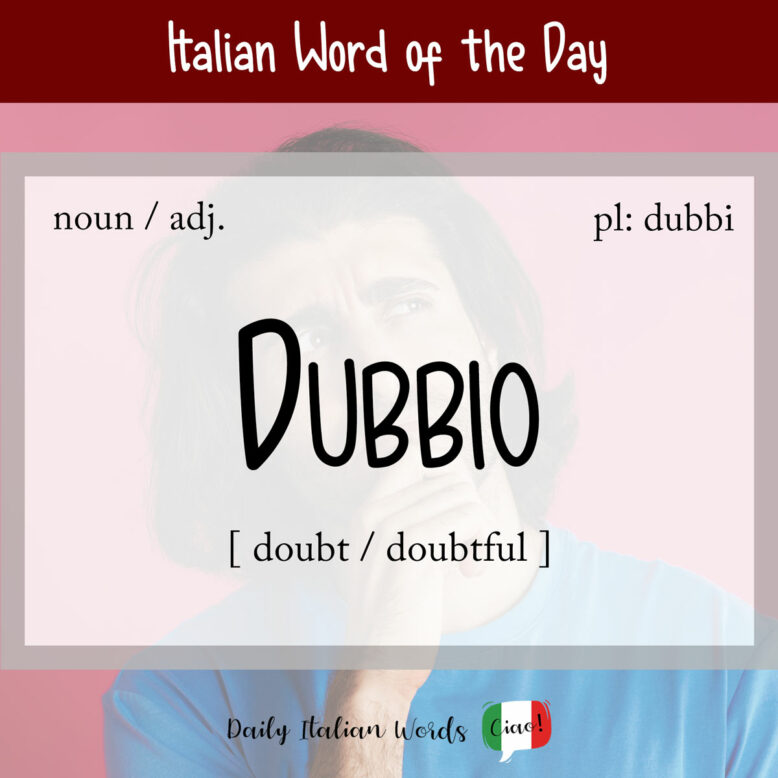
The origin of dubbio is straightforward – it comes directly from the Latin dubium, the neuter noun of the adjective dubius, meaning doubtful or uncertain. It is also a masculine noun, which means it takes the following definite and indefinite articles:
- il dubbio = the doubt
- un dubbio = a doubt
- i dubbi = the doubts
- dei dubbi = some doubts
What’s interesting about dubbio is that it functions as both a noun and an adjective. When used as a noun, it corresponds to our usage of doubt in most situations, as you can see from these common expressions:
- avere un dubbio = to have a doubt
- ho i miei dubbi = I have my doubts
- chiarire un dubbio = to clear up a doubt
- mettere in dubbio = to put in doubt / to question
- esporre / esprimere un dubbio = to express a doubt
- rimanere nel dubbio = to remain in doubt
- nutrire seri dubbi su = to have serious doubts about
- senza (ombra di) dubbio = without a shadow of a doubt
- non c’è dubbio = there’s no doubt
- il beneficio del dubbio = the benefit of the doubt
- nel dubbio = if in doubt
One exception is the phrase essere in dubbio, which literally translates as “to be in doubt” but can be more accurately rendered “to be uncertain” in English. If you see it contained within the construction essere in dubbio fra A e B, this means that you are hesitating between two options.
Ho un dubbio sulla sua sincerità.
I have a doubt about his sincerity.
Used as an adjective, however, you may encounter a number of translations ranging from doubtful and uncertain to ambiguous, questionable, unreliable or dubious. It always appears before the noun it describes in any “noun + di + noun” construction such as the examples below:
- uno scherzo di dubbio gusto = a joke in questionable taste
- un manufatto di dubbia provenienza = an artefact of dubious origin
- una persona di dubbia reputazione = a person of dubious reputation
- un politico di dubbia fama = a politician of dubious character
As you can see, the ending changes in accordance with the gender and number of the noun being described, with two good examples being dubbio gusto (masculine) and dubbia reputazione (feminine).
La sua versione della storia era quantomeno dubbia.
His version of the story was dubious, to say the least.


Heather Broster is a graduate with honours in linguistics from the University of Western Ontario. She is an aspiring polyglot, proficient in English and Italian, as well as Japanese, Welsh, and French to varying degrees of fluency. Originally from Toronto, Heather has resided in various countries, notably Italy for a period of six years. Her primary focus lies in the fields of language acquisition, education, and bilingual instruction.