
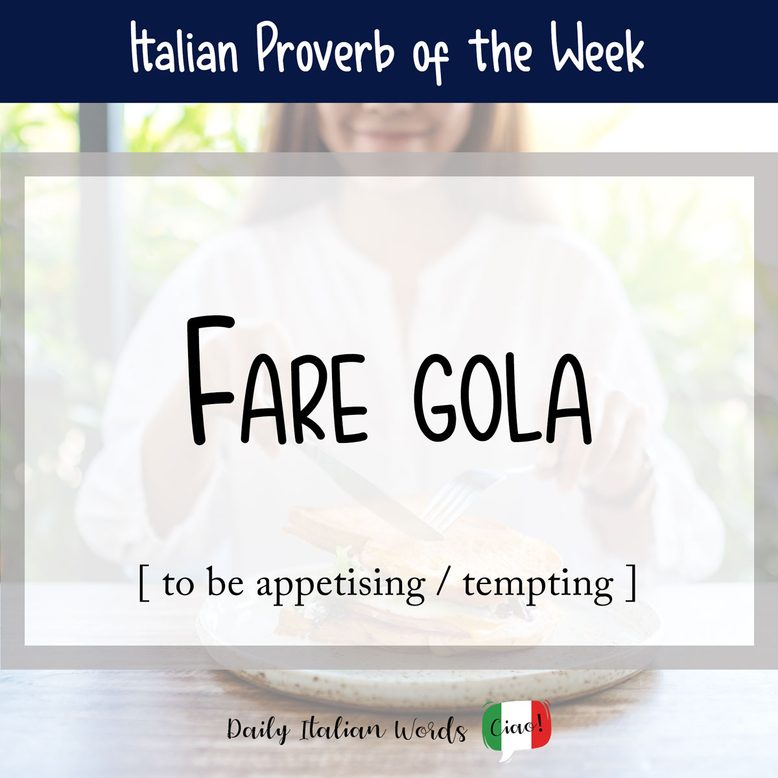
If something is going to end up in your throat, chances are it’s going to be something tasty – lo sciroppo per la tosse (cough syrup) being perhaps the one exception! This is the image behind today’s Italian idiom, fare gola, which means to be appetising / mouth-watering or to look tempting.
fare gola
to be appetising / mouth-watering
Gola is the Italian word for throat, which shouldn’t be confused with collo, the word for neck. Fare, on the other hand, is a catch-all verb that means to do or to make. So, literally, this idiom translates as something along the lines of “to make throat.”
As mentioned in the introduction, the origins of this expression lie in the connection between the gola and il piacere del cibo (the enjoyment of food). Since the throat is where food and drink pass, gola gradually acquired a figurative meaning associated with appetite and the desire to eat something delicious.
You can use it on its own (e.g. La torta fa gola = The cake is mouth-watering) or you can name the person being tempted by using the preposition a (to) (e.g. La torta fa gola a Marco = The cake makes Marco’s mouth water).
Quel dolce fa gola a tutti.
That dessert makes everyone’s mouths water.
Although it started out as a food-related idiom, the meaning of fare gola has expanded to objects or opportunities that you want or crave intensely – think of a great deal on the television you’ve been wanting to buy for years, a cool gadget, a high salary, an attractive job offer, or a luxurious vacation.
Una vacanza in Italia fa gola a molti americani.
A vacation in Italy is an attractive prospect for many Americans.
Related to this idiom is the verb ingolosire, which means to make one’s mouth water. It comes from the adjective goloso (gluttonous), which in turn derives from the Latin gulosus, a derivative of, you guessed it, gula (gola)!
L’odore della pizza mi ha ingolosito.
The smell of the pizza made my mouth water.
Gola also appears in another idiom, peccato di gola, literally translating as the sin of throat but similar in meaning to the English word overindulgence or guilty pleasure, especially in reference to moreish foods such as candies or pastries.
Anche quando si cerca di seguire un’alimentazione sana, è importante concedersi qualche peccato di gola.
Even when trying to follow a healthy diet, it’s important to allow yourself the occasional treat.


Heather Broster is a graduate with honours in linguistics from the University of Western Ontario. She is an aspiring polyglot, proficient in English and Italian, as well as Japanese, Welsh, and French to varying degrees of fluency. Originally from Toronto, Heather has resided in various countries, notably Italy for a period of six years. Her primary focus lies in the fields of language acquisition, education, and bilingual instruction.