How does your colleague know you’re looking for a new job? Because your other colleague overheard a phone call. And how does half the office already know by lunchtime? Because news travels really fast when a ficcanaso is involved!
ficcanaso
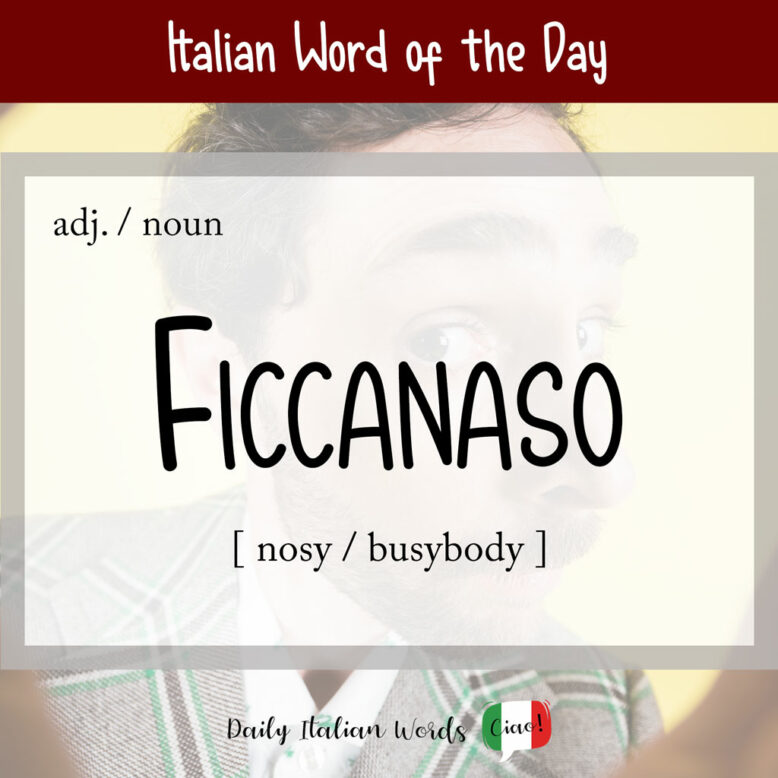
Ficcanaso is a compound noun made up of two parts: the verb ficcare (to stick, to shove) and the word il naso (the nose). If we put them together, we get a word that describes someone who sticks their nose somewhere—and that somewhere is where it doesn’t belong!). What in English you’d call a nosy person.
So, yes, il ficcanaso is that person who non si fa mai i fatti suoi (never minds their own business) and just can’t resist poking into other people’s lives.
Il signore del terzo piano è un gran ficcanaso!
The man on the third floor is a real busybody!
Using ficcanaso as a noun
As a word, ficcanaso doesn’t change based on gender or number; the only thing that changes is the article:
- Il ficcanaso (masculine singular)
- La ficcanaso (feminine singular)
- I ficcanaso (masculine plural, though you may sometimes hear i ficcanasi)
- Le ficcanaso (feminine plural)
Le tue cugine sono delle ficcanaso di prima categoria!
Your cousins are world-class busybodies!
La ficcanaso della casa di fronte sta sempre alla finestra a controllare cosa faccio.
The nosy woman across the street is always at the window checking what I’m doing.
There are two main ways we use the noun ficcanaso in Italian:
- Essere un ficcanaso: to be a nosy person
Letizia è una vera ficcanaso: sa sempre tutto di tutti!
Letizia is an unbelievable nosy person: she always knows everything about everyone!
- Fare il ficcanaso (literally, to do the nosy person): to be nosy, to snoop around
Non fare il ficcanaso, sono cose che non ti riguardano.
Don’t be so nosy, those things are none of your business.
Using ficcanaso as an adjective
Besides being a noun, ficcanaso can also work as an adjective to describe someone as nosy. Unlike most Italian adjectives, it never adapts to the gender or number of the noun it refers to. It’s always ficcanaso, no matter what.
Here are some examples:
Non sopporto le persone ficcanaso!
I can’t stand nosy people!
Ti ricordi quella mia coinquilina ficcanaso che apriva sempre la mia posta?
Do you remember that nosy roommate of mine who used to open my mail all the time?
Ho un collega ficcanaso che chiede sempre con chi parlo al telefono.
I have a nosy colleague who’s always asking who I’m talking to on the phone.
The expression ficcare il naso
Now, remember how ficcanaso is made up of ficcare (to stick) and naso (nose)? Well, those two words also form the very common expression ficcare il naso, literally, “to stick the nose.” Where? Into other people’s business, naturally. Same concept as ficcanaso, just in verb form.
La smetti di ficcare il naso nelle mie cose?
Will you stop poking your nose into my affairs?
È più forte di lei, ficca sempre il naso negli affari altrui.
She can’t help it, she always sticks her nose in other people’s business.
Senti, te lo ripeto, smettila di ficcare il naso dove non devi!
Listen, I’m telling you again, stop sticking your nose where it doesn’t belong!
Some synonyms of ficcanaso
Ficcanaso is not the only word we have for nosy people in Italian. Here are some other ways to express the same idea:
Impiccione: this is probably the closest synonym to ficcanaso, always describing someone who can’t resist meddling in things that aren’t their business. One key difference is that, unlike ficcanaso, which never changes form, impiccione behaves like a regular Italian noun and adapts to gender and number:
- L’ impiccione (masculine singular)
- L’impicciona (feminine singular)
- Gli impiccioni (masculine plural)
- Le impiccione (feminine plural)
Quella ragazza è un’impicciona, non dirle nulla!
That girl is really nosy, don’t tell her anything!
Curiosone/a: You probably already know curioso (curious). Now add the suffix -one, which in Italian amplifies the meaning of a word, and curioso becomes curiosone, which is someone who’s excessively curious. Like impiccione, it adapts to gender and number:
- Il curiosone (masculine singular)
- La curiosona (feminine singular)
- I curiosoni (masculine plural)
- Le curiosone (feminine plural)
Curiosone is a softer, more playful word thanficcanaso or impiccione, which both carry more the sense that someone is crossing a line. For instance, we might call a child who keeps asking questions a curiosone, or tease a friend who won’t stop trying to guess their birthday present by saying non fare il curiosone.
Cosa c’è in quella scatola? – Niente che vi riguardi, curiosoni!
What’s in that box? – Nothing that concerns you, you little snoops!
Portinaia: literally, a female building caretaker. But in popular stereotype, she’s also the unofficial tracker of everyone’s business in the building and the neighborhood: she knows who’s moving, who’s fighting, who’s seeing who, who came home at 3 AM in suspicious company. Over time, this reputation has turned the word into a playful slang for anyone who never minds their own business. It’s a stereotype, sure, but as an expression, it’s so fun to use. And despite being grammatically feminine, the word applies to anyone when it’s used in this figurative sense:
Ma come fai a sapere sempre tutto di tutti? Sei proprio una portinaia!
How do you always know everything about everyone? You’re such a busybody!

Valentina Nicastro is a travel writer in love with her home country, Italy. Having travelled widely around the globe, she realised there was more to explore closer to home and decided to put the passport aside for a while. When she is not immersed in documenting Italy, you’ll find her donning her communication consultant hat, weaving words as a content writer and bridging linguistic divides as a translator.