
I’ve never been much of a drinker, but many of my friends – especially at university – would spend their weekends knocking back cocktails and wine, dancing the night away as they tried to forget the results of the previous week’s exam.
If you ever find yourself having indulged a bit too much, here’s a handy Italian expression to add to your arsenal: alzare il gomito. It literally means “to raise the elbow,” but it’s used metaphorically to refer to drinking in excess – after all, every sip requires lifting your arm and raising your elbow to bring the glass to your lips.
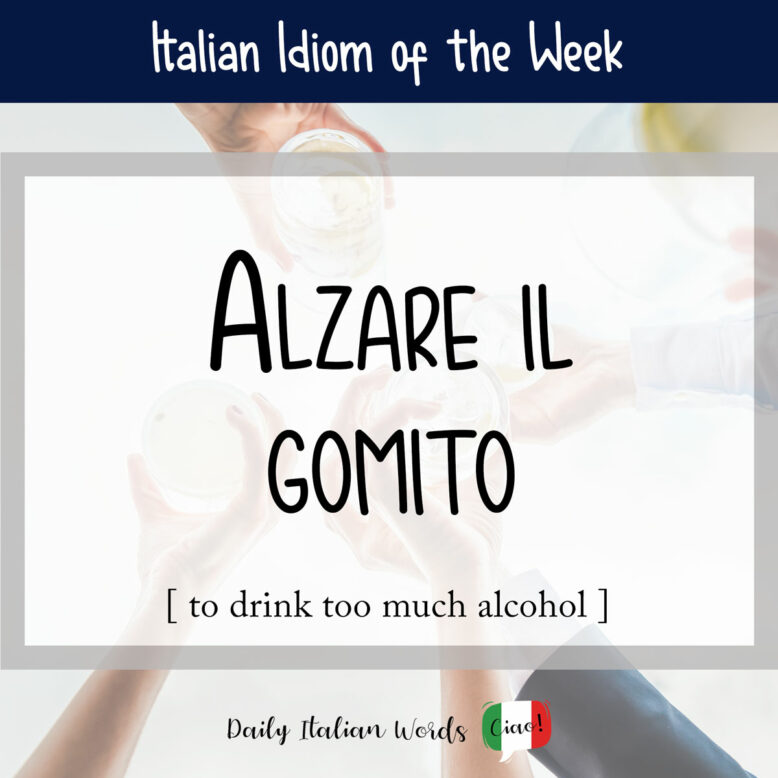
alzare il gomito
to drink (too much) alcohol
Although the fixed idiom is alzare il gomito, you will sometimes hear the phrase alzare un po’ troppo il gomito (literally “to raise one’s elbow a little too much”) in everyday speech.
Alla festa Daniele ha alzato un po’ troppo il gomito e ora ha i postumi della sbornia.
At the party Daniele had a bit too much to drink and now he has a hangover.
Ieri abbiamo davvero alzato il gomito.
Yesterday we really drank a lot.
Non alzare troppo il gomito stasera, mi raccomando.
Don’t drink too much tonight, okay?
There isn’t much more to say about the origin of this idiom – it simply refers to the movement your elbow makes when lifting a glass. Still, it’s used frequently, so it’s definitely one worth remembering!
Before we bring this article to a close, let’s take a look at a few more metaphorical ways of talking about drinking:
- prendersi una sbronza (or sbronzarsi) = to get hammered
- essere brillo / brilla = to be tipsy
- bere come una spugna = literally “to drink like a sponge”
- avere il bicchiere facile = literally “to have the easy glass” – used to refer to someone who gets drunk easily or drinks readily
- essere alticcio / alticcia = to be slightly drunk
- essere ubriaco fradicio / ubriaca fradicia = to be completely wasted


Heather Broster is a graduate with honours in linguistics from the University of Western Ontario. She is an aspiring polyglot, proficient in English and Italian, as well as Japanese, Welsh, and French to varying degrees of fluency. Originally from Toronto, Heather has resided in various countries, notably Italy for a period of six years. Her primary focus lies in the fields of language acquisition, education, and bilingual instruction.