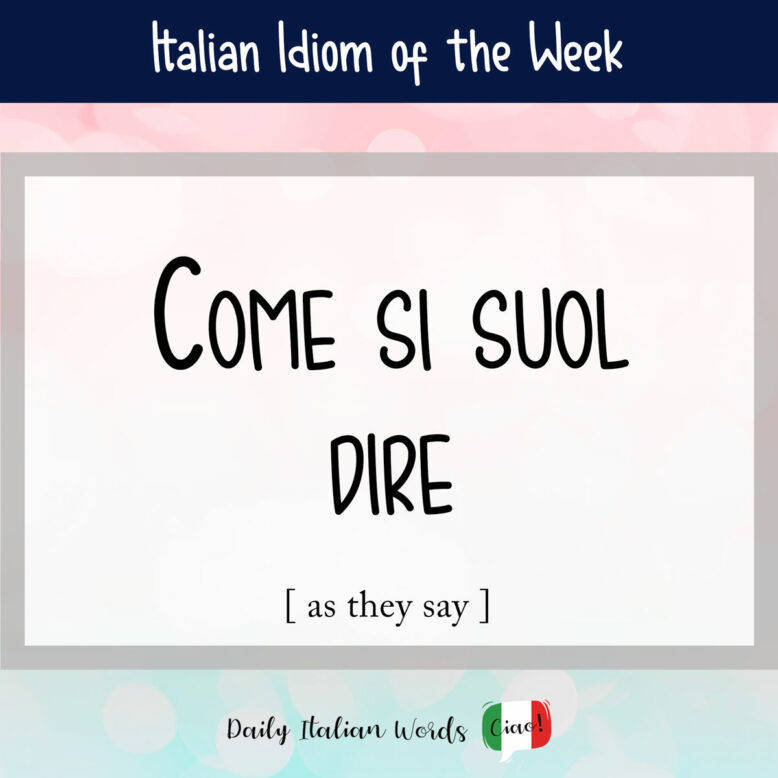
Before or after uttering a common saying or proverb, Italians often like to drop in the idiomatic expression come si suol dire, much in the same way English speakers might make use of the expressions as they say or as the old saying goes. This idiom allows the speaker to prepare the listener or reader for the forthcoming sentence, or redirect their attention to the importance of the previously uttered statement. It can also be a way for the speaker to acknowledge that what they are saying is somewhat cliché.
Come si suol dire
As they say
Now, you might be asking yourself, “What on earth is that strange verb suol ?” Suol (or suole) is the third person singular of solere, which means to be in the habit of. While it was often used in the past by poets and writers, it has fallen out of use in modern day Italian, with the exception of fossilised expressions such as today’s idiom.
La vita è piena di sorprese, come si suol dire!
Life is full of surprises, as they say!
In fact, you are much more likely to see its past participle solito, which appears in expressions like di solito (usually), come al solito (as usual), or more formally, essere solito (usually).
Di solito vado in biblioteca il lunedì.
I usually go to the library on Mondays.
And before you ask – no, the si before suol does not make solere a reflexive verb. This si is actually an impersonal pronoun, with the meaning of “one” as in “one eats pizza” or “one goes to the store”. This means that come si suol dire can also be translated as “as one says”.


Heather Broster is a graduate with honours in linguistics from the University of Western Ontario. She is an aspiring polyglot, proficient in English and Italian, as well as Japanese, Welsh, and French to varying degrees of fluency. Originally from Toronto, Heather has resided in various countries, notably Italy for a period of six years. Her primary focus lies in the fields of language acquisition, education, and bilingual instruction.