
I’m sure the vast majority of us have arranged to go out with someone, either on a date or just as friends, only to be left staring impatiently at our watch, waiting for that person to show up. In English, we might say that we’ve been “stood up” whereas in Italian, you can expect to hear the expression dare buca (a qualcuno).
dare buca a qualcuno
to stand someone up
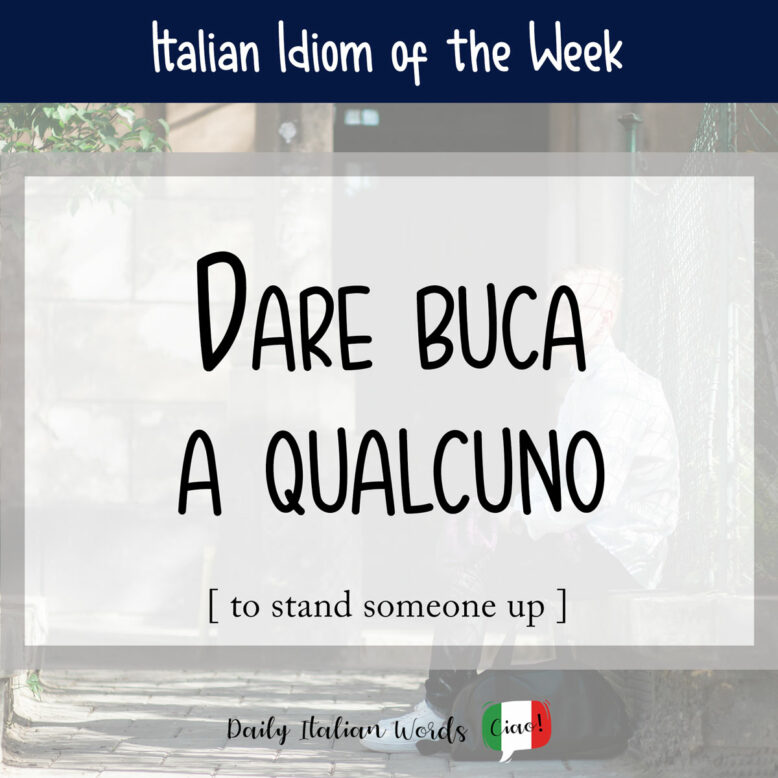
As it often happens when translating from one language to another, the literal translation of an idiom doesn’t really help us understand its meaning. In this case, dare buca literally means “to give hole” – as in the kind you dig in the ground. There is no clear consensus as to why buca was chosen over some other word for this expression, so we simply have to accept it!
By the way, there are two words for “hole” in Italian – one is the feminine buca, and the other is the masculine buco. Buca tends to be used when describing irregular shaped cavities in the ground, and for this reason, pit or pothole are also good translations. However, you’ll also hear it used to describe letterboxes (la buca delle lettere), pockets on a pool table, and holes on a golf course.
Buco, on the other hand, tends to refer to a perforation, puncture or empty space of some sort found within an object, such as the kind you get in your tire or sock. It’s also the preferred term to describe a black hole (buco nero) and the hole in the ozone layer (buco dell’ozono).
Coming back to dare buca, here are a couple of example sentences that reflect how it is used in everyday life:
Se mi dai buca di nuovo, giuro che non ti chiamerò mai più!
If you stand me up again, I swear I will never call you again!
Ci saremmo dovuti vedere per le otto, ma mi ha dato buca.
We were supposed to meet at eight, but he/she stood me up.

Heather Broster is a graduate with honours in linguistics from the University of Western Ontario. She is an aspiring polyglot, proficient in English and Italian, as well as Japanese, Welsh, and French to varying degrees of fluency. Originally from Toronto, Heather has resided in various countries, notably Italy for a period of six years. Her primary focus lies in the fields of language acquisition, education, and bilingual instruction.