One phrase we tend to say far more often than we realise is “I did it!” We use it for every kind of success, whether it’s acing an important exam or finally managing to open a stubborn bottle of water.
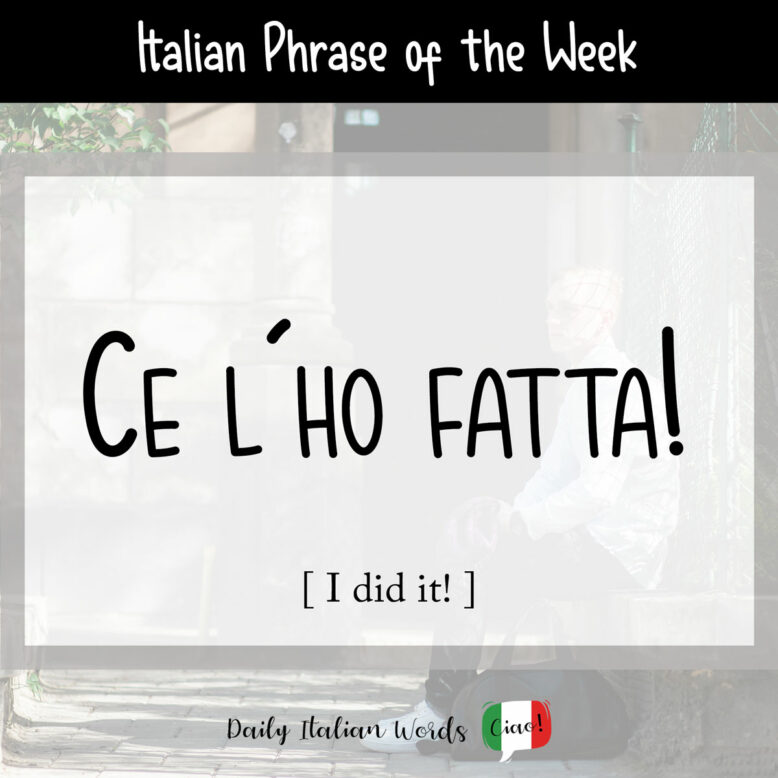
But translating this expression into Italian isn’t as straightforward as you might think. You may feel tempted to say L’ho fatto, a direct, word-for-word translation, but the expression you’re actually looking for is Ce l’ho fatta!
Ce l’ho fatta!
I did it!
So what’s that ce doing there? And why is it fatta instead of fatto? Let’s find out together!
1. CE
Ce is what is called a particle pronoun in Italian. It doesn’t have a full lexical meaning in this case but rather reinforces the idea of managing, succeeding or getting through something. It appears in the pronominal verb farcela which means “to manage” or “to succeed”.
Non penso di farcela.
I don’t think I will manage/succeed.
Some other pronominal verbs in Italian that make use of ce + la include:
- avercela (avere + ce + la) = to be mad at / upset with
- mettercela tutta (mettere + ce + la) = to give one’s all
It’s important to remember that ce is different from c’è. C’è is the combination of ci (there) and the verb è (is), while ce is a particle pronoun. They are also pronounced differently – c’è has an open E while ce has a closed E – but be aware that some dialects of Italian do pronounce them in the same way.
2. LA → becomes L’ (before vowel)
La is a feminine direct object pronoun meaning “her,” the formal “you,” or “it” depending on the context.
Voglio chiamarla stasera.
I want to call her/you tonight.
Mangerai la mela? – Sì, la mangerò.
Will you eat the apple? – Yes, I will eat it.
However in the case of this phrase, it is not a literal “it” – it simply part of the idiomatic structure of the pronominal verb farcela as discussed above. When followed by ho (I have), la becomes l’ due to elision.
3. HO
Ho, pronounced oh, is the first-person singular of avere (to have), and is used as one of two auxiliaries in the passato prossimo tense.
In this case, we are using ho to form the passato prossimo of the verb farcela:
farcela (infinitive) → ce la + ho + fatta → ce l‘ho fatta → I (have) managed / I (have) succeeded
4. FATTA
Fatta is the past participle of fare, but with agreement. In other words, because the direct object pronoun la (the idiomatic “it”) is feminine, the past participle must match it in gender and number whenever a direct object pronoun comes before the verb in a compound tense. For this reason, it is incorrect to say *ce l’ho fatto with an -o at the end of fatt-.
Here are some examples using another verb, mangiare (to eat):
il broccolo (masculine, singular) → lo ho mangiato → l’ho mangiato = I ate it
la mela (feminine, singular) → la ho mangiata → l’ho mangiata = I ate it
i broccoli (masculine, plural) → li ho mangiati → li ho mangiati = I ate them
le mele (feminine, plural) → le ho mangiate → le ho mangiate = I ate them
Example sentences
Usefully, ce l’ho fatta can be combined with the thing you managed to do by using the preposition a. In this case, the translation “I did it!” doesn’t really work – it’s better to say “I managed” or “I succeeded”. It is also possible to put the phrase into the negative by placing non (not) before ce l’ho fatta. Here are two examples:
Ce l’ho fatta a completare la maratona!
I managed to complete the marathon!
Non ce l’ho fatta a finire il progetto causa la mia malattia.
I didn’t manage to finish the project due to my illness.

Heather Broster is a graduate with honours in linguistics from the University of Western Ontario. She is an aspiring polyglot, proficient in English and Italian, as well as Japanese, Welsh, and French to varying degrees of fluency. Originally from Toronto, Heather has resided in various countries, notably Italy for a period of six years. Her primary focus lies in the fields of language acquisition, education, and bilingual instruction.